For several generations my Stocking ancestors lived and worked just South of the Thames, finding work in the building and decorating trades, London’s Leather Market, Bermondsey’s food and packaging works and in and around the docks and the areas South of Tower Bridge. Following the various jobs of my 2xgreat grand uncle William Thomas Stocking (1864-1923) provides an insight into Bermondsey’s streets … and some of its industries, most now long gone. But first, there is another name puzzle.
A baptismal mistake?
Known throughout his life – and at the registration of his birth – as William Thomas Stocking, his baptism record from St Mary Newington shows a different name:

The child’s name in the register is shown as James Thomas, but my 3xgreat grandparents James and Mary Ann Stocking already had a child of that name (my 2xgreat grandfather, born 1853). All the other details are consistent with other records, as is William’s birth date. Did the clerk make a mistake, mixing child’s name with the father’s? We’ll never know, but a similar error was made in the 1871 census, when James Thomas – the father – is shown as William J Stocking!
William grew up with his ever-increasing number of siblings, initially in John Street and then St Thomas Street, between London Bridge Station, Guys Hospital and the Leather Market, and South of Tower Bridge Road. He married Elizabeth Ellen Smith at All Saints, Newington on 25 March 1885:

William was the second of his siblings to be able to sign his name; Elizabeth, the daughter of a Northamptonshire Baker, does likewise. William is working as a Carman, and both are living at 34 Alfreton Street. This was a ‘just in time’ marriage: 11 days later, on 5 April 1885, the first of their 13 children, eldest son William Robert Stocking, was born.
Married life and family: a tour of Bermondsey streets
When their second child, Elizabeth Jane Stocking was baptised in March 1887, the family address is 40 Amery Place; William is still working as a carman.
In Victorian London, Carmen abounded, driving horse-drawn carts transporting all manner of good around the capital; Bermondsey, with its many factories and wharves, would have employed them in significant numbers. The Worshipful Company of Carmen offers a description:
Hand carts were the first mode of transport used for distributing goods. They were moved by Cartmen and it is easy to see that this name has been changed over time to Carmen. The Shorter Oxford English Dictionary definition of a Carman in 1580 is a carter, or carrier. In today’s world it is a person who drives a cart or a wheeled vehicle. The Worshipful Company of Carmen continues to reflect the transport and logistics industry and serve the City of London as it has done for over five centuries.
The Worshipful Company of Carmen. Visited 17 July 2023.
By the 1891 census, William and Elizabeth have moved to 24 Marigold Court (although Elizabeth’s name is mis-recorded as Isabella E). They have three children: William R (6), Elizabeth J (4) and James H F (2). Elizabeth would have been heavily pregnant when the census enumerator called on 5 April; another daughter, Maud Eliza Stocking, was born on 26 April that year. A few months later, both of their sons had died, their deaths registered in the July-September quarter of 1891.
They were still at 24 Marigold Court in March 1893, when their one-month old daughter Hannah Florence Stocking was baptised at St Mary Magdalen, Bermondsey. Her father’s career as a Carman appears to have ended some eight years after it began: he is now described as a Labourer. This was still his occupation in November 1895, when son Walter William Benjamin Stocking was baptised, and the family had moved again, to 12 Hargrave Street. Two years later, when six year old Maud was baptised, the family address is 13 Victoria Place, Decima Street. School admission records show that she and her sister Flo attended nearby Webb Street School.
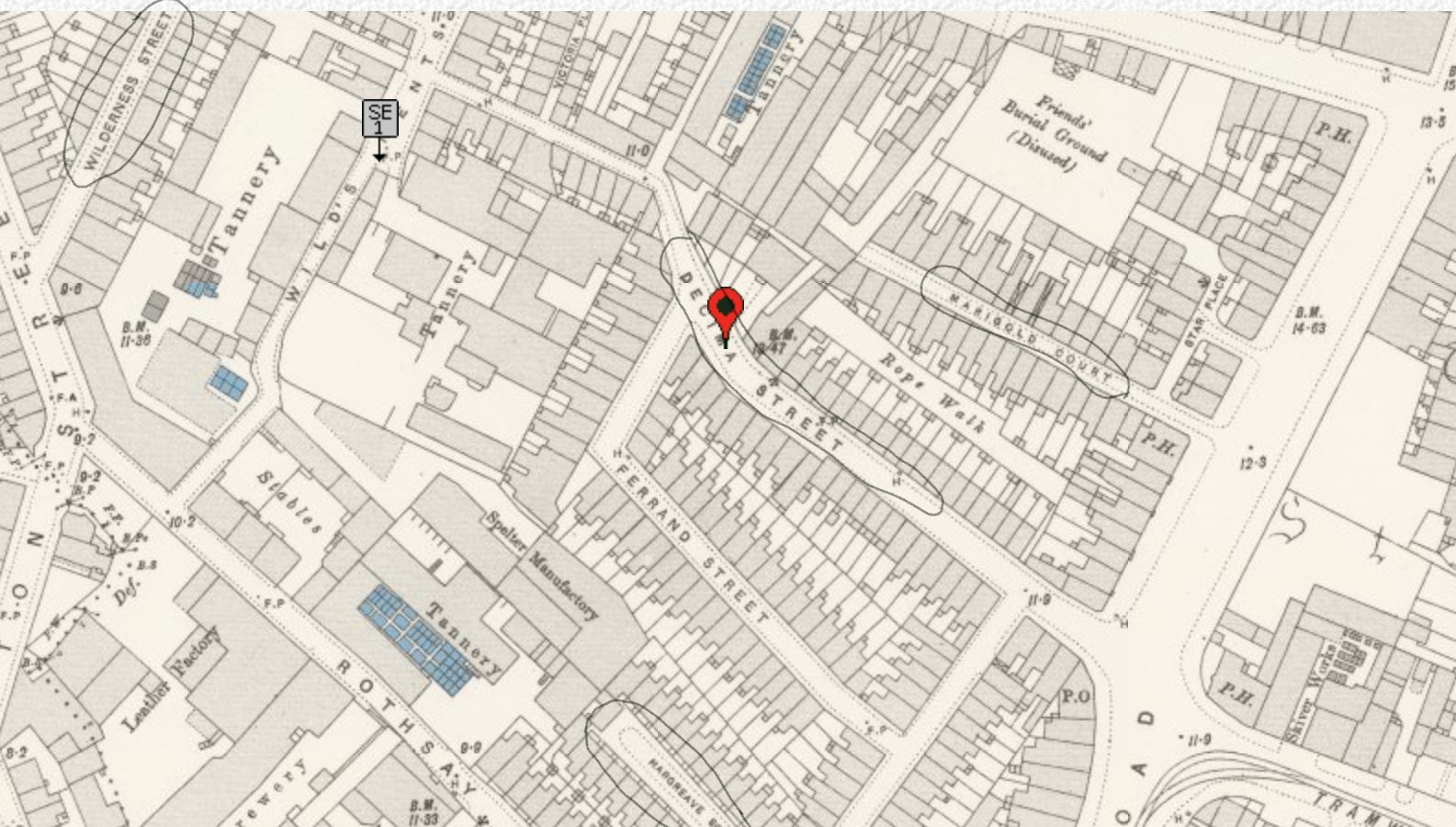
William’s brother also lived in Marigold Court for a time. The map above shows tightly packed streets surrounded by tanneries. Charles Booth’s survey of London noted, in 1899, that both this and nearby Decima Place were streets with many buildings having been pulled or fallen down:
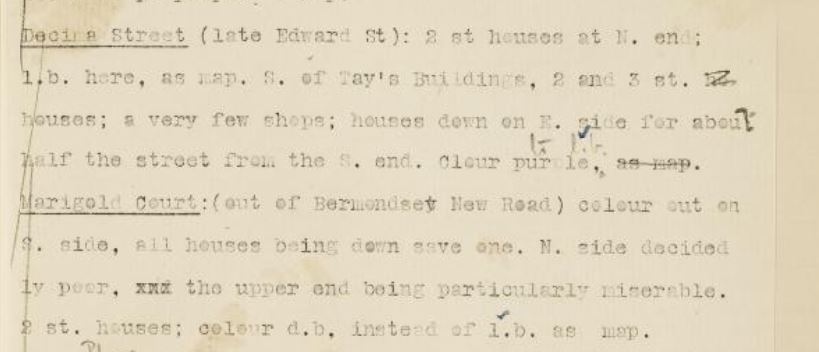
The colours mentioned refer to Booth’s poverty map: while Marigold Court was ‘d.b. (dark blue)’ – very poor, casual labour, chronic want’, Decima Street was a step up, being ‘purple to l.b (light blue)’ meaning a mix of households, from poor to fairly comfortable. Victoria Place, however, although the same classification, featured “tiny cottages, some very dirty, some very clean”.
Find out more about the maps and classifications here.
Sometime between 1895-1897, William started work as a Bricklayer, a trade followed by many Stocking men over the generations. By the 1901 census, though, he has changed job – and address – again. Now at the sorry-sounding 24 Wilderness Street (shown on above map), William is a Waterside Labourer.
This was another street very close to Victoria Place/Decima Street and described by Booth as “2st[orey] houses, flush [to the pavement] … one or two poor little shops”.
Despite what were probably crowded and fairly insanitary conditions, in the subsequent ten years, the couple added five more children to the family. The 1911 census shows that they had by then been married 26 years and had had a total of 13 children. Seven of them are at home at 1 Pottery Street, Cherry Garden Road, on census night, from one year old Thomas to Maud (20). William is working as a Labourer at a Granary Wharf, somewhere along the Thames barely a block away. However, it seems that he found work where he could, as he is described as a Decorator or Labourer on childrens’ baptisms between 1901-1910.
1 Pottery Street remained the family home until William’s death – at the early age of 58 – in 1923. The 1921 census shows that he was a Waterside Labourer for Lucas & Spencer of Bermondsey Wall. A thread on the Bermondsey Boy blog has a number of photos of the wharves – including Lucas & Spencer and Brandrams Granaries – taken in the 1890s. Some show the heavy frost of 1895, which William and his family would have endured.
Pottery Street still runs close to Bermondsey Wall East and the Cherry Garden Pier, but none of the buildings from William’s time survive. This 1900s map from the Underground Map Project shows the position of the Wharves, close to Cherry Garden Road, and the Granaries. Pottery Street is close to the pink marker on the left.

I have found out little about Elizabeth’s life after her husband died. I can’t locate her in the 1939 census; it is possible that her death was registered – as Elizabeth E Stocking – in the last quarter of 1943, in Deptford, although the death record shows her age as 78, whereas she would have been 76.
In the 1911 census, William and Elizabeth note that five of their 13 children have died, although these weren’t all in infancy. Three further members of the family would die in WW1. What happened to them all before and after William’s death is another story.
Main Sources:
- Baptism, marriage and death records for William Stocking (Ancestry)
- Birth registrations for William’s children (GRO)
- William’s children’s baptisms (Ancestry)
- Charles Booth’s London: Poverty maps and Notebooks
- 1871-1911 censuses (Ancestry)
- 1921 census (FindMyPast)
- Bermondsey Boy blog
- The Underground Map Project
- Death index entry for Elizabeth E Stocking (FreeBMD)
 My Stocking Roots