My maternal great grandfather Charles Brown was said, in family circles, to have served with the Indian Army. Could I find any evidence? I knew his birth year and place and father’s name from other records, and also knew he married as a Labourer, aged 31, comparatively late in life. There was a family photo said to be of him in uniform, but it took several years’ research before I finally tracked down his Army records. What did they and other records tell of his early life and military career?
Clues from the censuses
When he married my great grandmother Lavinia Seaby in Dry Drayton, Cambridgeshire, in September 1893, the marriage certificate records his father as Benjamin Brown, a Labourer like his son. The couple’s first census appearance in 1901 tells us that he was born around 1862-3 in Little Berkhampsted, Hertfordshire, so I searched for him in the 1871 census in that area, when he would have been about 7-8 years old.
I found a family headed by Benjamin Brown, a 56 year old Agricultural Labourer born in Benington, Herts, with wife Esther, 40 and four children, including Charles Brown, aged eight and born in Little Berkhampsted. This was enough information to find his birth certificate.
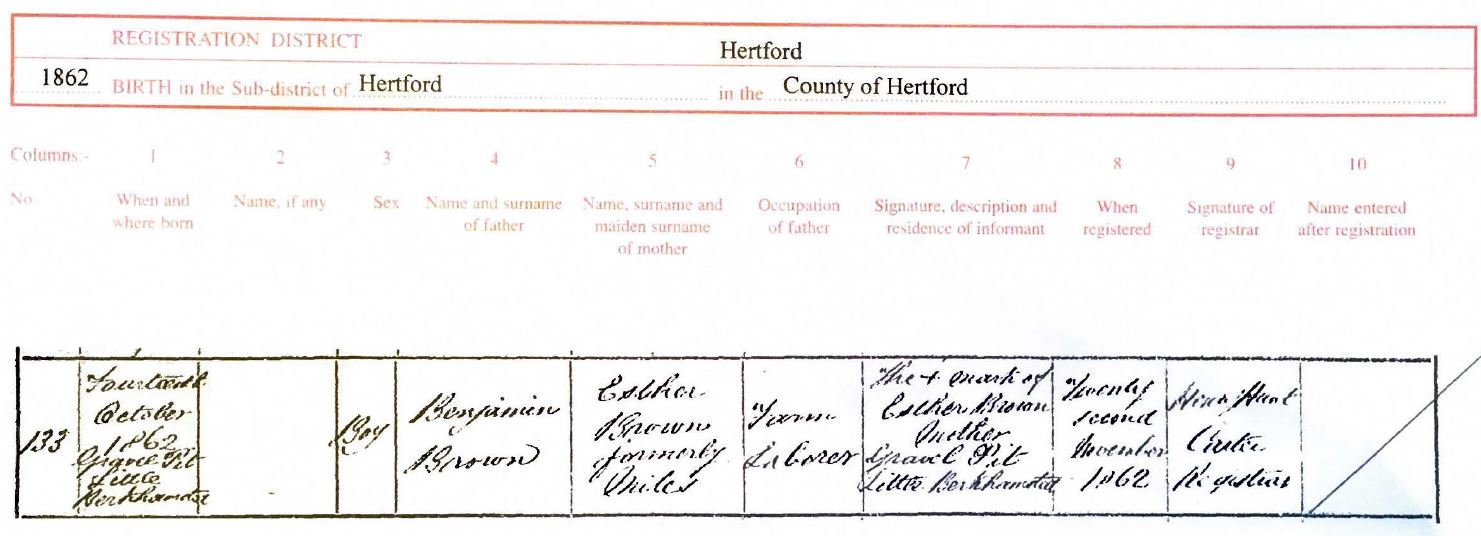
Extract from birth certificate for Charles Brown, 1862 (GRO)
He was born on 14 October 1862 at Gravel Pit, Little Berkhampsted, the son of Benjamin and Esther Brown. Her maiden name was Miles, and she made her mark when registering the birth some six weeks later. Roll forward to 1881, and Benjamin and Esther are still living in the village, but there is no sign of son Charles at home with them.
Charles Brown is a common name, but I finally tracked him down as ‘Chas Brown’, aged 18, from Little Berkhampsted, Herts, lodging at The Black Horse Inn, 12 Railway Street, Hertford with ten other young men of a similar age, all described as ‘Militiaman’.
There is still a Black Horse pub in Hertford, but it is at West Street. Black Horse, Hertford (closedpubs.co.uk) shows a photo of what used to be the pub building at 12 Railway Street, now in commercial (retail) use. So, it seems that on 4 April 1881, when the census was taken, he had left home in Little Berkhampsted and joined the local Militia.
Family stories and photographs indicated that he had served in the Army in India. I finally found his service record at FindMyPast (WO97 2377 64, TNA). This comprises many pages, the first of which (extract below) shows that he applied to join the Regular Army on 7 April 1881, a few days after the census was taken. His civilian occupation had been a Bricklayer’s Labourer and he had also been a member of the Herts Militia, from which he had been conditionally discharged. He was finally approved medically fit to serve on 9 April 1881.

Extract from page 1 of Charles Brown’s Army Attestation records (TNA)
Further down the page, it is confirmed that he wished to join the 33rd Infantry Brigade of the Bedfordshire Regiment. His regimental number was 2952.
An annotation across the top left hand corner of the page confirms that he extended his service in March 1887 in order to complete 12 years of service in accordance with Part II of the Army Act. The second page of the record notes his description on enlistment. He was 18 years and six months old, 5’ 5 1/8th inches tall, with a fresh complexion and blueish grey eyes, light brown hair and a scar of an incised wound on the inside of his right knee joint. His religion is recorded as Church of England.
He was appointed Lance Corporal in the second battalion on 6 November 1889 and deprived of that rank a few days later. He was finally discharged, having completed his term of service, in April 1893, five months before he married Lavinia Seaby.
Later pages in the records confirm that his next of kin was his father, Benjamin Brown, and that after home service between 1881 and 1882, in Hertford and then Newry, Ireland, he spent nearly ten years serving in India before a final period of home service. General remarks about his conduct were “Very good, steady and sober”. He appears to have had several bouts of gonorrhoea (mild), one of syphilis and two bouts of fever throughout his period of service.
The page detailing his postings is partly obscured on the digital image at FindMyPast, but suggests:
- 9 April 1881, Hertford
- 22 August 1881, Newry (Ireland)
- 4 January 1882, ?cliffe
- 17 October 1882, Crocodile
- 11 December 1882, ? elempo?
- 9 January 1885, ?ellary (Bellary? – now Ballari)
- 20 March 1888, ?underabad (Secunderabad?)
- 15 January 1892, Crocodile
The Bedfordshire Regiment had previously been the 16th Regiment of Foot, which had already raised two battalions and had seen service during the American Civil War, amongst others. The Childers Reforms of 1881 renamed the regiment The Bedfordshire Regiment. Wikipedia says of the Regiment:
On formation, the 1st Battalion the Bedfordshire Regiment was stationed at Newry in Ireland, while the 2nd was in India. The 1st Battalion remained on home service in England and Malta until 1889, when it sailed for India. In 1895, it formed part of the force that took part in the Relief of Chitral. …
The 2nd Battalion served in India and Burma until 1891 when it returned to England, moving to Dublin in 1898.
Both Bellary and Secunderabad were cantonment towns, ie permanent residential areas of a military fort, with extensive facilities for British Administrators and the Army regiments stationed nearby.
I believe that the mentions of ‘Crocodile’ may refer to the British Army Troopship HMS Crocodile, built in 1867 and still in service until she made her last voyage in 1893 (HMS Crocodile (1867) – Wikipedia).
.jpg)
HMS Crocodile. William Frederick Mitchell, Public domain, via Wikimedia Commons

This photo (left) shows Charley (or Charlie) Brown, as he was known, on active service in India, in undress (ie without his uniform jacket).
He looks to be in his early 20s here, so the photo was probably taken between 1884-1888. This seems a strangely informal photograph, compared to the one below, which shows him in formal pose in full uniform, and which may have been taken shortly before he completed service with the colours and perhaps in anticipation of his forthcoming wedding. Unfortunately I do not have the originals of either photo; these were copies made for sharing within the family in the 1990s.
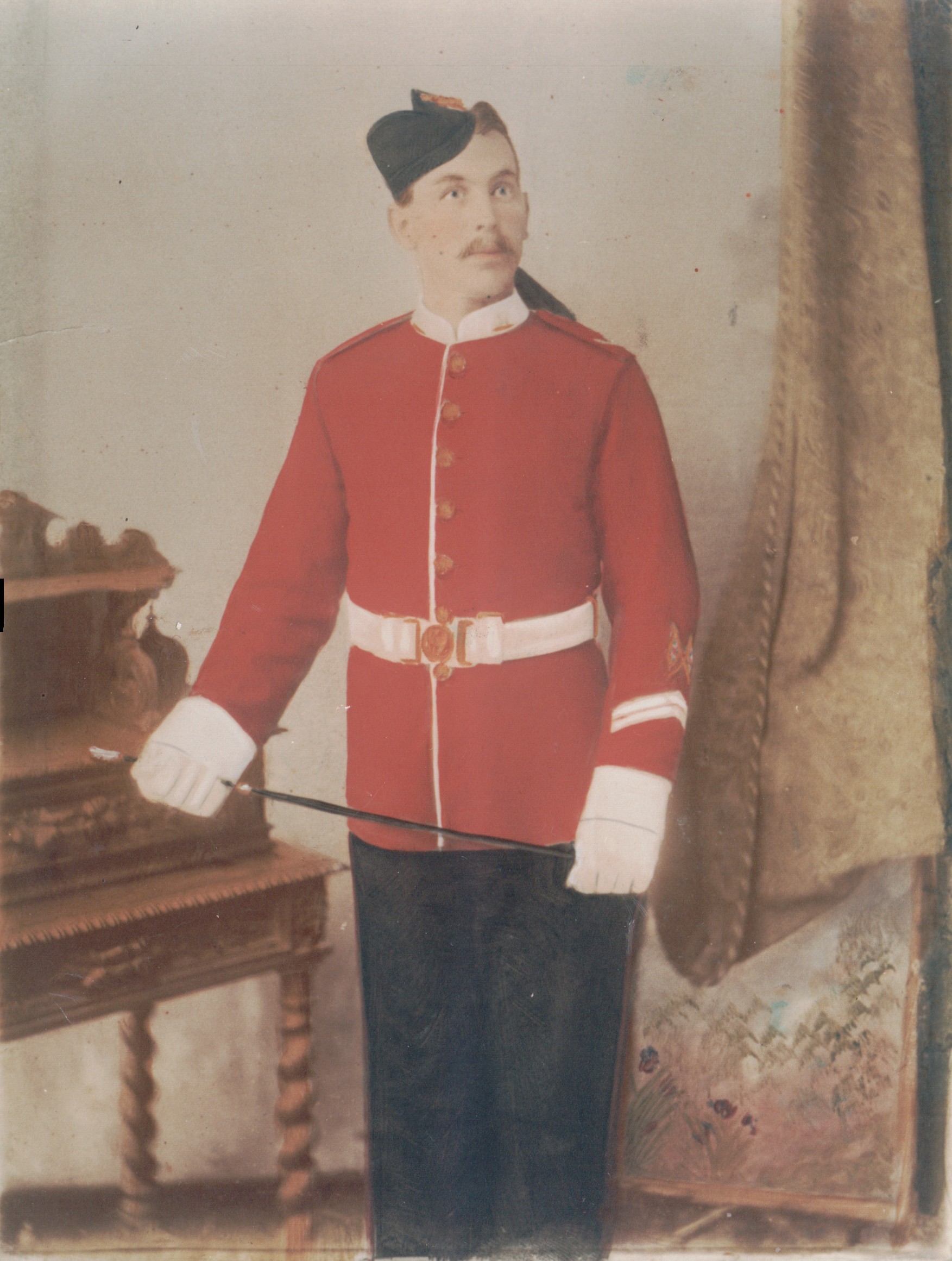
The photo of him in uniform has been rather clumsily hand-coloured, presumably at the time the photo was originally taken.
The sleeve badge on his left arm looks like crossed flags, indicating that he was a Signaller, although there is nothing in his service record to confirm this. The two ‘pointing up’ chevrons on his lower arm indicate periods of good conduct.
From his marriage record of a few months after his discharge from the army, it seems he stayed in Bedfordshire, where he undertook his last period of home service, and took work as a Labourer.
By 1894, though, when the couple’s first child, Emily Brown, was born, he was working as a Platelayer for the Great Northern Railway (GNR), a job he continued until his early death from mouth cancer in 1904.
Main sources:
- 1871-1901 censuses
- British Army Service Records at FindMyPast, from TNA
- Wikipedia
- The National Army Museum: Bedfordshire & Hertfordshire Regiment
- Closedpubs.co.uk
- GRO: birth, marriage and death certificates for Charles Brown
 My Stocking Roots