My mother’s father was born in 1901 in the small Bedfordshire town of Sandy. Both he and my grandmother were still alive when my interest in family history was piqued, so I was able to hear about their early lives and families at first hand. Was Granddad Brown really a ‘bad lad’, as Nana Brown recounted? What do newspaper reports and other records tell us about his upbringing?
Early years in Sandy
Horace Brown’s birth certificate shows that his father Charles Brown was working as a Platelayer at the time; his mother registered the birth, her maiden name recorded as Lavinia Seaby.
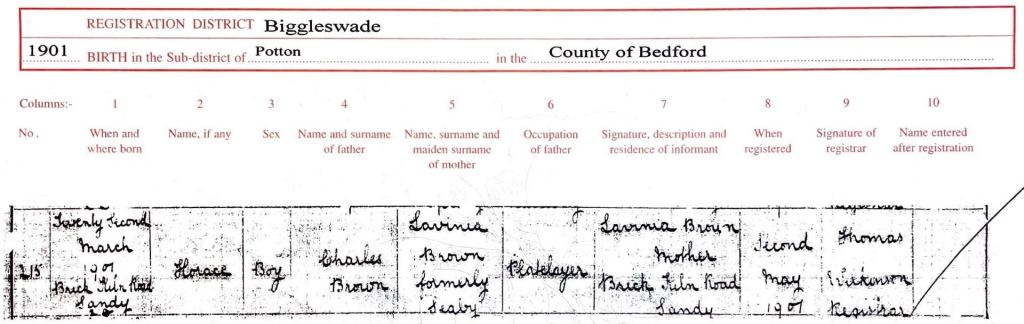
Extact from birth certificate for Horace Brown, 1901 (GRO)
He was born on 22 March 1901 at ‘Brick Kiln Road’ Sandy, although his birth wasn’t registered – by his mother – until 2 May. In the meantime, he had made his first official census appearance aged ‘under one month’, at home with his parents and siblings.
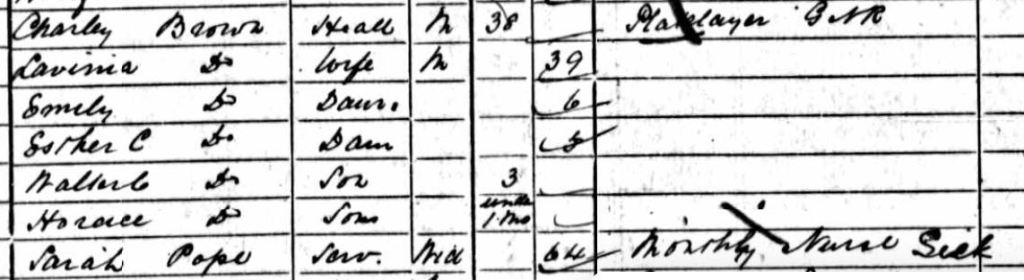
Extract from 1901 census for Charles Brown and family, Sandy (Ancestry.co.uk)
His father, Charley Brown, is 38, his mother Lavinia a year older, and they have three other children: Emily, Esther and Walter. Widow Sarah Pope is staying with them, a ‘monthly nurse, sick’ – perhaps helping Lavinia out with the new baby and her own health after the birth.
Horace Brown’s father died when he was just three years old, in 1904. He had been suffering from cancer of the mouth, and had been treated at St Bartholomew’s Hospital in London, although for how long, I do not know. By then, Horace had four living siblings (two others had died in infancy, one before, and one after he was born).
Ancestry.co.uk has a record showing that he was admitted to Sandy’s Church of England Junior School on 4 October 1910, when he was nine, having previously attended the Infants School there. The record shows that he left on 31 July 1914, when he was 13, the reason given as ‘Work (War)’.
I had some difficulty finding the family in the 1911 census, but finally tracked them down under the mis-transcribed surname of Brawn. Horace’s widowed mother Lavinia Brown is head of household and completes and signs the census form with a rather wobbly hand.
Nana Brown (Horace’s wife, Elizabeth) told stories of her husband-to-be as a young man to our mum:
“Horace went to the C of E school and wanted to be a blacksmith as he loved horses and wanted to work with them. He was apprentice to a blacksmith for six months in 1915, but as he wasn’t allowed to shoe the horses he left and then went to work for Siemens [Seamers?] in High St. Sandy, the Undertakers. He learnt his carpentry trade there. He was at one stage screwed down into a coffin by his workmates, so he could find out what it was like at first hand!
Horace was a bad lad when a boy: he used to chase Elizabeth and her sisters with a horsewhip, and upset their games (Whip and Top, Skipping, hide-and-seek). Horace was in trouble with Elizabeth’s father for chasing the girls and generally upsetting them. He went to see Horace’s mother – who was widowed – and she said not to be too hard on him as he had no father to chastise him.”
I believe the Undertakers was what is now G & H Seamers, based at 47 High Street, Sandy. Their website says:
“In February 1903 Alfred Seamer took over the funeral and joinery business from the Withey Family after working for them for 23 years. He then handed the business over to his sons George and Harry who registered the company as G & H Seamer”. About Us – G and H Seamer Funeral Directors| Bedford| funeral directors| funerals| funeral services (ghseamer.co.uk)
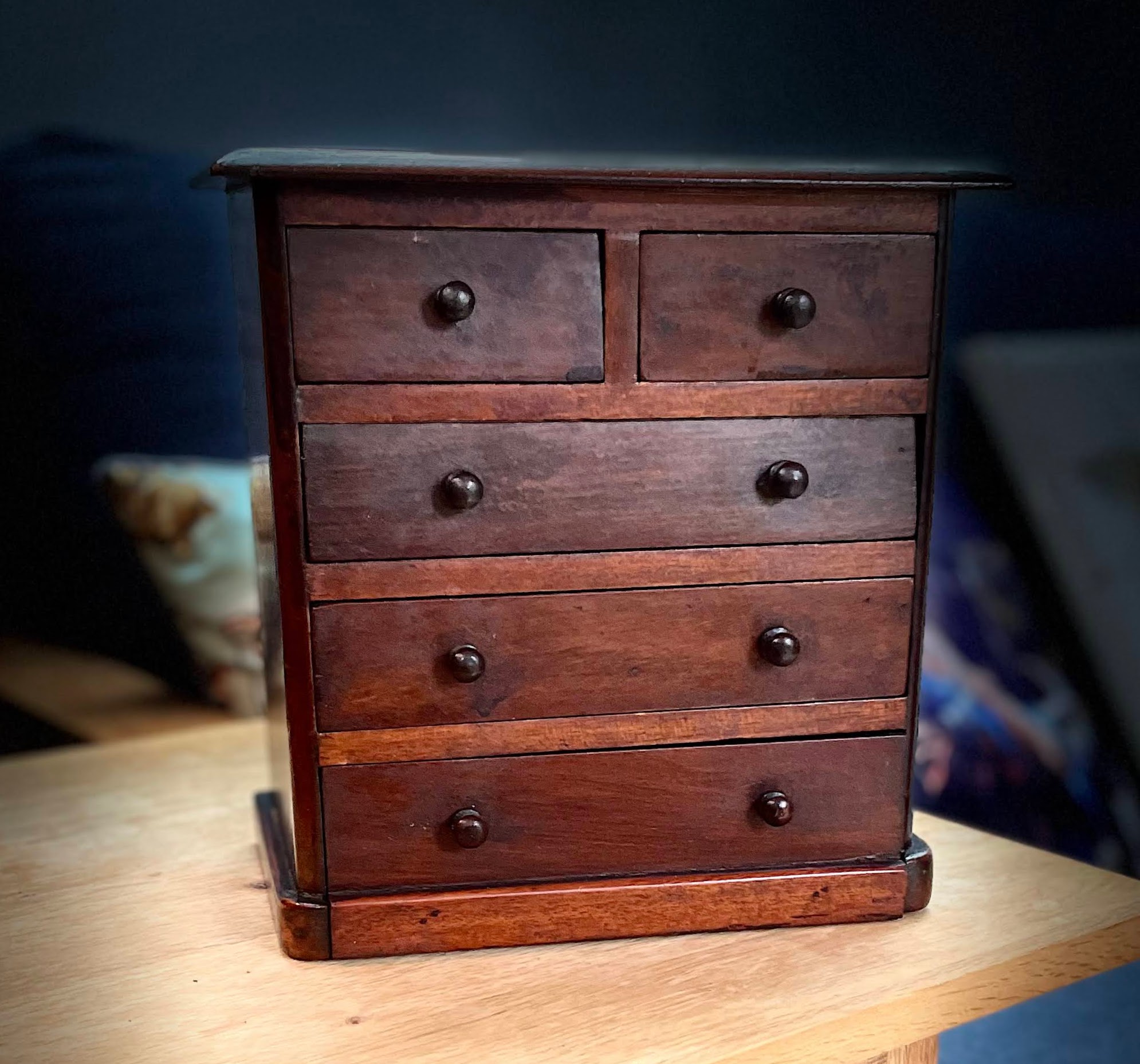
I have a small chest of drawers (left) that Grandad was said to have made when he was an apprentice carpenter, although whether that was at Seamers or elsewhere, I don’t know.
Horace’s older brother Walter Charles Brown (born 1897) left Sandy school in 1910, when he was 13, to work for a Market Gardener. He didn’t stick to it long, as a newspaper report from 26 August 1910 describes him as a Season Messenger employed by the Post Office when he had an accident while riding this bicycle, and suffered a fracture to his elbow.
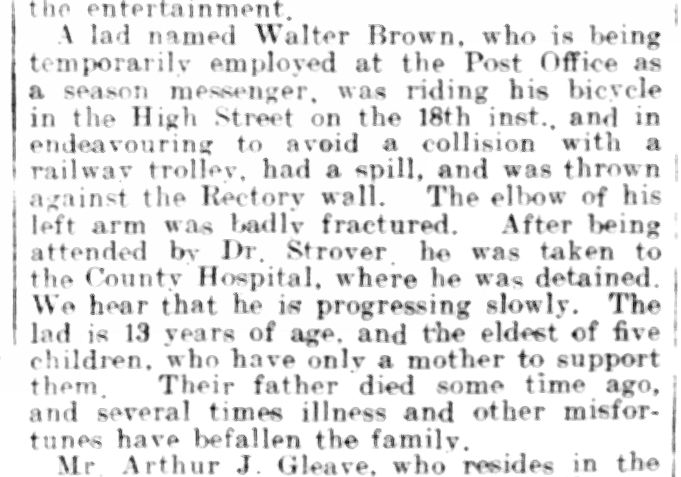
The article (right) adds that he is the eldest of five children “who have only a mother to support them, the father died of cancer sometime ago after a long and painful illness, and Mrs Brown, who lives in the St Neots Road, has had a hard struggle to bring up her large and young family and several times illness and other misfortunes have befallen them.”
Extract from Biggleswade Chronicle, 26 August 1910. British Newspaper Archive via FindMyPast.
Horace was not so much a ‘bad lad’ then, as perhaps missing a father’s guiding hand, something the newspaper seems also to attribute vaguely to his brother’s accident! If I were his mother, having raised five children more or less single-handedly, I think I might have been rather miffed at this dismissal of her parenting.
Main sources
- Birth certificate for Horace Brown 1901 (GRO)
- 1901 and 1911 censuses (Ancestry.co.uk)
- British Newspaper Archive via FindMyPast
- G & H Seamer, Funeral Directors, Website
- Sandy School Records, FindMyPast
 My Stocking Roots