My maternal great grandparents Charles Brown and Lavinia Seaby married fairly late in life; he was 30 and she was 32. Both had had careers before marriage, he as a soldier in India, she as a Cook in London. Their marriage was sadly cut short by Charley’s early death. What do we know of their brief time together?
Work and family life in Sandy
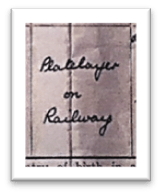
After their marriage in early September 1893, my great grandparents settled in Sandy, Bedfordshire. Their first child, a daughter, Emily Brown, was born at Water Lane in Sandy on 18 May 1894. Her birth certificate describes her father as a ‘Platelayer on Railway’ (see extract from her birth certificate, shared by another family member, on the right).
This image from Flickr – possibly from a postcard – shows Water Lane, Sandy. It was probably taken in the late 1800s/early 1900s going by the clothing, so about the time the Browns were living there. The Lane was later renamed Ivel Road and most of the buildings have been replaced with modern dwellings.
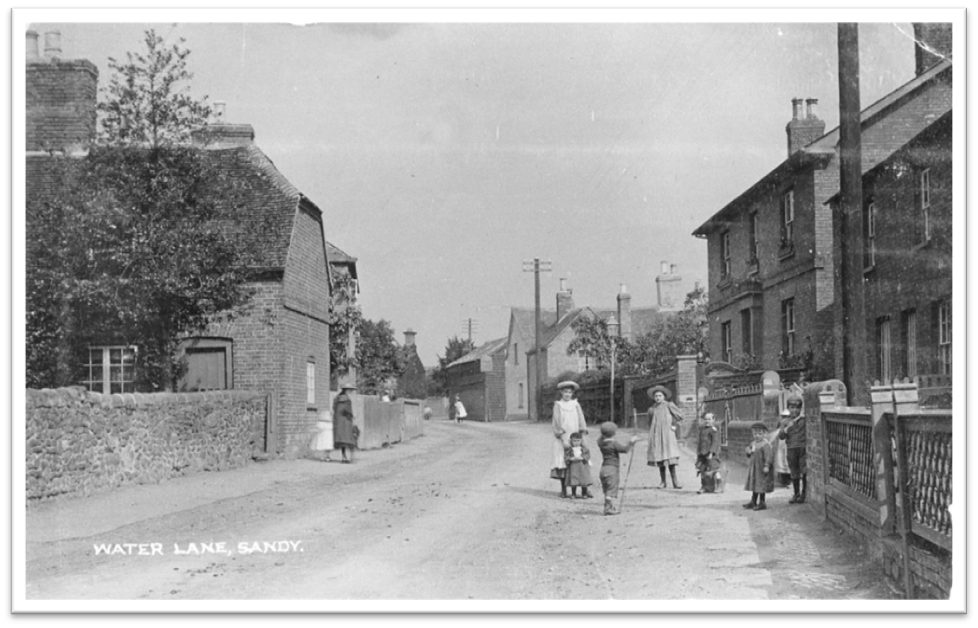
Image taken from Flickr account Water Lane, Sandy | This is the photograph which inspired my… | Flickr (JImslamps)
I contacted the Great Northern Railway Society to see if they had any occupational records for Charley. David Ingleby, their Genealogy contact, replied within a few days. Unfortunately most of the company’s records were destroyed during WW2, but he did manage to find a record in the Amalgamated Society of Railway Servants records which showed that Charles Brown, a 35 year old Platelayer for the GNR, based at Sandy, had joined the society on 14 January 1898.
The Society was a form of Trades Union, founded in 1871 and merged with two other unions in 1913 to form the National Union of Railwaymen. The record shows that he was deemed to have left the Society on 30 September 1898, as his subs were in arrears (the same reason given for almost all the other men on the page). David confirmed that many railwaymen only joined for short periods. He also added:
“Platelayers are overlooked staff members, partly because they were not attached to a station or engineering works but simply patrolled their section of line in all weathers at all times of the year. They needed to be pretty robust individuals to cope with the elements and the hard, manual labour they undertook. I admire them!”
My information on Charley and a photo of him in his regimental uniform have been added to the GNRS’ database of Railway workers, for posterity.
Charley and Lavinia had four more children in the eight years between their marriage and their next census appearance in 1901, their key dates recorded in a family bible passed on to my Grandfather Horace Brown. They were Esther Clara Brown (born 8 February 1896); Walter Charles Brown (14 August 1897); Maud Brown (born 11 September, and died 14 September 1899 of ‘lack of vitality’) and my grandfather Horace Brown, born on 22 March 1901, a couple of weeks before the census was taken (below). On their son Walter’s birth certificate, their address is shown as Brick Kiln Road.
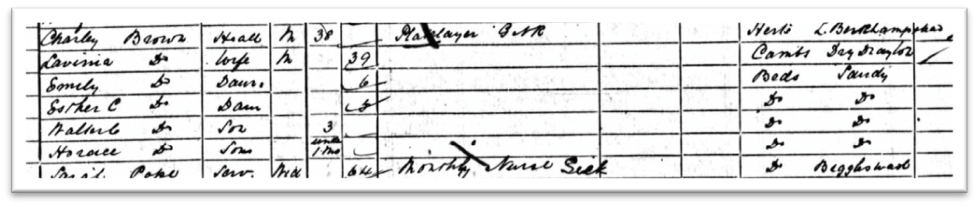
Extract from 1901 census (Ancestry.co.uk)
On the census, they are recorded at Cambridge Road/Brickhill Road, Sandy, where Charley’s employer is named as GNR – the Great Northern Railway. Were Brickhill Road and Brick Kiln Road the same?
Hosted By Bedford Borough Council: The Brickmakers Arms Beerhouse Sandy suggests that yes, they were. The point where Cambridge Road merges into Brickhill Road can be seen on various old maps (eg at The Genealogist). The GNR station, near where Charley probably worked, is close by.
On the census form, all the children are shown as born in Sandy. My grandfather’s age is recorded as ‘under one month’. The family has a servant, a 64 year old widow, Sarah Pope, a ‘Monthly Nurse Sick’, from Biggleswade. She has perhaps been brought in to help Lavinia Brown after the birth.
The following year, they had another son, Frederick Brown, born on 13 June 1902, who died two months later on 14 August that year. His death certificate gives the cause of death as ‘Whooping Cough, Exhaustion’. Their seventh and last child was George Brown, born on 2 March 1904. By then, Charles Brown had probably been suffering for some time from the carcinoma of the mouth from which he died, at St Bartholomew’s Hospital, London, on 23 June that year. He had perhaps been sent there for specialist treatment unavailable in Bedfordshire. He was buried two days later at St Swithun’s Church, Sandy (see extract from GRO death certificate, below).

Lavinia Brown was widowed aged 42, with five children under 11 years old. My grandfather was just three when his father died, his youngest brother George just five months old. I do not know how much Charley Brown would have earned as a Platelayer, but having worked for the GNR for around ten years, his was a steady income and his widow must have felt his loss keenly, both emotionally and financially. How did they fare after his death? That’s another story.
Main sources:
- Great Northern Railway Society
- 1901 census (Ancestry)
- Maps at The Genealogist
- Death certificate Charles Brown
- Children’s birth and death certificates (GRO)
- Flickr
 My Stocking Roots