My maternal great-grandmother Lavinia Seaby was born in Dry Drayton, in rural Cambridgeshire, but family tales suggested that before she married Charles Brown, she was a Cook ‘to the gentry’ in London. Censuses do show that she worked in service, latterly as a Cook, in private houses in fashionable Notting Hill, London. What more could I find out about her career, and her move from Cambridgeshire to London?
A childhood in Dry Drayton
At the time the 1861 census was taken, her parents William Seaby and his wife Emma, nee Badcock were living in Dry Drayton with their two year old son Samuel Seaby, who was later witness to his younger sister’s marriage. Samuel was their third son; two baby boys had died in infancy. Lavinia was born four months after census night, and happily also survived. Her birth certificate shows that she was born on 13 August 1861 and that her father was a farm labourer; her mother registered the birth, making her mark as she could not write.

Ten years later, she is at home, a ‘scholar’ aged nine, with her parents, brother Samuel, and four younger siblings, the youngest then only one year old. The whole family was born in Dry Drayton.
Six miles to the North West of Cambridge, Dry Drayton is a fairly small village which I’ve visited just once. British History Online has an entry for Dry Drayton which suggests that it has always been a very small village, with around 16 of its 90 houses empty by 1881. It presumably offered little in the way of employment for its young men and women, but how Lavinia found her way from there to work in service in London is still not clear. Perhaps a fellow villager, or the village vicar, had connections there.
Service in respectable circles
The 1881 census finds 19 year old Lavinia working as a General Servant in the household of C L Stephens, a Stockholder, at 5 Notting Hill Terrace. Mr Stephens was living off his ‘stock’ holdings, supported by a Housekeeper and Lavinia. As far as I can tell, this street was not far from Ladbroke Grove. Charles Stephens had been at the same address since at least 1871, where he is listed there as an annuitant at the time of that year’s census. Lavinia may not have worked for him long, as by 1885, newspapers were advertising the property’s sale.
In 1891, the family stories appear to have some truth as at the time of that year’s census, Lavinia is described as a Cook in the household of a Thomas R Walker, a Retired Bank Manager, his wife and adult son at 26 Aldridge Road, Paddington. There were two housemaids too. It seems that this was a genteel area, their neighbours are mostly people ‘living on own means’, ie with investments or other income sufficient to live on without having to work, on the edge of Notting Hill, not far from her previous place of employment.
The Google Street View image was unfortunately taken on a day when the large trees outside what is now called 26 Aldridge Road Villas were being pollarded, so the property can’t be seen clearly. It looks to have three storeys above street level, and a basement, which may have been the original kitchen where Lavinia Seaby worked. The property is now divided into flats. The top floor flat (one bedroom) was last sold in 2017 for £720,000 and is on the market for nearly £900,000 in October 2024.
Lavinia’s husband-to-be, Charley Brown, was still stationed in Bedfordshire until he was discharged from the Army in April 1893. How did they come to meet? Perhaps she had returned to Dry Drayton after 1891, and their paths somehow crossed there, or she moved to work in service in Bedfordshire. Or was he for some reason in London in 1893? Our Nana didn’t mention it, and I suppose we will now never know.
This photo below is of her, possibly taken around 1889-1890. She is wearing a well-fitted, fashionable costume dateable by the sleeves; it could have been taken at the time of her wedding, although by 1893, sleeves had started to widen again at the top.
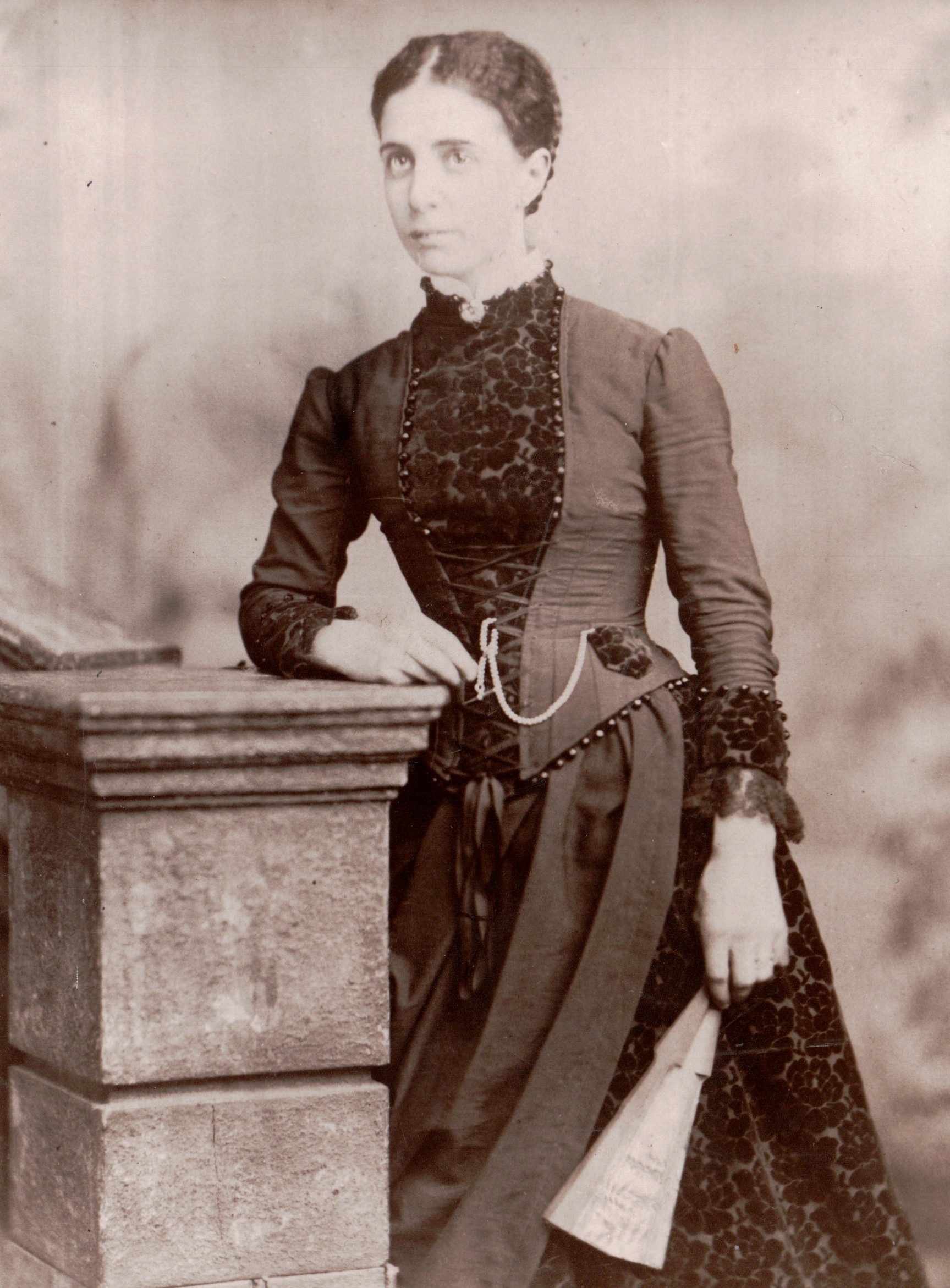
There is a faint suggestion, when the image is enlarged, of a wedding ring which would mean it was taken in or after 1893; working women didn’t necessarily keep up with the latest fashions, which would involve considerable outlay on new clothes, so an 1893 date could be possible. The ribbon ties at the front suggest that she was used to dressing herself, rather than needing assistance to tie her stays at the back.
In any case, she looks very handsome, with a trim figure and upright bearing, her bodice, cuffs and skirt trimmed with what looks like figured velvet, a neat lace collar and brooch at her throat, and a pocket for her pocket watch.
Both my Mum and particularly my Aunty Dorothy bore a resemblance to her.
Main sources:
- 1861-1891 censuses
- Birth certificate for Lavinia Seaby 1861
- Marriage certificate for Lavinia Seaby and Charley Brown 1893
- Family stories
- Google Street View
- British Newspaper Archive via FindMyPast
 My Stocking Roots