My maternal great grandmother Alice Fage died at home in Sandy on 12 February 1940. Two weeks later, on 26 February, her widower was involved in a fatal accident. Reports of the inquest heard of his state of mind at the time, and reveal witness statements from some of the family. This is his final, sad story.
Sandy man’s death in blackout
Alice Fage died of kidney disease a few months after the outbreak of WW2. Reports of her death and funeral revealed the love and loss felt by her family.
14 days later, my great grandfather, her widower William John Fage, was walking home from a nearby pub in the blackout when he was involved in a collision with a heavy milk lorry and was killed. At the inquest it was gently suggested that he may have been distracted by grief at his wife’s death at the time. The newspapers take up the story.
The Biggleswade Chronicle and The Bedfordshire Times and Independent both covered the Coroner’s inquest, which took place at The New Inn, Sandy, on Wednesday 28 February. The Chronicle’s report covered three columns (part one is shown below left).
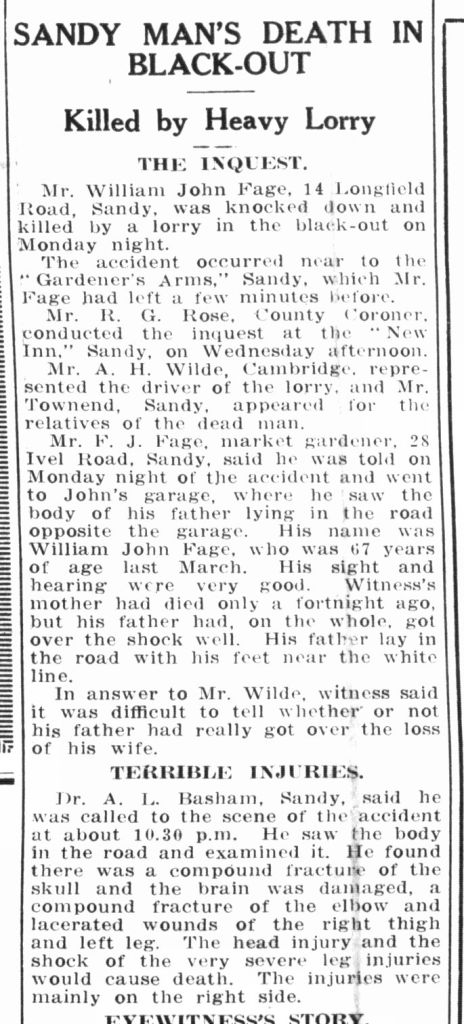
The inquest heard that Sandy man Mr William John Fage, of 14 Longfield Road, Sandy, was knocked down and killed by a lorry in the blackout. The accident took place on the Great North Road, close to The Gardener’s Arms pub, which William had left “a few minutes before”.
His eldest son Frederick John Fage of 28 Ivel Road Sandy gave evidence, saying he had been told of the accident and had gone to the site to find his father’s body lying in the road. He advised that his father was an old age pensioner whose sight and hearing were very good, and his wife had died only a fortnight ago. He found it hard to say whether his father had really got over the loss of his wife.
William John Fage sustained “terrible injuries” to his legs and head and died at the scene. Witnesses reported seeing a man on the side of the road trying to light a pipe when a lorry, carrying about ten tons of milk, came along at about 15-18 miles per hour. The man stepped into the road seemingly to cross it, lifting his arms and shouting at the oncoming vehicle, and then turning back, before the collision.
The lorry, on examination, was found to have working lights and brakes.
According to a website describing wartime motoring regulations, by February 1940, vehicles could only light one headlight and that had to be masked to allow only a small amount of light to filter through. The lorry driver stated at the inquest that he had seen ‘a man’ at the end of the beam thrown by his masked headlight. It is possible that William may not, therefore, have realised the size of the vehicle and its direction of travel. Reading betwen the lines, there is a sense that William John Fage may also have been confused after the recent death of his wife. Had William carried on crossing the road, rather than turning back, he would have missed the lorry. The Coroner, having heard all the evidence, brought in a verdict of accidental death, and fully exonerated the driver of any blame. He extended sympathy to the family.
The Gardeners Arms Beerhouse was on the corner of the Great North Road and Cottage Road, Girtford close to ‘Girtford Siding’, the Fages’ home in the early 1900s, and was first licensed in 1863. William John Fage would therefore have been familiar with and probably a regular at the pub for several decades. In 1940, the licensee was George Lintott. The pub was demolished in 1958, and the site now lies under the A1.
The Coroner’s verdict is reflected in the cause of death on William John Fage’s death certificate, stated as “Fracture of skull caused by having been accidentally run down by a motor lorry. No PM.” The certificate was received from R G Rose Coroner for the district of Bedfordshire, inquest held 28 February 1940”.

Extract from death certificate for William John Fage (GRO)
Another family funeral
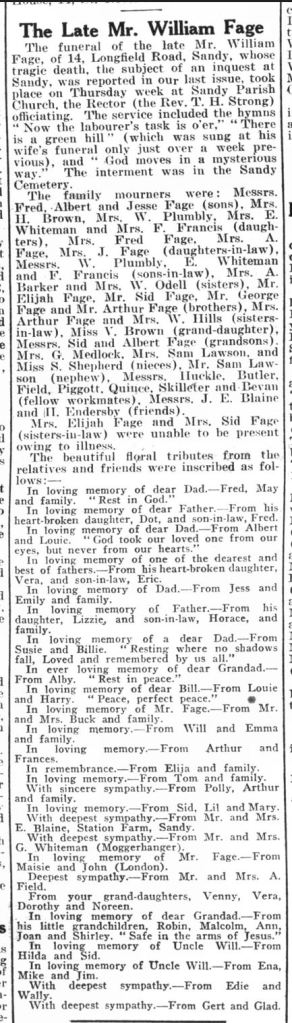
William John Fage’s funeral was held the day after the inquest, on 29 February 1940, at St Swithun’s Church, Sandy. Again, the sad event attracted significant column inches in local newspapers.
The Biggleswade Chronicle of 8 March 1940 (right) reported on the service and listed all the family mourners, detailing their relationship to the deceased. Leading the list were all his sons, daughters and their spouses, and William John Fage’s own surviving siblings. Grandchildren, nieces and nephews and workmates were also named.
My grandmother Elizabeth Sarah Fage and her husband were present, their floral tribute labelled “In loving memory of Father – From his daughter, Lizzie, and son-in-law Horace and family”, and my Mum and Aunts sent a separate wreath, “From your grand-daughters Venny, Vera, Dorothy and Noreen”. To his nieces and nephews it seems he was known as ‘Uncle Will’. To others he was ‘Bill’.
The deaths of their parents coming so close together and, in their father’s case, as the result of a sudden accident, seems to have hit the family particularly hard.
For many decades later, they published ‘In Memoriam’ notices in the local papers on the anniversaries of their deaths. When I interviewed my Mum about her parents and grandparents in the 1980s, she recalled her grandfather’s favourite song, which she wrote out for me:
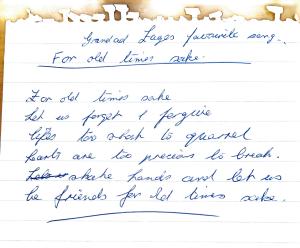
Grandad Fage’s favourite song, written out by my Mum, Noreen Stocking.
Main Sources:
- Death certificate for William John Fage (GRO)
- Inquest report, British Newspaper Archive (FindMyPast)
- British Newspaper Archive (FindMyPast)
- Family documents
 My Stocking Roots