My 2xgreat grandparents John Hill and his second wife, Elizabeth Sarah Windebank brought up their family in some of the poorer parts of south and east London. My great grandmother was their second child, but the first, third and fourth each died in their early years, a result perhaps of poor sanitary and housing conditions. They didn’t leave much documentary evidence behind in their short lives, but that doesn’t mean they should be forgotten.
South and East London in the 1870s-1880s: Backdrop to family life
John Hill married Elizabeth Sarah Windebank at St Thomas, Lambeth, London on 16 May 1869. After much detective work, I found that John Hill had been married before, even though he declared himself a bachelor for this marriage.
A search for possible children of the marriage at FreeBMD, cross-checked at the GRO with mother’s maiden name, and with censuses from 1871, suggested that the couple probably had eight children in all, although there is a gap between 1871-1875 which might indicate still births or miscarriages. John and Elizabeth Hill moved several times during their early married life. John was a labourer, probably taking casual work where he could. Money would have been tight, and they may have moved to chase work or to find better and/or more affordable rented accommodation which is likely to have been one or two rooms at most.
The first 18 months or so after marriage found them in rural Sunbury-on-Thames (1870-1871). However, within 18 months they were living at various addresses in east London, finally settling in Blue Anchor Lane in Bermondsey, Southwark, from around 1875 to the end of the 1880s. Their house number is variously given as 4 or 94.
Blue Anchor Lane, Bermondsey ran close to the South Eastern Railway line, joining Blue Anchor Road at its Southern end. Old maps from the 1870s show fairly dense housing with glue works, leather works and floor cloth manufacturer nearby on one side of the railway tracks, an iron foundary and patent rope works on the other. Building News of 24 December 1875 carried an advertisement for Geo. M. Hammer, Manufacturer of School and Church Furniture, whose new Steam Manufactury on Blue Anchor Lane, Bermondsey, had just been completed. In the same year, a meeting of the Bermondsey Vestry reported in the South London Chronicle, 10 July 1875, reported on very offensive collections of artifical manure being piled up in several of the railway arches on Blue Anchor Lane, which was also carted around the area.

F Bartlett, of 93 Blue Anchor Lane, Bermondsey, Corn and Flour Dealer, also advertised Flour to be given away in May 1880 (left).
The streets seem likely to have been named after the Blue Anchor pub, rebuilt in the 1870s and still standing today.
At the time of the 1881 census, John and Elizabeth and their surviving family shared no.94 with Laundress Margaret Sullivan and her son, a Dock Labourer, and two unmarried male lodgers, one a Smith’s Labourer, the other a Leather Dresser.
Amongst their neighbours were Lightermen, Labourers, a Confectioner, a Coachman, Carpenters, House Painters and other trades people and several school children. They weren’t living amongst the poorest class, but all the houses were in multiple occupancy. The conditions they were living in weren’t necessarily the worse, but they may have had an impact on their health, and the health of their children.
At no. 104 Blue Anchor Lane was John Davis, London City Missionary, who had married Susan Windebank, his second wife, in 1878. She was Elizabeth Sarah Windebank’s sister, he was a US Veteran and well-known campaigner. But that’s another story. What follow are the brief stories of three of John and Elizabeth Hill’s children who died in childhood.
John David Hill: Death from croup
The couple’s first child was John David Hill, whose birth was registered in the Oct-Dec quarter of 1870 in the Staines district of Middlesex, which covers Sunbury-on-Thames. I ordered a digital copy of the birth certificate to be sure.

Digital birth certificate for John David Hill 1870 (GRO)
This shows that he was born on 24 September 1870 at Sunbury, the son of John Hill, a Labourer, and Elizabeth Sarah, formerly Winderbank [sic]. His mother makes her mark to register the birth, her usual residence shown as Sunbury.
John David Hill was baptised at the church of St Mary, Church Street, Sunbury-on-Thames, on 6 November 1870 (below):

Extract from parish register of St Mary, Sunbury-on-Thames (Ancestry)
This ancient riverside church was rebuilt in 1752, according to Wikipedia. Many additions were made from 1871 onwards, such as a porch and stained glass windows, but in 1870 it may still have been a simple, elegant space.
The 1871 census finds baby John David Hill, aged seven months, enumerated with his parents at Layton’s Lane, Sunbury-on-Thames. The OS map (below), reproduced with permission from the National Library of Scotland, shows the location of St Mary’s church, centre bottom, just above the words ‘Sunbury Lock Ait’, by the river. From later maps, Layton’s Lane led off Nursery Road, top left of the map, where the ‘N’ of Sunbury appears. A very rural location. Google maps indicates it would take about 25 minutes to walk between the two today, although there are now more paved roads.
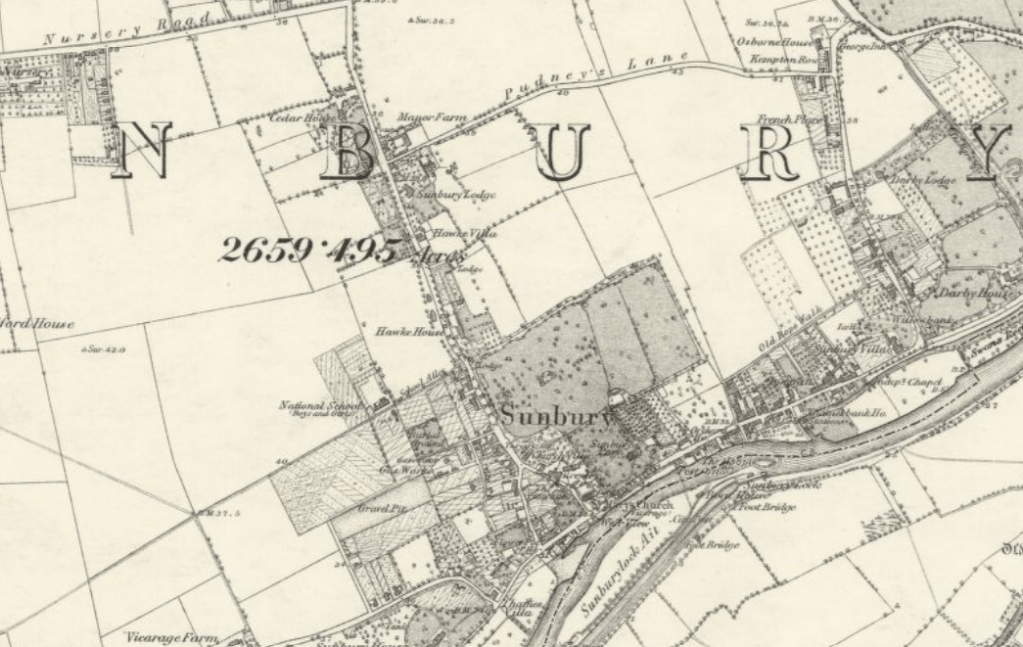
National Library of Scotland: Middlesex Sheet XXV Surveyed: 1864 to 1870, Published: 1869 to 1872
John and Elizabeth Hill appear to have moved from Sunbury-on-Thames by early 1872, as their son John Hill died on 25 February that year at Charles Street, Bromley, in London’s Poplar district. The digital death certificate ordered from the GRO cuts off the actual date and place of death, which I have surmised from the ‘informant’ column.

Digital death certificate for John David Hill, 1872 (GRO)
His father, John Hill, a Labourer, registered his 17 month old son’s death from Croup on 26 February 1872, giving his usual residence as 3 Charles Street, Bromley. This was Bromley-by-Bow, in London’s East End. A map of the 1860s shows Bromley-by-Bow, near Bow Station and the River Lea, as a mix of market gardens, starch works and industries related to sailing. But by the 1870s, as ‘The Underground Map’ shows, the area was far more built up and surrounded by factories and heavy industry relating to the growing railways. I have not found Charles Street on old maps so far.
Croup is a respiratory disease most likely to affect young children, leading to a barking cough and difficulty breathing. Today, serious cases can be treated at home with a single dose of steroids, but no such medication was available to help John. There was a large cemetery in Bow, and John may have been buried there. I have not found a burial record for him.
Emily Elizabeth Hill: Death from genital ulcers
My great grandmother Susan Caroline Hill was born between the birth and death of John Hill, in 1875, and survived to old age. She was born at 29 Vauban Street, Southwark. After her came a sister, Emily Elizabeth, whose birth was registered in the December quarter of 1877 in Southwark (FreeBMD). The digital birth certificate from the GRO confirms that she was the daughter of John Hill, Builder’s Labourer, and Elizabeth Sarah formerly Windebank. She was born at 94 Blue Anchor Lane, not far from Vauban Street. Her parents and older sister were still living there at the time of the 1881 census.

Digital birth certificate for Emily Elizabeth Hill, 1877 (GRO)
Her mother once again makes her mark when registering the birth on 4 October 1877.
She also died young, at the age of two, the cause of death – genital ulcers; there are many causes for this in young girls, including influenza, other respiratory diseases and inflammatory or bacterial conditions.

Digital death certificate for Emily Elizabeth Hill, 1879 (GRO)
She died on 20 October 1879 at Guys Hospital in London. A secondary cause of death was exhaustion, so she had, perhaps, been in hospital for at least a few days suffering from some kind of infection and/or inflammation. A post mortem was undertaken to determine the cause of death, although the root cause of the ulceration is not mentioned. Her death was registered by H C Gore, Sister of Ward at Guys Hospital, ie a nurse. She was just over two years old. It is difficult to imagine how this second infant death will have affected her parents. They did, however, still have two daughters in the family: Susan Caroline, my great grandmother, who was four years old, and four month old Mary Ann Hill.
Mary Ann Hill: Death from Measles
John and Elizabeth’s fourth child was another daughter, Mary Ann Hill, whose birth was registered in the Apr-Jun quarter of 1879 in Southwark. She was christened on 18 May 1879 at St James, Bermondsey, the daughter of John, a Labourer, and Elizabeth Sarah Hill of 94 Blue Anchor Lane, five months before the death of her sister Emily.

Extract from St James Bermondsey parish register (Ancestry)
The church was a few minutes’ walk from their home, one of the ‘Waterloo Churches’ built with funds raised after the Battle. According to a history of the church (PDF booklet), in 1878, it had the largest Sunday School in London and, in 1879, when little Mary Ann was baptised, it was extensively repaired and redecorated. It is also noted that the Vicar, Dr Allen, was a great believer of infant baptism, and regularly did ‘sweeps’ of the parish to bring unbaptised infants into the church. It seems likely, however, that Mary Ann Hill was voluntarily brought for baptism not long after her birth, given the time between her birth being registered and the date of her baptism.
I have not ordered her birth certificate, but it is likely that she was born at the family home at Blue Anchor Lane. She appears with her parents and older sister Susan Caroline Hill at the same address in the 1881 census, taken on 3 April. On 18 July the following year, a second son, George William Hill, was born, and baptised at St James, Bermondsey on 4 September; the family were still at 94 (or 4, it isn’t too clear) Blue Anchor Lane. In between his birth and baptism, their daughter Mary Ann Hill died, aged three, from Measles.

Digital death certificate for Mary Ann Hill, 1882 (GRO)
The family address is shown as 4 Blue Anchor Lane; there may have been a renumbering of houses, or the family may have moved to another property in the same street. This time it is her father who registers her death, on the same day she died.
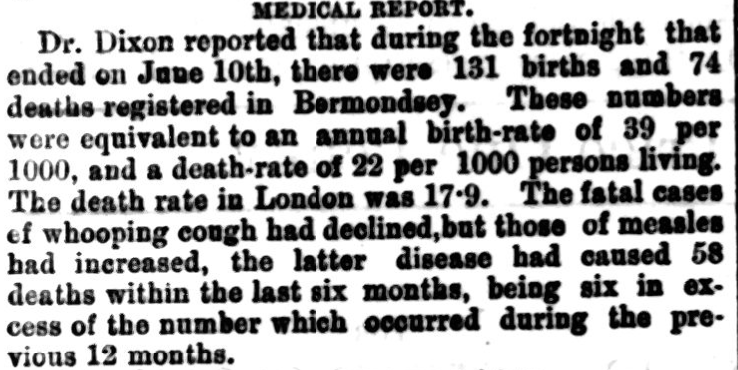
The month before her death, on 24 June 1882, The Southwark and Bermondsey Recorder carried a report (left) from the Bermondsey Vestry’s Medical Officer, highlighting an increase in deaths from Measles.
Newspapers continued to report on an increase in child deaths particularly from Measles and respiratory diseases over the following months. Thankfully, none of the other children appear to have caught the disease … or at least, not fatally. They and the three children born after Mary Ann’s death all survived to adulthood. But those are stories still to be told.
Main Sources
- 1871-1881 censuses (Ancestry)
- FreeBMD birth and death indexes
- Birth and death certificates (GRO)
- Baptism records (Ancestry)
- Old maps (National Library of Scotland)
- The Underground map website
- British Newspaper Archive (FindMyPast)
 My Stocking Roots