My 2xgreat grandfather came from a line of Rope Mat Makers of Bermondsey. He spent most of his working life as a Labourer in south London, sometimes for bricklayers or builders. Many of his sons, grandsons and great grandsons learnt specific building or associated trades, but what would life have been like for Jim?
Large family, little money
James was born on 11 June 1853 at 11 St Stephens Place, Southwark. His birth certificate (below) shows that he was the son of James Stocking, a Mat Maker, and Mary Ann, formerly Collins. She registered his birth, but couldn’t write, making her mark in the register.

Extract from birth certificate of James Thomas Stocking (GRO)
I need to investigate his father’s occupation further, but it doesn’t sound as though it would have made the family much money. James was his parents’ second child, one of a total of 11 born between 1851 and 1869; a lot of mouths to feed in one of London’s poorer areas. Ultimately, the couple had more than 350 descendants. But let’s focus for a moment on their son James.
James was 18 at the time the 1871 census was taken (although he’s recorded as 19). He has no occupation shown; his father is a brickie’s labourer, and his two older sisters are in work as a flag maker and servant, so money is likely to have been tight. They are living at 26 John Street, near London’s Leather Market. Some of their immediate neighbours are working in trades allied to leather goods, including bootmakers and fitters, a furrier and patent leather dresser, but there are also sugar boilers, railway workers, poultry salesmen and a coffee roaster.
It took me a while to locate John Street on old maps. There are, in fact, two John Streets fairly close to each other. The 1871 census entry for the Stocking family at no.26 is close to entries from King Street and Bermondsey New Road, which helped to locate the correct one.

John Street was just off Kent Street [Old Kent Road], close to the Bricklayer’s Arms station, Bermondsey New Road and a local Tan Yard. The map above is from 1850, from Tabard Street, SE1 (theundergroundmap.com) Twenty years after the 1871 census, Charles Booth’s notebooks reveal that the areas of King Street and John Street had been incorporated into what was then called Leroy Street, and were gloomy, depressing places (BOOTH/B/364Ernest Aves’ Notebook: Police District 32 [Trinity Newington and St Mary Bermondsey]). Generally, by the 1890s, the area was poor, with some criminal classes, prostitutes and gambling, although King Street and John Street were a mix of two and three storey houses and mixed economic standing.
On 29 November 1874, James married 17 year old Alice Mary Wales, the daughter of a harness maker who was originally from Norfolk. She was heavily pregnant and gave birth to their daughter Alice Caroline Stocking just 11 days later. Both signed the register, so had some basic schooling. James was working as a plasterer; although his maternal grandfather Daniel Collins spent his working life as a plasterer, he died in 1862, so James’ induction to the trade must have come from elsewhere.
19 children: Labouring of a different kind
James and Alice went on to have a total of 19 children although, according to custom at the time, James is unlikely to have attended any of Alice’s labour or births. Two years after their marriage, their eldest son, my great grandfather James Aaron Stocking, was born at 30 Bermondsey New Road. This was close to John Street (see map above). His birth certificate shows that his father is now working as a Bricklayer’s Labourer, a job he did on and off for the rest of his life.
Bermondsey New Road (now parts of Bermondsey Street and Tower Bridge Road) was in the Leather Market district of London, in Bermondsey and Southwark. It can also be seen clearly on the five inches to a mile OS map of 1891-93, at the National Library of Scotland’s collection, surrounded by factories and tramways, a baptist chapel and school. Photos from The London Picture Archive show that, 20 years later, buildings on Bermondsey New Road were dilapidated or derelict.
Education in England had been compulsory for children aged 5-10 since the Elementary Education Act of 1880. A follow up Act of 1891 provided for the state payment of school fees up to ten shillings per head, which effectively made primary education free (Wikipedia). However, it wasn’t until 1899 that the school leaving age was raised to 12 years; it seems that James and Alice were keen to ensure their children had an education, and could perhaps afford it even beyond the compulsory period, despite their large family and occupations which would probably not have brought in large sums of money.
Ancestry has School Admission and Discharge Registers for Rolls Road School, and the names of many of the Stocking brood feature in both infants and junior school records. The London Picture Archive has some photos , one from the 1880s and the rest from just before WWII, showing the exterior of the school.
By 1880, the growing family had moved a little further South to rented accommodation in the terraced Bowles Road and Herman Road, adjacent streets close to the Tramways Depot and the Grand Surrey Canal. Apart from a couple of years in the mid-1880s, they lived there until Alice’s death in 1907.
This photo of James and Alice was probably taken outside their home on Bowles/Herman Road (the addresses seem interchangeable over time, but I need to investigate that further).
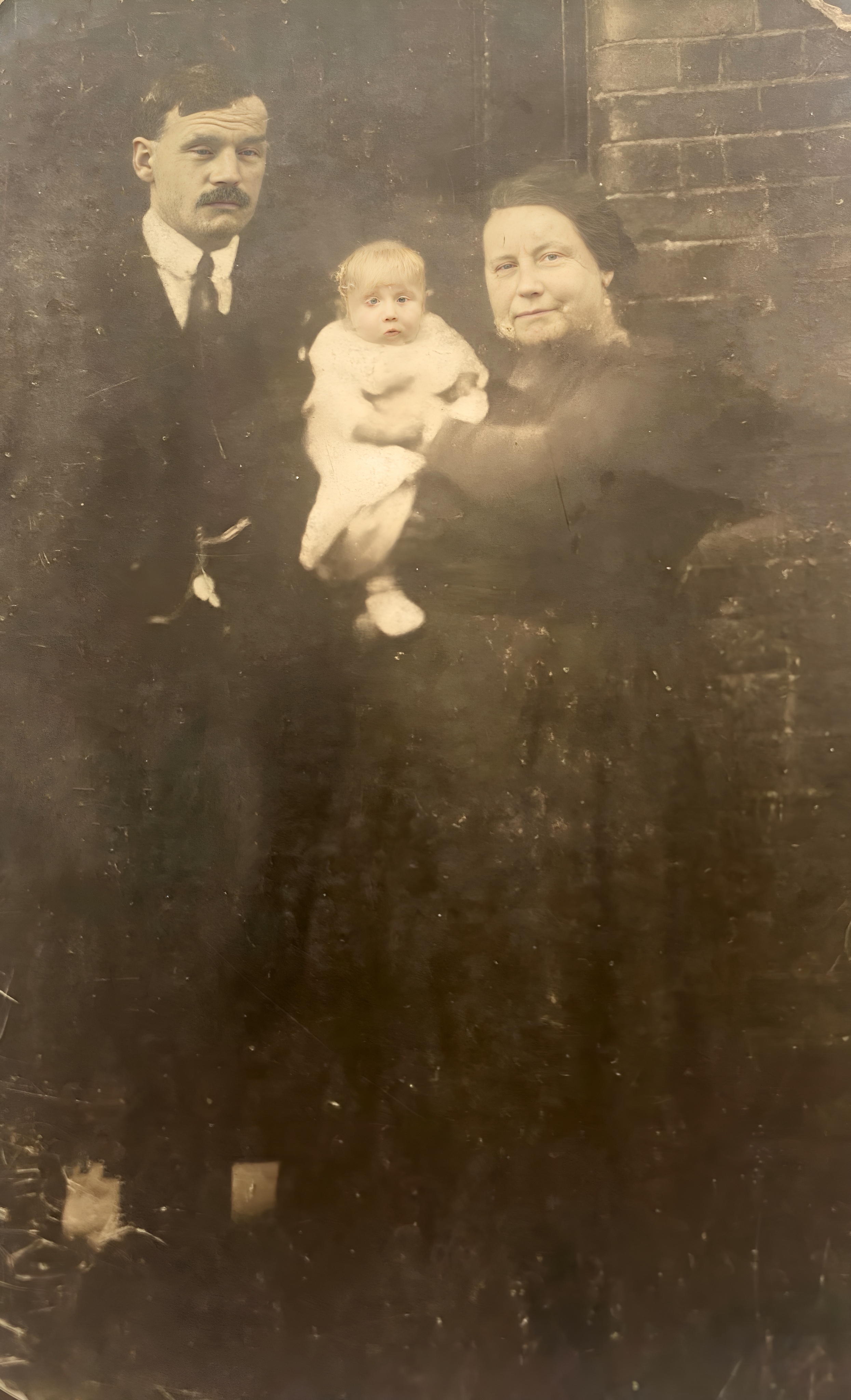
Photo of James and Alice Stocking, late 1890s/early 1900s (with thanks to Angela McKay)
I often get distracted trying to find information about the places my family used to live, particularly as so many parts of Victorian London have disappeared under new roads and developments. Blackcablondon’s blog often fills in the gaps. This post covers the London Bridge to Greenwich railway arches and the route of the Grand Surrey Canal. It runs through nearby Trundley Road, site of Folkestone Gardens, where my great grandmother’s sister and family were killed by a V2 attack in WWII, and on to Greenwich, close to where I grew up and the station which I often used when working. But I digress.
Another variation on James’ occupation appears on the baptism record of his son Alfred Edmund Ilott Stocking in 1899. This time, instead of the usual ‘Labourer’, he is described as a Caretaker. Unfortunately, where and what he took care of is not revealed, and the job is not repeated elsewhere. Later that year, his daughter’s marriage certificate shows her father as a Labourer, and his son’s in 1900 shows him as a Builder.
I think it fair to say that he had various casual labouring jobs for brickies and builders throughout his life, sometimes specified as such on baptism, marriage and census records. That he may have had steadier work in the 1900s is suggested by the descriptions Paper Hanger, Gas Fitter, Estate Agent, Builder and House Decorator (Journeyman). Even these, though, are interspersed with spells as a labourer.
After Alice’s death, James and his younger children moved to Beechfield Road in Catford, joining my great grandfather and various others of his grown-up siblings who also lived there. When James remarried (to his wife’s widowed sister) in August 1919, he was still living at Beechfield Road. Both died within days of each other in early December of the following year. He was buried at Camberwell Old Cemetery, joining Alice in her last resting place.
Main Sources:
- 1871-1901 censuses (Ancestry, FindMyPast, The Genealogist)
- Birth, baptism, marriage and death records (Ancestry, GRO)
- Burial records (Ancestry)
- London Picture Archive
- Blackcablondon.net
- National Library of Scotland old maps of London
- Underground London old maps
- Family photo (with thanks to Angela Mckay, Brendan Nolan and Valerie Bradley)
 My Stocking Roots