My great grandfather Charles (Charley/Charlie) Brown served 12 years as a soldier with the British Army in India before marrying cook, Lavinia Seaby, in Cambridgeshire in 1893. His residence at the time was Girtford in Sandy, Bedfordshire, where they spent their short married life. It took a while to trace his birth, and the home life and losses that may have led to his seeking pastures new at 18.
Bedfordshire, Cambridgeshire or Hertfordshire?
The 1901 census, the first in which Charley and Lavinia appear as a married couple, finds them living at Cambridge Road/Brickhill Road in Sandy. They had married in Dry Drayton in Cambridgeshire, where she lived until moving to London for work. His residence at the time is Girtford, a hamlet near Sandy in Bedfordshire. Neither had been married before, their careers leading them perhaps to marry late in life.
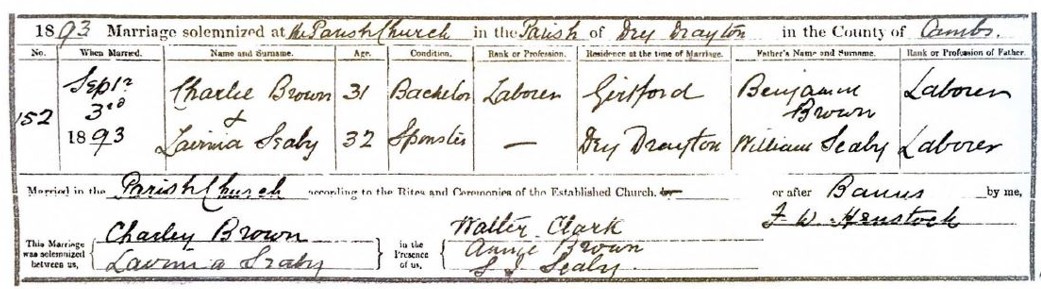
Extract from marriage certificate (GRO)
While his wife’s birthplace is recorded in the 1901 census as Dry Drayton, his birthplace is in another county again: Little Berkhamsted (sometimes also spelt Berkhamstead), Hertfordshire. I couldn’t find him on the 1891 census, two years before the marriage; as I later discovered, he was into his tenth year of serving in the British Army in India at the time.
I searched for him and his family in the 1871 census using clues from the 1901 census and the marriage certificate: he would have been about 7-8 years old, his father was Benjamin Brown, a Labourer, and Annie Brown, one of the marriage witnesses, may be another family member. The family could have been living in Bedfordshire, Hertfordshire or even a neighbouring county.
I found them living at ‘Gravel Pits’, Little Berkhamsted, Hertfordshire. Head of household Benjamin Brown is 56 (b.1815), born in Benington, Hertfordshire. His wife, Esther Brown, is 40 and hails from Hatfield. In addition to Charles Brown, aged eight, there are three other children: David Brown, born in Hertingfordbury, aged 15; George Brown, aged six and Elizabeth Brown, aged four. All three younger children were born in Little Berkhamsted. No sign, though, of the ‘Annie Brown’ who witnessed Charles’ marriage. Was she living elsewhere, or had she not yet been born?
Failing to find a Charles Brown born around 1861-1862 in Hertfordshire in the GRO birth index, I searched for ‘male’ births in the Hertford Union registration district (which included Little Berkhampsted) instead. There was one index entry for the last quarter of 1862 for an unnamed boy, mother’s maiden name Miles. The certificate ordered from the GRO suggested this was the ‘correct’ birth:

Extract from Charles Brown’s birth certificate (GRO)
It seems he was born at home at Gravel Pit, Little Berkhamsted, the son of Benjamin Brown, Farm Labourer and his wife, who was formerly Esther Miles. The latter registered the birth on 22 November, making her mark as she could not write. By the time he was baptised in the parish church four months later, on 8 February 1863, his parents had finally decided on his name. His date of birth matches that shown in the baptism register.

Baptism of Charles Brown at Little Berkhampsted 1863 (FindMyPast)
Little Berkhamsted: A small place in history
The village population currently stands at 560; census returns indicate it was of a similar size while Charles was growing up there. The village church is dedicated to St Andrew, the current building dating to the 17th century, but built on earlier, possibly Saxon, foundations. A history BOOKLET-Bayford-Little-Berkhamsted-with-cover_compressed.pdf (hertfordmuseum.org) offers insights into the two villages of Little Berkhamsted and neighbouring Bayford over time, although the majority of memories are inevitably from the early 1900s-1950s, at least two decades after Charley left to join the army.
The Five Horseshoes pub had been slaking villagers’ thirsts since at least the 17th century and is still doing so today, so Charley would have known both it and the shop, pictured in the above booklet in 1880, which may have been a source of the family’s provisions. It seems from this that, even after WW2, most people in the village relied on getting about on foot, by bicycle or horse-drawn vehicles.
Despite its small size, Little Berkhamsted – or just Berkhamsted as it was known – can lay claim to a place in quite a big bit of England’s history.
The village’s parish council website notes that:
It was in Little Berkhamsted that William the Conqueror accepted the surrender of the City of London after the Battle of Hastings in 1066.
The history of the manor of Little Berkhampstead [sic] was detailed in the Victoria County History of Hertford vol. 3, now available at British History online. It was mentioned in the Domesday book, and appears to have been held by a number of the great and good on the periphery of royal circles for several centuries.
I have not been able to find out anything about ‘Gravel Pit’, the family address in 1871 and on Charles’ birth and baptism records. In the 1861 census, their address is ‘Bedwell Gravel Pit’. Old maps of the area at the National Library of Scotland show Bedwell Park Farm to the west of Berkhamsted (where, incidentally, Charley’s father had worked as a servant before he married Esther Miles), and geological maps show the area is largely gravel, but I have not found any specific place labelled Gravel Pit. The 1861 census schedule enumerates 450 people in the wider village. Following the enumerator’s route on the 1874 map of the area (NLS), it seems likely that the Gravel Pit was located to the north and east, between Bedwell Park and the centre of the village, and later documents give their address as ‘Bedwell Park, Little Berkhamsted’.
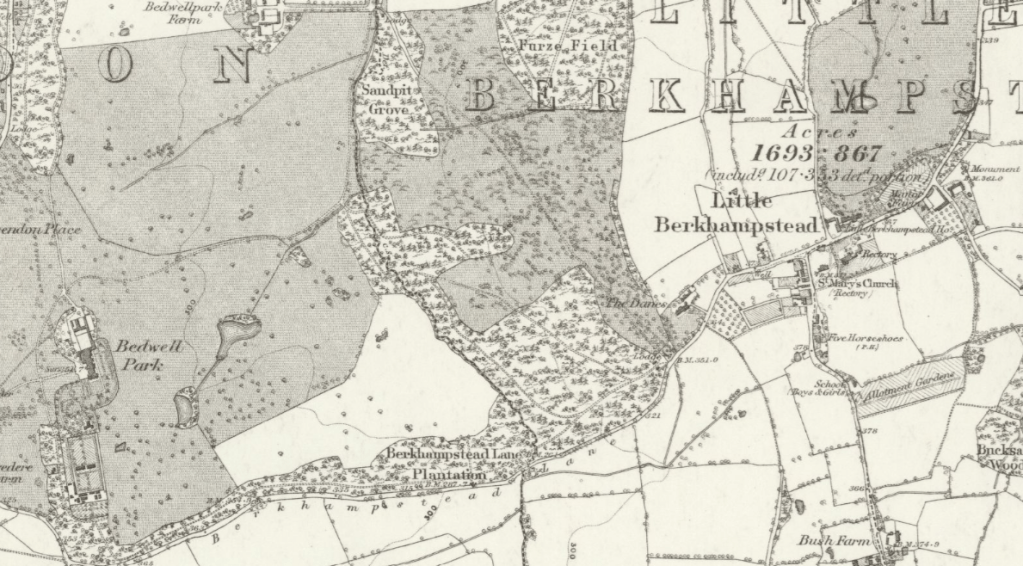
Area of Little Berkhamsted, possible location of Gravel Pit (Hertfordshire Sheet XXXVI Surveyed: 1873 to 1880, Published: 1883). Reproduced with permission of the National Library of Scotland
From Herts to India: What (and who) did he leave behind?
We know that Charley had left home by 1881 to start his military career as a Militiaman, as the census that year finds him, aged 18, lodging with ten other recruits at The Black Horse Inn. It would be 12 years before he returned to England; he was the fourth of seven children and by 1881, two of his sisters had died. At the time of his army attestation he was working as a Bricklayer’s Labourer. Perhaps the lure of army life seemed a better prospect than staying in Little Berkhamsted; certainly, his surviving siblings all moved away, even if not very far.
A year before he was born, the 1861 census shows the three older children, Jane Brown (7), David Brown (5) and Sarah Brown (2) as born in Hertingfordbury, 3.5 miles north of Little Berkhamsted, suggesting that their parents had only recently moved to the latter. Ten years later, eldest daughter Jane, by then 17, is working as the only servant in the household of Calcot Stokes, a Commission Agent, and his family of eight, in St Andrew’s Street, Hertford. Still at home in Little Berkhamsted are David (15), Charles (8), George (4) and Elizabeth (2). Their sister Sarah Brown had died of ‘fever’ the previous year.

Extract from death certificate for Sarah Brown, 1870 (GRO)
Her death wasn’t registered by a family member but by an Ann Cordwell, from Essendon, who was present at the death. The 1871 census shows her, aged 59, at Essendon, an agricultural labourer from Redbourn, Herts. Was she a friend? A neighbour who moved away? We may never know. Charley was only eight years old when his sister died; another girl, Anne Brown, was born in 1872, completing the family.
Unfortunately, there were more losses to come. Sister Elizabeth Brown died from ‘disease of the heart’ on 8 December 1875, aged eight years (although it says nine on the certificate).

Extract from death certificate of Elizabeth Brown, 1875 (GRO)
Again, no family member registered her death; the informant was S Boulton, present at the death at Bedwell Park, Little Berkhamsted. The Boultons, Samuel and Sophia, were the Browns’ next door neighbours at Gravel Pits in the 1871 census and presumably still lived close by in 1875.
1881, the year of Charley’s departure, seems to have seen both happiness and tragedy for the family. His older brother David Brown was, at that time, a patient at St Andrew’s Convalescent Home in Folkestone. He had married Kate/Kitty Parish, from Essendon, three years earlier, in Little Berkhamsted. She remarried in Essendon in 1887. There was a death index entry which appeared to be for David Brown in the last quarter of 1881. I am unsure whether the death certificate (below) is correct, although his age and residence seem consistent; his occupation – Shepherd – and widow’s initial (L, not K) are not. However, I have been unable to trace him in later records.

Extract from death certificate for David Brown, Shepherd, 1881 (GRO)
In July the same year, their sister Jane Brown married John Simons, a Signalman originally from Leicestershire, in Little Berkhamsted (FreeREG). The 1881 census shows her working as a servant in Dawlish, Devon, a long way from home; in the same household is Sarah Beacher, a scullery maid, who was one of the witnesses to her marriage. Her husband-to-be meanwhile was boarding with a Farm Bailiff in nearby Hertingfordbury, so the couple perhaps met while she was visiting her family at home. They moved to Sandy in Bedfordshire shortly afterwards and had two sons, William and Edward, who both died as babies in 1882 and 1883. By then, Charley Brown had completed an initial period of service in Hertford and later in Newry, Ireland, and had sailed for India.
Brother George Brown had also left home by 1881, apprenticed to a Blacksmith in the neighbouring village of Bayford. He married Rose Ephgrave at St Andrew’s, Hertford, on 23 December 1888; he was 24, his bride just 18 (although she claimed to be two years older). I have yet to establish what, if any, relation she was to my paternal grandmother’s Ephgrave family. Sadly, she died in childbirth on 29 December 1889, in Essendon, complicated by ‘intestinal obstruction’.

Extract from death certificate of Rose Brown, nee Ephgrave, 1889 (GRO)
A year later, the family was faced with further loss when Benjamin Brown died on 8 July 1890 at Mill Green, Essendon. He was said to be 73 years old, although he may have been older, and died of exhaustion and bronchitis. By the time of the 1891 census, George Brown has moved to Mill Green to live with his widowed mother, by then taking in washing as a laundress, youngest sister Annie Brown, 19, and three year old Annie Brown, described as Esther’s granddaughter. So far, I have failed to determine whose child she was although her birth year would coincide broadly with the death of Rose Brown.
Charles Brown returned to England early in 1892 but remained in the army until April 1893; presumably he was stationed in Bedford with the 2nd Battalion Bedfordshire Regiment until then and this may have led to his move to nearby Sandy prior to his marriage.
Main Sources:
- Birth and death certificates (GRO)
- Baptism records (FindMyPast, FreeREG)
- Marriage records (FindMyPast, FreeREG)
- Burial records (FindMyPast)
- Census records (Ancestry, The Genealogist, FindMyPast)
- National Library of Scotland maps
- British History Online (Victoria County History)
- Little Berkhamsted parish council website
- Cover image: Acabashi, CC BY-SA 4.0 https://commons.wikimedia.org/wiki/File:Little_Berkhamsted,_Hertfordshire,_St_Andrew%27s_Church_20_-_Churchyard_from_road.jpg via Wikimedia Commons
 My Stocking Roots
