My 2xgreat grandfather Jesse Ephgrave was a master baker. He had 13 children – a baker’s dozen – with Harriet Scrivener. Their first son, my great grandfather, was illegitimate and their second was born only a few months after their marriage. Times were hard for them, with the loss of four children in infancy, and financial struggles. What can the records tell us about the life of a Victorian baker and his family?
In the family way
When my great grandfather Frederick Hipgrave Scrivener was born in April 1872, his as yet unmarried parents were living a few streets apart from each other in the Bedfordshire town of Luton. His mother, Harriet Scrivener, a 20 year old hat sewer, was living with her parents and two surviving sisters at 23 Stuart Street. At the time of the 1871 census, his father, a 19 year old journeyman baker, was a boarder in the household of Charles Cooper, Baker, at 23 Bute Street, and may still have been there a year later. Perhaps Harriet met Jesse while walking from home to the hat factory at the end of Bute Street, or on busy George Street, which lay between and was where straw plait and related goods – amongst much else – were traded.
This photo is said to have been taken in George Street in the 1860s/1870s, so contemporary with when Jesse and Harriet lived close by:
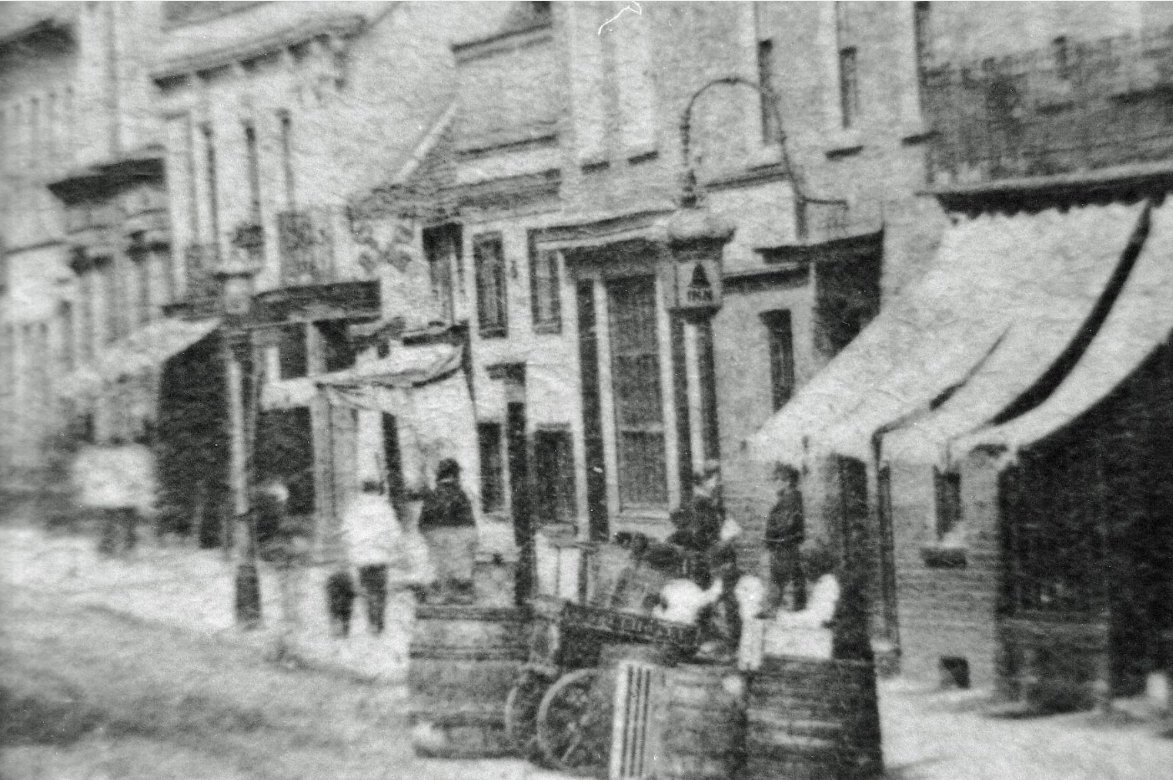
George Street, Luton, 1860s/1870s, from Luton Heritage Forum
Straw plaiting offered women well-paid work and gave them financial independence not common in the Victorian era. Women flocked to Luton for work, creating a female-male ratio in around 1885 of (some sources say) up to 11 to one. It seems that Jesse and Harriet continued their relationship, and they were both said to be resident at her parents’ address when they married on 21 August 1873. The wedding took place at Luton’s Christ Church, an imposing red brick building on Upper George Street, completed in 1858. Harriet’s older sister Mary Ann was one of the witnesses. Both the groom and his father (deceased) are described as bakers.
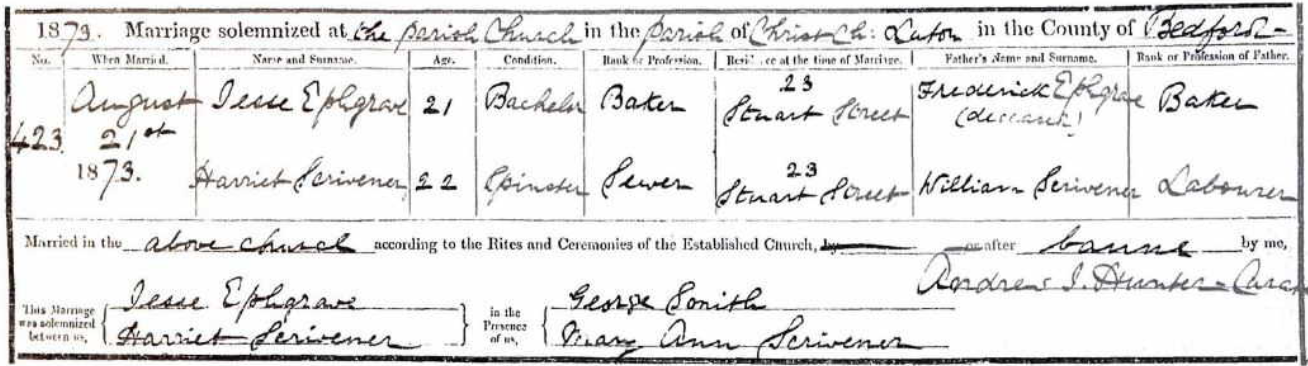
Extract from marriage certificate 1873 (GRO)
Perhaps with Harriet’s sewing income, there were sufficient prospects for them to set out on their own. Or perhaps they and/or their families felt a need for them to legitimise their relationship and find a stable home; at the time of the wedding, Harriet was six months pregnant with their second son. Three months after the marriage, the couple have left Luton and set up home in the town of St Alban’s, Hertfordshire, a few miles from Jesse’s home village of Redbourn. Edward Thomas Ephgrave was born there on 6 November 1873, named after his father’s step father, Edward Thomas Dexter. He was also a baker, in Redbourn.

Extract from birth certificate for Edward Thomas Ephgrave 1873 (GRO)
By now, 21 year old Jesse is described as a master baker, working on his own account rather than finding work daily (a journeyman), so may well have had more money coming in.
Google maps shows Albert Road/Street as a long, narrow lane lined (now, and probably then) with attractive red brick and rendered terraced cottages and some larger terraced villas. Did Jesse have his bakery in Albert Street, or elsewhere? Or did he bake at home and then go out to sell his wares, or did he have a shop front? Researching Food History details the gruelling work of the Victorian baker. Life would not have been easy, even if he had his own place.
St Albans’ heydey as the first stop on the stage coach route north out of London (and presumably the last in the opposite direction) was over by the 1870s, the railways having taken their place in the previous decade. However, although this was a prosperous town (and city from 1877), there were no sewers built until the 1880s. It may not have been the most sanitary of places to live and, as the above article recounts, baking was hot and hard work.
A year after their marriage, on 28 August 1874, Harriet’s mother Hannah Scrivener, nee Hawkes, died of liver disease. Her sisters continued to live in Luton, either with their father or with each other, but Harriet does not seem to have returned to her birthplace for any length of time until after WW1. Early in 1875 (or possibly the end of 1874), she gave birth to a third son, Henry Charles Ephgrave. The family was still living at Albert Street, where baby Henry died, aged 8 months, on 4 October 1875.

Extract from death certificate of Henry Charles Ephgrave 1875 (GRO)
He died after suffering from diarrhoea for 21 days; the informant, Sarah Nevill, was, I believe a neighbour, as she and her husband are enumerated at ‘Albert Road’, St Albans, in the 1871 census. Her husband was a tailor and she was a bonnet sewer (the straw hat industry was almost as big here as in Luton), so Harriet may well have continued sewing at home while raising her family.
Reduced circumstances and family dispute
The same may not be said, perhaps, of the viability of the bakery business. In 1879, Jesse’s was one of several names appended to a notice in The Herts Advertiser announcing that ‘the undersigned’ Bakers and Confectioners of St Albans would no longer be giving or receiving Christmas Boxes owing to ‘the great depression of business, and a still greater competition in trade”.
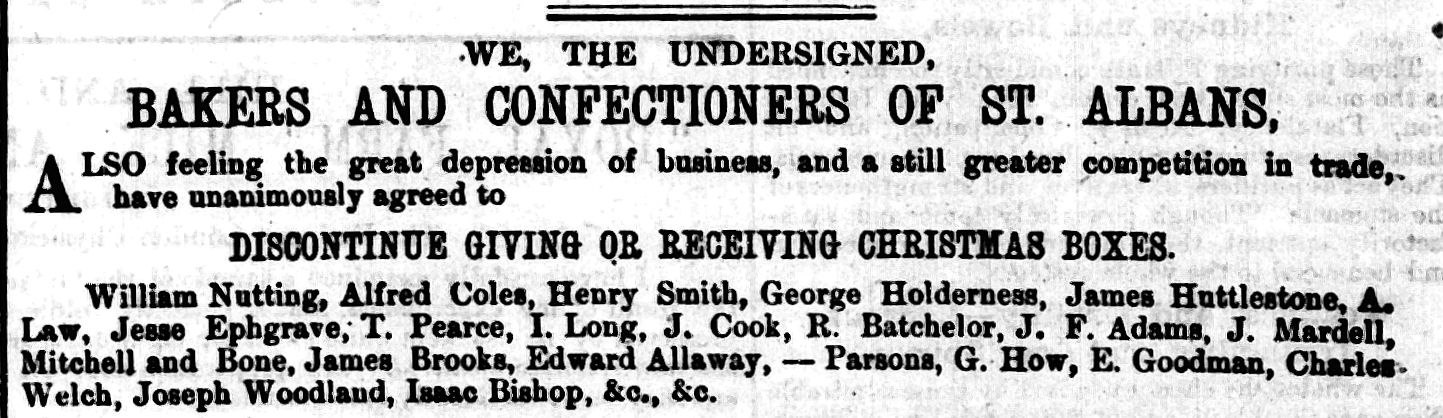
Extract from Herts Advertiser, 13 December 1879 (British Newspaper Archive at FindMyPast)
Jesse and Harriet soon had three more children, two boys and a girl, bringing the total living at Albert Street by the 1881 census to six. On census night, my great grandfather was in Redbourn, four miles away, with his maternal grandmother and her husband, baker Edward Thomas Dexter. Whether he was usually resident there, or just visiting, I do not know.
Two more daughters followed, Alice in 1882 and Florence Louisa in January 1884.

Extract from birth certificate for Florence Louisa Ephgrave 1884 (GRO)
At the time of Florence’s birth, the family was still at Albert Street, but by the time she died seven months later, they are at 4 Inkerman Road in the St Peter’s district of the city.

Extract from death certificate for Florence Louisa Ephgrave 1884
Like her older brother Henry, baby Florence died from diarrhoea after suffering for six days. The informant was Ann Welch (another neighbour?), also of Inkerman Road. She may not have known the family that well; the father’s name is shown as Thomas Ephgrave, not Jesse. The family’s finances may also have reduced in the time between Florence’s birth and death and the move from Albert Street. Jesse is no longer working for himself, but is described as a baker journeyman.
The Commercial Gazette of 13 March 1884 listed Jesse Ephgrave, baker of Albert Street, St Albans, in the Extracts from the Register of County Court Judgements. Jesse either owed, or was owed, £32. An inflation calculator suggests this would have had the same purchasing power as over £15,000 today . Was this change in finances behind the move from Albert Street?
More woes were to come. On 17 May 1884, the Herts Advertiser reported on a ‘quarrel between brothers’ which came to court. It seems there was no love lost between Jesse and his younger brother Eli, who was a baker in Redbourn. The latter filed a complaint for assault, although it was withdrawn after Jesse, begrudgingly it seems, agreed not to interfere with him further.
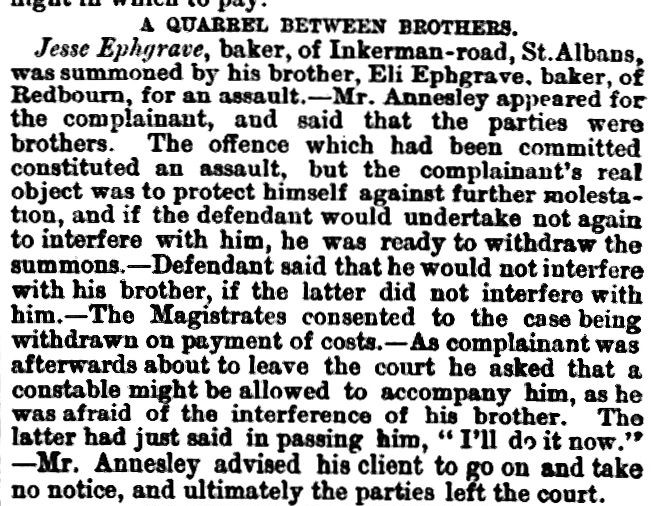
Herts Advertiser, 14 May 1844 (British Newspaper Archive at FindMyPast)
4 Inkerman Road is now a building (Google maps) that looks out of place in the street of red brick bay windowed cottages, said by estate agents to have been built around 1860; it is rendered and has a larger front garden than the others, and two side buildings. I don’t know if that is its original configuration or whether this is a much newer or altered property. And in any case, house numbering often changes over time, so this may not be the same building occupied by the Ephgraves.
Inkerman Road continued to be their home for a few more years. A son, George, was born in 1885, followed by a daughter in 1888. Sadly, Louisa also died as a baby, aged just nine months, on 2 February 1889.

Extract from death certificate for Louisa Ephgrave, 1889 (GRO)
Her death was due to tubercular disease of the lungs and intestines. Her mother registered her death. Four months later, another daughter, Ellen Ephgrave, known as Nellie, was born.
If quarrels with his brother weren’t enough, children and money both seem to have caused difficulties for Jesse; on 29 November 1884, the Herts Advertiser lists him amongst parents who had not paid fines levied for non-attendance at school. Not long after the birth of Ellen, on 2 November 1889, ‘Jesse Ephgrave, Inkerman Road’ is listed again for the same offence.
The 1870 Education Act was a first step in establishing compulsory education for all children, which became compulsory from 1876, before the majority of the Ephgrave children were of school age. Parents still had to pay, however, and many refused to send their children to school. In 1881, school fees were abolished and all children aged between 5 and 10 years old had to go to school. Although they didn’t have to pay for school places, Jesse and Harriet would still have had to source suitable clothes and shoes and take them to and from school – which may have impacted too much on Jesse’s and Harriet’s working days. With a growing family, ends clearly did not meet.
A return to Redbourn
Jesse’s mother Mary Dexter died in 1884 and her widower, Edward Thomas Dexter, master baker of Redbourn, married widow Jane Huckle the following year. However, by the 1891 census, he is working as a dairyman, an occupation which he continued for at least the next two decades. Photographs and captions at the Herts Memories website show subsequent generations of Dexters managing milk herds and a dairy at Mansdale Dairy | Redbourn Work Groups, Redbourn Places | Herts Memories.
His stepfather’s retirement may have provided Jesse with an opportunity for change. By 1891, he and their six younger children, aged 1-14 years are enumerated at High Street, Redbourn. He is once again described as a baker, rather than a journeyman, although the family of eight are living in a house with only four rooms, so space was limited. Another move may well have prompted Jesse to return to Redbourn; his brother Eli, who had worked as a baker and corn & flour dealer at High Street, Redbourn had, by 1891, moved with his growing family to Shoreditch, London.
Jesse and Harriet’s two youngest children were born in Redbourn: Rose in 1892 and Bertie in 1894. By then, Harriet was 43 years old. Bertie was their last child and, sadly, the fourth to die in infancy. His death certificate gives his age as 17 months, but as his birth was registered in the first month of 1894, it’s more likely he was a few months older.

Extract from death certificate of Bertie Ephgrave 1895 (GRO)
He had been suffering from chronic inflammation of the liver for 5-6 months prior to his death, and bronchitis for six hours. His mother registered his death; she could still not read and write, and makes her mark in the register.
Jesse and Harriet continued to live at High Street, Redbourn for the next two decades, their surviving children gradually growing up and leaving home for work and to marry. Jesse is variously described in records as a journeyman or master baker, so his fortunes may have fluctuated during that time. By 1911, after almost 40 years of marriage, Jesse and Harriet are still at High Street, he working as a baker and their two youngest daughters, Nellie and Rose, still living at home, both working as machinists at a waterproof clothing factory.
The Lloyd George Domesday Survey at The Genealogist has a description of properties on High Street Redbourn. Jessie [sic] Ephgrave is shown as the occupier of a cottage, its description identical to that below:
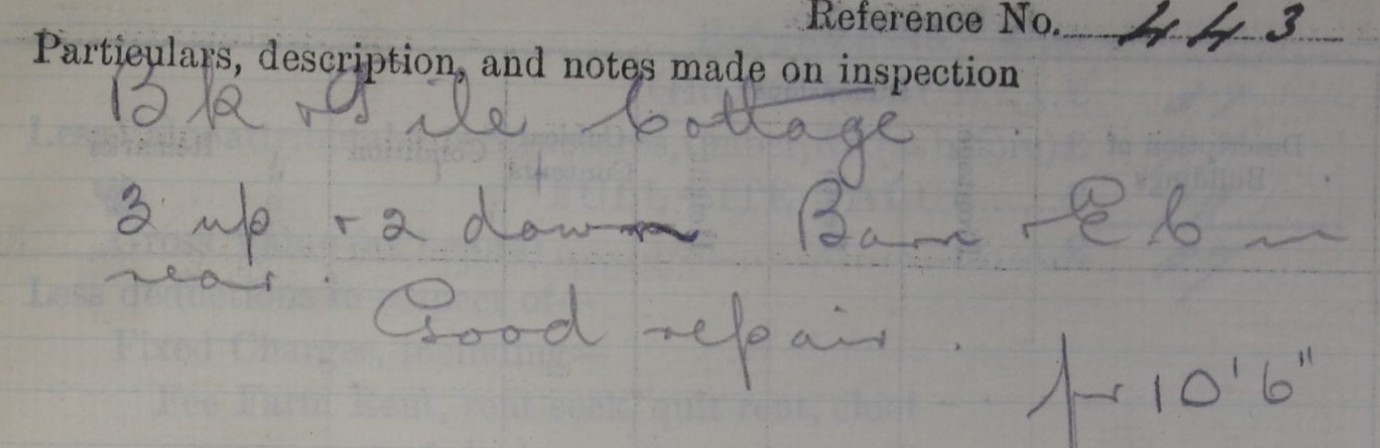
Extract from Lloyd George Domesday Survey (The Genealogist) Ir58_71516_0175
It was a brick and tile cottage, three [rooms] upstairs and two down, in good repair. I am unclear on the rest of the description, which looks like ‘barn and E… in rear’. The map related to the properties shows that they were situate close to the corner with Fish Street (the green-coloured marker pin to the left and below the word ‘Inn’ at the top border of the map):
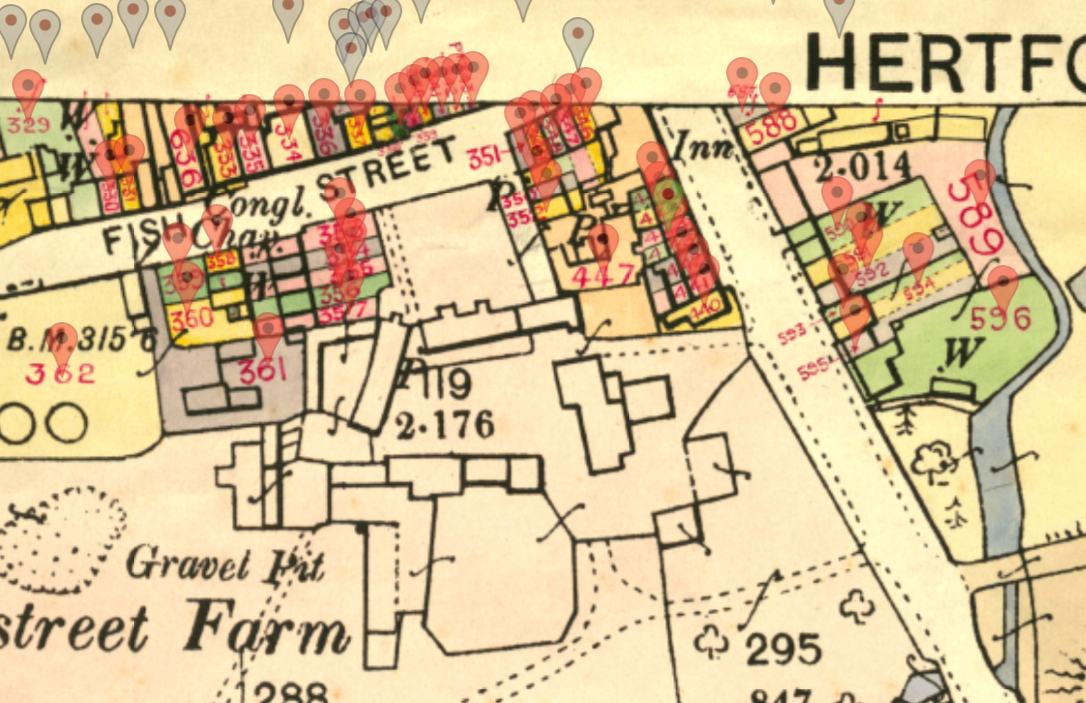
Extract from field map, Lloyd George Domesday Survey, property ref: 444
On the corner now (Google maps) is what used to be an inn (possibly the one marked on the map, which has had several names, most recently, since 1877, The Railway). Alongside are some narrow-fronted terraced cottages, which may well have been where Jesse and their family lived.
Later life in Luton
FindMyPast has electoral registers that show Jesse Ephgrave registered to vote at High Street, Redbourn, in 1914 and 1915. None of the family’s sons saw service in WW1 as far as I have been able to find out; they were all at least in their mid-30s by then, with some in their early-mid 40s. The family will not have been exempt from the impact of War, as many of their neighbours and extended family will have served, some not returning, others coming back mentally and/or physically scarred.
The Herts Memories | Gateway to Hertfordshire’s community archive network website has a photograph taken on 3 September 1916 of a number of Redbourn villagers looking at a bomb crater left by a Zeppelin. Perhaps Jesse joined them to review the damage.
However, at some point before the end of WW1, he and Harriet had moved back to her home town of Luton. Her parents and siblings were long dead, but perhaps the lure of steady work brought the return. In the 1918 electoral register (Ancestry), he is listed at 6 Wimborne Road, Luton; they are still there at the time of the 1921 census. All their children have left home, so it is just the two of them, by now almost 70 years old. Jesse remarkably is still working as a baker. His employer is the Cooperative Society, Manor Road, Luton.
Wimborne Road still stands, although no. 6 appears to have been demolished. The rest of the street is lined with red brick terraced cottages; the Co-op in Manor Road, which is also still there, would be a good half hour walk away, although buses may well have been available to shorten the trip.
I do not know how much longer Jesse continued to work. When he died, aged 73, in 1926, he is described as formerly a baker (journeyman), his ‘master’ title no longer applied.

Extract from death certificate for Jesse Ephgrave (GRO)
He died at home at 6 Wimborne Road, Luton, on 11 May 1926 following a cerebral haemorrhage. His married daughter Clara Lamb registered the death, giving her usual address as 32 Ferndale Road, Luton. It seems that, after her husband’s death, Harriet went to live with Clara and her husband Allan Lamb, a metal pattern worker (they had married in 1913), by then in their mid-late 30s with no children. Harriet died at 32 Ferndale Road, Luton on 10 September 1931, at the venerable age of 80, of senility.

Extract from death certificate for Harriet Ephgrave (GRO)
Clara registered her mother’s death. Her parents were married for over 50 years and, despite financial struggles and the loss of four children, raised the survivors of their baker’s dozen. They may not have gone to school when they should, but all were literate in adulthood. What happened to them?
That will have to be another story.
Main Sources:
- Birth and death certificates (GRO)
- Marriage records (Ancestry)
- Baptism records (Ancestry)
- 1871-1921 censuses (Ancestry, FindMypast, The Genealogist)
- Lloyd George Domesday Survey (The Genealogist)
- Street maps and views (Google Maps)
- Old photos (Luton Memories)
- British Newspaper Archive (FindMyPast)
 My Stocking Roots