My 2xgreat grandfather was born in Redbourn, a small historic town in Hertfordshire. His father, a baker, died when he was six and he was brought up by his mother and stepfather – also a baker. He followed the same often financially precarious trade for at least 50 years; but what was his childhood like? And what happened to his grandmother’s legacy?
A baker’s boy
Jesse was born on the last day of May 1852 to Frederick Ephgrave, a baker, and his wife, formerly Mary Hedges, at Mount Pleasant, in the Hertfordshire village of Redbourn.

Extract from birth certificate of Jesse Ephgrave 1852 (GRO)

This 1878 map from Redbourn VIllage Online shows Mount Pleasant as part of an area bordering Redbourn Common. Elsewhere on the website, it is suggested that ‘Mount Pleasant’ was the name given to a row of houses on East Common, occupied by Irish immigrants fleeing famine in the 1840s. There are modern photos of what may have been these so-called ‘dirt houses’ on the site. Clearly, by the 1850s, other occupants had moved in.
Jesse’s parents had married just over a year earlier, on 14 May 1851, in Redbourn’s parish church.
The 1851 census, taken in March that year, finds his father, Frederick, at the 140 acre Hearn’s Farm, Gustard Wood, Wheathampstead, with his parents, described as ‘Farmer’s son’; Mary meanwhile was lodging at Chequer Street, St Albans, where she is described as a dress maker. She was originally from Redbourn, presumably why she was married from her home parish church.

Nigel Cox / Redbourn: St Mary’s Church
Redbourn’s history traces back to Saxon times. The parish church of St Mary was probably founded by a Norman bishop of St Albans, although it is thought a Saxon building once stood in the same general area. Faced with flint, it has a squat tower and although altered and added to in earlier centuries, it is said, on the Redbourn Village History site, that it has remained largely unchanged for the past 500 years. The box pews, however, were removed in the early 1850s and had perhaps already disappeared by the time Jesse was baptised there on 27 June 1852.
The Ephgrave surname often gives trouble with spelling, possibly because it was pronounced in a variety of ways (vis. my great grandfather’s middle name spelt Hipgrave); the vicar or parish clerk seems to have made a bit of a mess of the baptism register entry (extract below from FindMyPast), with corrections added later.

Extract from parish baptism register, St Mary, Redbourn, 1852 (FindMyPast)
Their marriage certificate shows that his parents could both at least sign their names, so would have been able to point out any mis-spelling if given sight of the register.
Family losses and legacies
Jesse’s birth was followed by two more children: Eli Ephgrave, born in April 1855 at Mount Pleasant, and Charles, born there in Summer/Autumn of 1857. Their paternal grandparents died around the same time: Thomas Ephgrave, farmer of Hearn’s Farm, Gustard Wood, died of consumption in October 1854 and his wife Elizabeth, of fluid around the lungs (hydrothorax) in April 1855. Their wills named their three surviving children as beneficiaries. On 19 May that year, the Hertfordshire Mercury and Reformer carried a notice asking that creditors of Elizabeth Ephgrave come forward to make claims against her estate, via the executors, Frederick, his brother Charles Ephgrave and their married sister Sarah Archer.
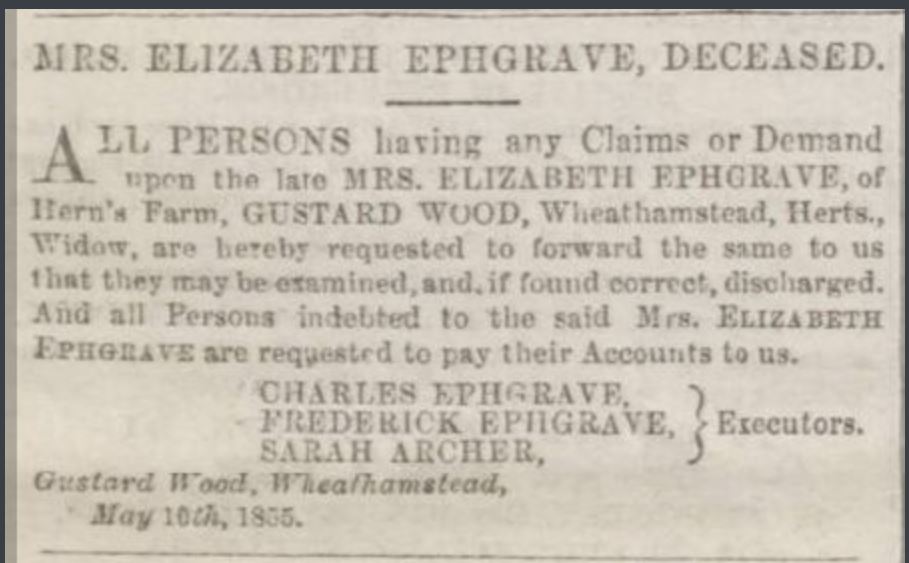
Extract from Hertfordshire Mercury and Reformer, 19 May 1855 (FindMyPast)
The farm was variously referred to as Hern’s, Hearn’s and Heron’s Farm. It still stands, as do three attached cottages which would have formed part of the farm estate. However, Frederick’s father Thomas Ephgrave would have been a tenant farmer, not the owner, and left his wife only his stock, farm implements, personal effects and money. She in turn bequeathed to her son Frederick Ephgrave (and his ‘heirs and assigns’ forever) two cottages in Gustard Wood” in the occupation of James Reeves and Robert Wright”, and an equal share of the residue of his mother’s estate, subject to payment of £10 each to his late brother John’s three children.
In the 1861 census, a cottage in Gustard Wood was still occupied by James Reeves, mentioned in Frederick’s mother’s will. He was a sawyer, living there with his wife and three children. Next door, on his own in a separate cottage, is Robert Wright, a Farm Labourer. The occupiers presumably continued to pay rent to the owner who, after his mother’s death, should have been Frederick Ephgrave.
St Albans council published a Conservation Area and Character Assessment document in 2020 (PDF) which includes the listed Heron’s Farm (dating to the 16th century) and associated cottages, with photos. See page 16 of the linked PDF. Elizabeth Ephgrave’s will mentions four cottages, and it is likely that she owned these separate to the farm and its cottages, which were tenanted.
Sadly, Frederick did not survive long to enjoy the legacy his mother left him, nor to see his sons grow up. He died on 28 September 1858 at Mount Pleasant aged just 31, of pneumonia and Typhoid fever. His wife Mary was left with three young sons aged 1-6 years, and heavily pregnant with a fourth. Frederick Ephgrave junior was born at Mount Pleasant on 22 November 1858, two months after his father’s death. Jesse was six years old. I do not know whether their grandmother’s two cottages – or the rental from them – passed on to the boys at some point. As far as I have been able to tell, their father did not leave a will. There is little evidence in later life of any extra income, with both Jesse and his younger brother Eli both facing bankruptcy in the late 1880s.
Childhood in Redbourn
There may have been some bright spots in Jesse’s childhood. Four months before his father died, in May 1858, an infant school was opened in Redbourn. I have not found any records of admission or discharge, so do not know if Jesse and his brothers attended. They may have found themselves “abundantly supplied with tea, bread and butter and cake” as part of the opening celebrations:

Extract from Hertford Mercury and Reformer, 15 May 1858 (FindMyPast)
I wonder whether some of the comestibles came from Jesse’s father’s bakery.
Further loss was to follow. Jesse’s two year old brother Charles Ephgrave died of pneumonia, like his father, on 4 September 1859. The family were still living at Mount Pleasant, but the informant was Charles’ uncle by marriage, John Archer, who lived with his wife Sarah, another of their mother’s legatees, in Harpenden.

Extract from death certificate of Charles Ephgrave (GRO)
A new chapter
I do not know if Jesse’s mother Mary continued her husband’s bakery business after his death. On 5 February 1861, she married Edward Thomas Dexter at Redbourn’s parish church. She was said to be 34 (actually 37), and was by then a widow with three sons under nine years old. He was 22, unmarried and a baker, originally from Market Harborough some 60 miles away in Leicestershire. His father is named as William Dexter, a Butcher.
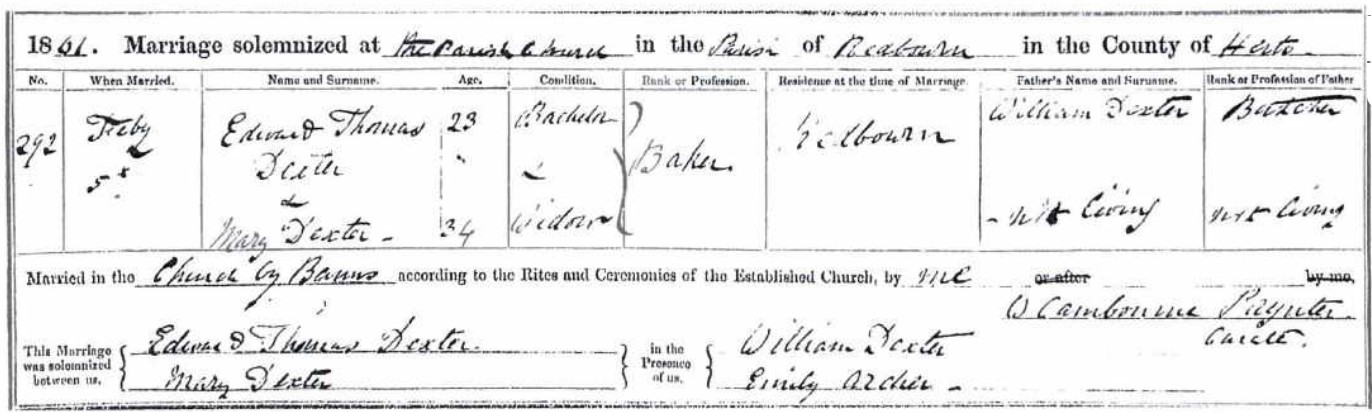
Extract from marriage certificate for Edward Thomas Dexter and Mary Dexter (GRO)
The banns had been called and published in the correct names, but this copy of the marriage register from the GRO has Mary’s surname as Dexter, not Ephgrave.
One of the witnesses was Emily Archer, Mary’s first husband’s sister-in-law. She was sister to John Archer, who had married Frederick Ephgrave’s older sister Sarah; they all lived in Harpenden and clearly kept in close contact after Frederick’s death. All the women were dressmakers, which may have provided an additional connection. Emily Archer was 25 at the time of the wedding; perhaps sister-in-law Sarah was tasked with looking after the boys for the day.
Did Frederick’s estate, such as it was, pass to his wife and through her to her second husband, by-passing her sons? Or would it have reverted to his brother and sister after his death? Or was there, perhaps, nothing to leave?
I have not found out much about Edward’s early years or how he came to meet Mary and marry her at Redbourn. The 1841 census shows an Edward Dexter, aged 3, living at High Street, Market Harborough with his parents, William, a butcher, and his wife Elizabeth. He has two younger brothers, William and John, aged 2 and 1 respectively. The 1851 census appears to show the same young boys, aged 12, 11 and 9, all from Market Harborough, as paupers in the Watford Union Workhouse. I do not know what happened to their parents, but I presume they must have died before 1851. A William Dexter is another of the marriage witnesses and is likely to be Edward’s brother, by then 21 years old.
Edward may have been apprenticed to a baker by the overseers of the poor, perhaps even to Mary’s husband. He would have been just 20 when Frederick died and could have carried on the business. All of this is pure speculation, but later records show that the young Edward was regarded as a father figure to his stepsons.
The 1861 census was taken just a month after the wedding. Enumerated at Mount Pleasant, Redbourn are: Edward Dexter, baker; Mary Dexter, baker’s wife; ‘Jessy’ Ephgrave, 9; ‘Eliza’ Ephgrave, 5 and Frederick Ephgrave, 2. The children are clearly Edward’s stepchildren, but are described as ‘sons-in-law’ (although Eli has become Eliza and female in the copying of the original household schedule). Their near neighbours are agricultural labourers, straw plaiters, a carpenter and workers at the Redbourn silk mill. A few families have children of a similar age to Jesse and his siblings.
On 23 March 1862, Mary Dexter gave birth to another son, named after his father. Jesse was just shy of his tenth birthday.
By the time the 1871 census was taken in March that year, 19 year old Jesse has left home and is working as a journeyman baker in Luton, where he met straw plait sewer Harriet Scrivener. Their first son, my great grandfather Frederick Hipgrave Scrivener, was named after his father. Their second (and first legitimate child) was named Edward Thomas Ephgrave after Jesse’s stepfather. They had a total of 13 children together, a baker’s dozen.
In 1879, Mary’s first husband’s uncle, George Ephgrave, named her in his will, bequeathing her £19.19s. Mary herself died in 1883; although the married women’s property act came into force two years earlier, there is no evidence she took the opportunity to purchase any, nor that she left a will. Any legacy that Frederick Ephgrave may have inherited from his mother seems to have disappeared.
Main Sources:
- 1841-1891 censuses (Ancestry, FindMyPast, The Genealogist)
- Parish baptism, marriage and burial records (Ancestry, FindMyPast)
- Birth, marriage and death records (FreeBMD, GRO)
- Probate records and wills (National probate register, Discovery – TNA)
- British Newspaper Archive (FindMyPast)
- Redbourn Village website
- Herts Memories website
- Geoff Webb Redbourn picture archive
 My Stocking Roots