I am often distracted from my research by people tangential to my family history. One such is Benjamin Looker, father-in-law of my great grand uncle William Ephgrave. He was a much-married London coffee house keeper, Hertfordshire publican and son of a London ‘ruby hole maker’ (watch jeweller). I became rather obsessed with trying to fill gaps in the fragments of their lives. This first post of 2026 shows what I found.
The marriage of William Ephgrave and Annie Louise Looker
My great grandfather Frederick Ephgrave was born illegitimately in Luton in 1872, moved to London Colney in Hertfordshire to train as a baker in his late teens but then moved to Islington in London where he worked in the dairy industry for several decades. He was the eldest of 13 children, only nine of whom survived. It was research into the life of his younger brother William Ephgrave which first brought Benjamin Looker to my attention.
William was born in St Albans in 1878 and moved with his parents to his father’s home village of Redbourn, Hertfordshire, around 1891, when he was about 13. By the 1901 census, he has joined his two older brothers at Culford Road, Islington. He is working as a carman and living with Frederick Ephgrave at 174, a few doors along from the site of the large dairy where the latter worked as a milk sterilizer. William perhaps also worked for the dairy. Not long after the census was taken, William Ephgrave married Annie Louise Looker in the village of London Colney on the outskirts of St Albans in Hertfordshire. All nice, straightforward facts and figures to add to my tree. And this is where I got distracted.
The lure of a London coffee house
At the time of the 1901 census, William’s bride-to-be Annie Looker was working as a general domestic servant in the household of a Mr Hawes, wine merchant, in St Albans. However, research into her life revealed that, when she was baptised with her two older sisters at the historic church of St Botolph without Bishopsgate in the city of London on 12 June 1881, her father had the unusual occupation of coffee house keeper at 28 Bevis Marks, in the historic parish of Allhallows (see map below).
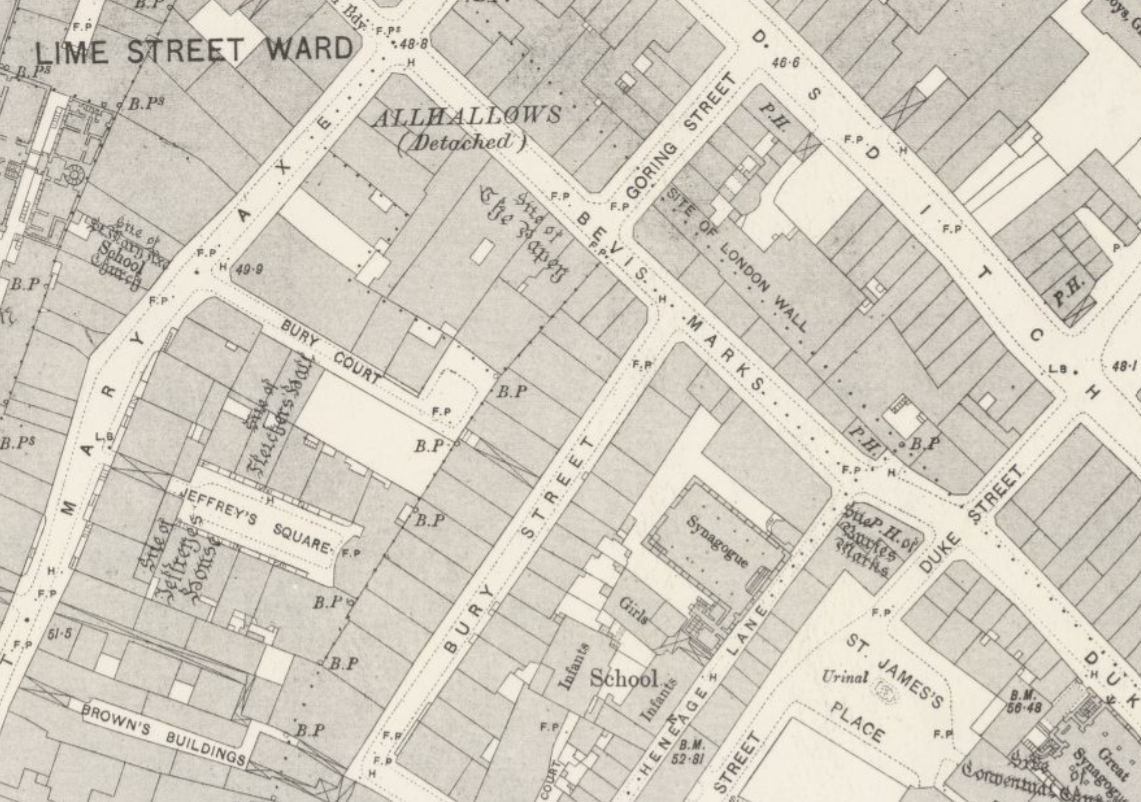
OS Map London – London VII.66 Revised: 1894, Published: 1896.
Published with the permission of the National Library of Scotland.
From warehouseman to coffee house keeper?
The map above shows Bevis Marks running parallel to the site of the ancient London Wall. Britain’s oldest continuously functioning synagogue is accessed from the street, which is now lined with skyscrapers and glass-fronted office blocks. ‘The Gherkin’ is nearby on the corner of St Mary Axe; when I worked in London, our offices were not that far away, near Chancery Lane.
London Land Tax records at Ancestry show 28 Bevis Marks as a house ‘in the occupation of Benjamin Looker’ from 1878 (his name was added to no. 27 in 1879) until about 1884. Later records refer to both properties as ‘site of house, late in the occupation of Benjamin Looker’. From 1883, No 25 was occupied by Solomon H Schwersee, no 26 was ‘pulled down’.

Extract from London Land Tax Records 1878 (Ancestry)
This city of London character assessment of the Bishopsgate area (PDF) gives a sense of the history of the area, and how its character and social mix have changed over time. The London Picture Archive has a much later photo (said to be 1911) which shows S H Schwarsee’s jewellery manufactury at no 25.
The Post Office Directory for London published in 1880 (Ancestry) lists Benjamin Looker at 28 Bevis Marks, the property listed as ‘Dining Rooms’. The role of the coffee house had changed significantly from its early years in the 17th and 18th centuries. It is likely that Looker’s coffee house and dining rooms offered basic food and drink for the artisans, labourers and commuters of the area.
In the 1871 census, no.28 is occupied by Jacob Apfel, an importer of fancy goods from Germany (who is later shown at no. 30 on Land Tax Records, as above). So when did Benjamin move in, and when did he open the coffee house there?
Did fatherhood and marriage prompt a change?
Further research into Benjamin’s life revealed a possible clue to timing and Benjamin’s changing circumstances. On 29 April 1876, his son Benjamin Norman Looker was born. The child’s mother ‘Mary Ann Looker, formerly Norman’ registered the birth, giving the family address as 32 Harman Street, Haggerston (Shoreditch). At the time, Benjamin’s occupation is recorded as warehouseman.

Extract from birth certificate of Benjamin Norman Looker 1876 (GRO)
Harman Street was in a densely populated area of Shoreditch, close to the workhouse.
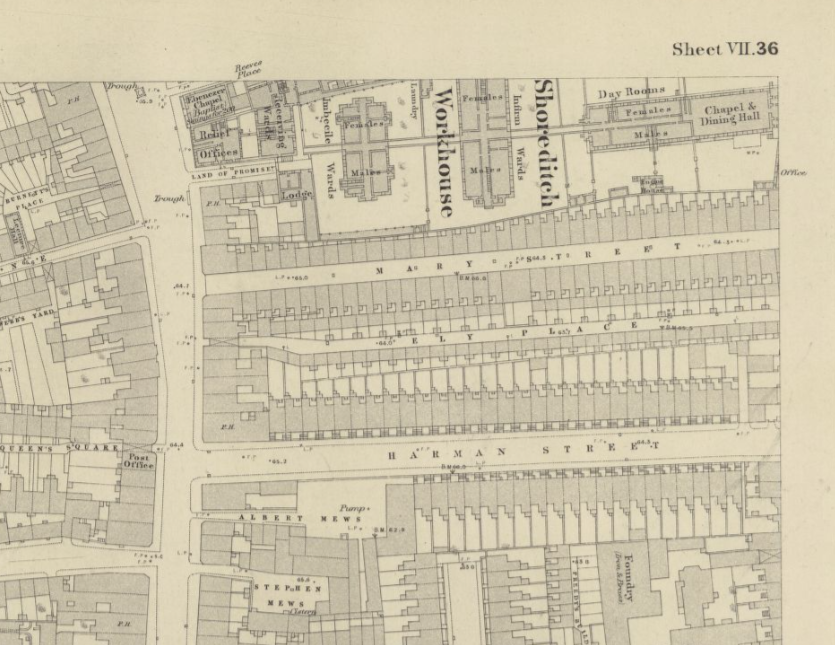
Extract from OS map London – Middlesex VII.36 Surveyed: 1872, Published: 1875. Published with permission of the National Library of Scotland
Despite the birth registration details, Benjamin and Mary Ann Norman did not marry until around a year later, in Holborn, in the Jul-Sep quarter of 1878. Before then, they had another illegitimate child:

Extract from birth certificate of Elizabeth Mary Ann Looker 1877 (GRO)
By this time, they are living at 28 Bevis Marks, but Elizabeth’s father is described as a dock clerk – nothing to do with any form of catering. This may have been a step up from warehouseman, and Benjamin may have opened the coffee house shortly after. Another child – legitimate this time – was born at 28 Bevis Marks on 25 May 1879, her father now recorded as coffee house keeper.

Extract from birth certificate of Florence Edith Looker 1879 (GRO)
At the time of the 1881 census, Benjamin Looker is recorded as a 50 year old, Islington-born coffee house keeper at 28 Bevis Marks, with his wife ‘Maria’, 37, and their daughters ‘Eliza M’, aged 3 (Elizabeth Mary Ann), Florence, 2 and ‘Any’ [Annie] just three months. The girls were all born in ‘City’. They have a general servant, a kitchen maid and waitress helping in the business. A nurse maid lived in and presumably helped Mary Ann look after the three young girls. There were also two male lodgers, a vellum binder and a cigar maker; renting rooms perhaps helped make ends meet. There is no sign of their son, Benjamin Norman Looker, who would have been five years old. Sadly, he died aged three in the last quarter of 1879, so shortly after sister Florence’s birth.
Annie Louise Looker was born on 10 January 1881. The girls were all baptised on 12 June 1881; perhaps Benjamin and Mary Ann didn’t feel comfortable telling fibs about their children’s legitimacy in church, although they showed no such compunction when registering their births. This probably means that young Benjamin Norman Looker died in 1879 without being baptised.
Benjamin does not seem to have stayed long at Bevis Marks. On 13 September 1884, the Herts Advertiser carried a report that the license of The Swan Inn, London Colney, had temporarily been transferred to Benjamin Looker. The same paper confirmed the permanent transfer a week or so later.
From coffee to beer – and another Ephgrave connection
It seems that intoxicating liquor and a village lifestyle were more appealing to Benjamin, with his growing family. The Swan Inn public house was one of several in the large village of London Colney, near St Albans in Hertfordshire. Hertfordshire Genealogy suggests that the pub was originally a coaching inn, and cites references dating back to the 17th and 18th century (by which time it had stabling for 70 horses). In 1880, the village had a population of 843. This later photo of the inn shows that dinners were provided, and a horse & trap could be hired. So perhaps Benjamin’s dining experience in Bevis Marks stood him in good stead.

Image taken from Hertfordshire Genealogy
(Picture & background information kindly provided by Arlene Wright)
On 27 May 1887, Benjamin’s wife Mary Ann died, as the notice, below, from the Herts Advertiser of 4 June 1887, shows:

Extract from Herts Advertiser, 4 June 1887 (FindMyPast)
The National Probate Calendar records that she died at The White Swan and that administration of her personal estate of £500 was granted to her widower, Benjamin Looker, publican.
A stout lady causes damage to his dog cart
The Herts Advertiser of 29 March 1890 describes a case brought by Benjamin Looker, publican, against Henry Pike, tobacconist, for damage to his dog cart. It seems he hired the cart (as still advertised in the photo above) – and his ‘boy’ to drive it – to Mr Pike who, on returning from St Albans, decided to take the reins himself. He gallantly offered a ride to ‘a stout woman’ who weighed 16 or 17 stone. As she alighted the tail board of the cart, her weight broke the shafts clean off. Damages of £2 were granted, amidst much laughter in court.

Extract from Herts Advertiser 29 March 1890 (FindMyPast)
The following year, the 1891 census finds Benjamin still as a licensed victualler, still at The Swan Inn. His three daughters are at home, including ten year old Annie, and there is a servant and ostler helping out. A few doors away, my great grandfather Frederick Ephgrave is shown as an 18 year old baker’s assistant in the household of Edward Parsons, baker. Perhaps Fred’s younger brother William visited him there, and met his future bride-to-be?!
A man of many marriages
By 1901, Benjamin has a new wife, 47 year old Elizabeth, from Chelmsford in Essex. The Herts Advertiser once again documents this next stage in his life:

Extract from Herts Advertiser, 21 December 1889 (FindMyPast)
A transcript of the parish marriage record at FindMyPast shows that they married on 17 December, the groom being 55, the bride 40 (although more likely 57 and 45). Benjamin’s father is named as William Looker, while Elizabeth’s is Benjamin Turner. Both parties were widowed. Unfortunately, the marriage was short. Elizabeth died in the last quarter of 1894 (FreeBMD); the local newspaper was this time silent on the matter, as it was on Benjamin’s next marriage, to Ellen Hammond in the last quarter of 1897.
The 1901 census for London Colney suggests that Benjamin is still licensee of The Swan Inn. By then he was 70 years old; wife Ellen, from Ramsbottom in Lancashire, is 57 and daughters Elizabeth and Florence (both shown as born at Bevis Marks) are still living at home. Annie, as we know, was working as a servant in St Albans for a wine merchant – perhaps a contact made through the pub.
Around 1903, T Wright, shown in the photo above, took over the license of the Swan Inn, and Benjamin Looker transferred to the Green Dragon in London Colney, which is still trading as a pub today (CAMRA website). On 27 September 1906, five years after his daughter Annie married William Ephgrave, ‘much respected’ Benjamin Looker died at the Green Dragon.
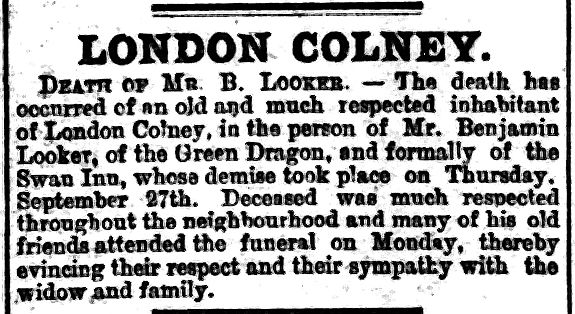
Extract from Herts Advertiser 6 October 1906 (FindMyPast)
It seems that he had made his mark in the village in the two decades he had lived and traded there. The National Probate Calendar shows that his effects amounted to £1322 12s 2d, with probate granted to his widow, Ellen Looker.
Benjamin’s story doesn’t quite end there though. From the above, it seems that Ellen was Benjamin’s third wife, but trying to trace him in earlier censuses revealed another likely marriage, widowhood and loss of at least one other child.
Benjamin’s early years and first (?) marriage
We know from Benjamin’s marriage to widow Elizabeth Hancock in 1889 that his father was named William Looker. The 1841 census shows a nine year old Benjamin Looker, son of William, a watch jeweller, living at 1 Halton Place, Islington, with three siblings. His father’s wife is named as Ann (she was 22 to his 57), the children’s stepmother. Benjamin’s baptism record from 30 January 1831 names his parents as William and Hannah:
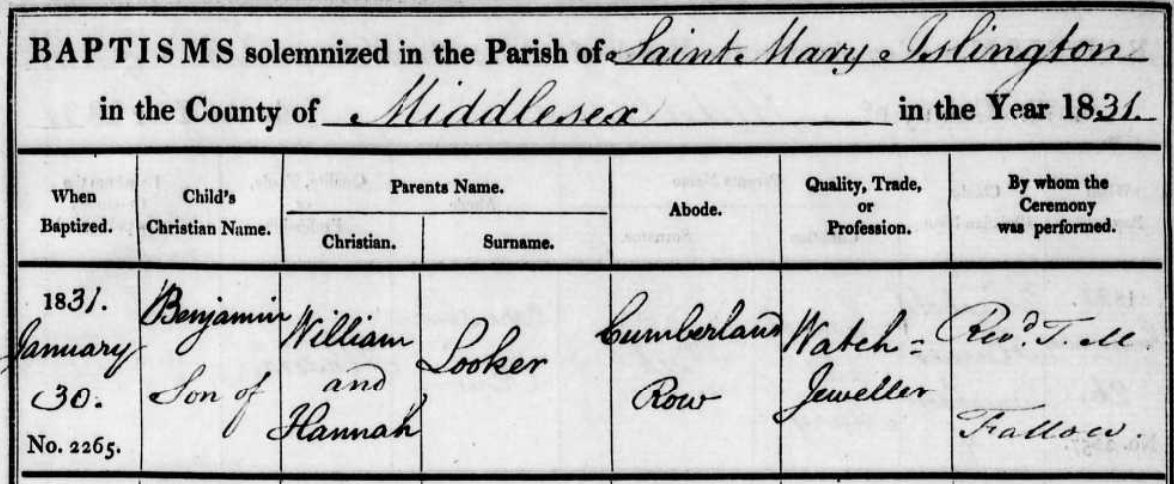
Extract from baptism of Benjamin Looker, St Mary Islington, 1831 (Ancestry)
William had four children with his wife, formerly Hannah White, although only Benjamin and a sister Hannah survived infancy. They married in 1827 when William would have been in this 40s, so this may have been a second marriage for him. Hannah herself died in 1838, when Ben was seven, and his father married Ann Fuller in 1844 – although the 1841 census suggests they were already living as man and wife. An example that his son Benjamin appeared to follow. That marriage record, by the way, showed that William Looker was the son of another William, an excise officer and his bride was the daughter of a surgical instrument maker. More trails I’d have liked to follow, but I have to draw the line somewhere. They’re not even family!
Back to Benjamin, who is a bit more closely related, albeit by marriage. I initially failed to find him in the 1851-1871 censuses despite searching across FamilySearch, FindMyPast, Ancestry and The Genealogist. He was not with his father and stepmother, who are still at 1 Halton Place in 1851, where William’s occupation of ‘watch jeweller’ has become ‘ruby hole maker’ – presumably he drilled holes in precious stones for use in pocket watches. By then, Benjamin would have been around 20 years old, and had four young step-siblings. Perhaps he felt it was time to make his own way in the world, but where?
Clues to his first marriage and census (mis)transcriptions
Benjamin’s name as ‘second beneficiary’ came up in search results at FamilySearch for the estate of Thomas Burt. Being able to search for beneficiaries as well as testators/deceased is a feature of which I was unaware, and proved very useful in piecing together Benjamin’s earlier adult life.
Thomas Burt, seaman ‘late of HMS Forte’, who died at sea in January 1864, named his ‘sister and next of kin’ Elizabeth Looker, ‘the wife of Benjamin Looker’, as first beneficiary. The couple’s address is shown as Rosemary Street, Rosemary Branch, Islington. Could this be the same Benjamin Looker, with an earlier wife? It seemed likely, but where were they before 1864?
There is a marriage record for Benjamin Looker and Elizabeth Burt at Ancestry (brief transcript only) on 4 January 1857, at St John the Baptist, Shoreditch. They had a daughter, Elizabeth, born in 1859 (who died the same year). There are other Looker children in the GRO’s indexes, with mother’s maiden name BIRD, which could be a mis-hearing of BURT, but I haven’t ordered their birth certificates to check (William, Louisa and Richard, all born between 1861-1868).
An Elizabeth Looker died in Shoreditch in the last quarter of 1870, aged 39.
I decided to do a last-gasp broad search of the censuses at FindMyPast, entering just the first name Benjamin, birth year 1831 and location within five miles of Islington. To my delight, I found Benjamin Looker in the 1861 census, a 30 year old Middlesex-born warehouseman at 58 Newtown Street, St Leonards, Shoreditch. With him is wife Elizabeth, also 30, born in Bedford and working as a straw bonnet sewer (like so many of my Ephgrave ancestors). Their surname has been left blank in the transcription, even though it’s fairly legible on the digitised census page, which is why earlier searches had failed to find them. They have no children; daughter Elizabeth Looker had died two years earlier, and son William (if indeed he was their child) would not be born until later in 1861. Does this all add up to being the correct couple?
Well, I found Elizabeth Burt, aged 20, in the 1851 census, a bonnet sewer from Bedford, but lodging at 27 New Town Street, Luton. In 1841, aged 11, she was at home at Pepper Alley, Bedford, with her widowed mother, who was a charwoman, and four siblings, including Thomas Burt, aged 5 (b 1836).
HMS Forte, aboard which Thomas Burt was a seaman when he died on 7 January 1864, was a frigate commissioned in 1858. The ship spent 1864 off the south east coast of America, and many days’ sickness and several fatalities from disease were recorded (Naval Database via RootsWeb), including:
Fevers.- Seventy-four cases of primary fever were under treatment, of which four had a fatal termination. Two-thirds of these cases occurred on board the Forte.
No names are recorded, so I do not know if Thomas Burt was one of those who succumbed to fever, or if he died of some other cause. He would have been about 28 years old.
Just to tie up loose ends, I ordered the birth certificate for baby Elizabeth:

Extract from birth certificate for Elizabeth Looker 1859 (GRO)
They are at a different address again (47 Gopsall Street, Hoxton Old Town), and Benjamin’s occupation is a packer journeyman – so he was seeking daily casual work at warehouses and factories as a packer.
That just left me to find out what happened to Benjamin after he was widowed for the first time. A Benjamin Lewkt (!), widower, aged 40, born in Islington and working as a warehouseman was living at 10 Newtown Street at the time of the 1871 census. Another transcription error which had confused the trail in earlier searches. There are no children living with him, so the three children with MMN Bird may not have been his or may have died. But I should probably not keep trying to confirm that.
It’s been fun following the twists and turns of this Islington man, father-in-law of my great grandad’s brother, through four marriages, the loss of three wives and at least two children, and from humble casual labouring in warehouses to being a well-respected, long-serving publican. I wonder how much of it all Annie Looker and the Ephgrave family into which she married knew about Benjamin’s history?
Main sources:
- 1841-1901 censuses (Ancestry, The Genealogist, FindMyPast, FamilySearch)
- National probate calendar (Ancestry, FindMypast)
- England and Wales, National Index of Wills and Administrations, 1858-1957 (FamilySearch)
- National Library of Scotland maps collections
- Birth and death certificates (GRO)
- Birth, marriage and death records (Ancestry, FindMyPast, GRO)
- Parish baptism records (Ancestry)
- British Newspaper Archive (FindMyPast)
- London Land Tax Records (Ancestry)
- Hertfordshire Genealogy
- London Picture Archive
- Post Office directories (Ancestry)
 My Stocking Roots