The fourth of my great grandparents’ 13 children, Arthur grew up in St Alban’s but raised his own much smaller family in Luton following a brief stay in London. He worked in two of Luton’s major industries before and after WW1 service, but finished his working life at Vauxhall’s Motor Works. Intriguingly, his wife appears to have had a blind sister and a brother who, after a spell in a truant school in London, seems to have joined the militia, then worked for much of his life in India. After much research, I am still not sure that I have got to the bottom of these family puzzles. See what you think.
A change in family fortunes
Arthur was born on 9 September 1876 at Albert Street in St Albans, Hertfordshire. His parents had 13 children but only nine survived. His father Jesse was a master baker who grew up in the nearby village of Redbourn, but who had moved to Luton and then St Albans in his twenties to find work, and that is where he and his wife raised their large family.
The family’s fortunes seem to have taken a turn for the worse around 1884, when Arthur was eight years old. His father was no longer a self-employed baker, but a ‘journeyman’, looking for employment with other bakers. It was around this time that Jesse was brought to court by his brother Eli, also a baker, for assault; no details were given in the newspapers of the time, and the case was settled by Jesse agreeing to pay costs and, begrudgingly, not to interfere with his brother. I wonder how much of the feud between the two bakers impacted on young Arthur?
By 1891, his uncle Eli Ephgrave had left Redbourn, and Arthur’s parents had moved there to make their home on the village High Street. 14 year old Arthur was the oldest child living at home on census night, but doesn’t seem to be in work. Their High Street neighbours were a mix of tradespeople, shopkeepers, artisans, labourers and even those living on their own means. The Ephgraves lived towards the top end of High Street, towards the corner with Fish Street, according to the Lloyd George Domesday Survey (The Genealogist). This postcard view from 1904 may show their cottage amongst those on the right, opposite the Red Lion Inn.
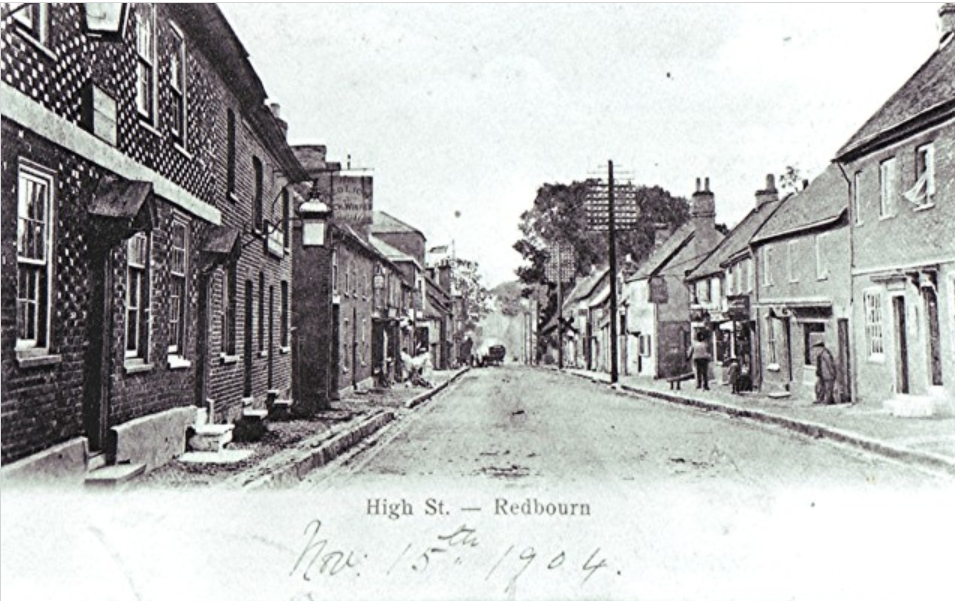
Postcard of Redbourn High Street, Geoff Webb Collection, Herts Memories
Marriage, Luton to London and back, and war
Aged 21, Arthur married Rose Tomlin, who grew up in Luton, on Christmas Day 1897, a rare holiday for poor working people and a common date for weddings. The transcript of the marriage entry at FindMyPast confirms their fathers’ names and the couple’s ages: he was 21, she was 20. Unlike her husband, Rose was already in work in 1891, aged 14, as a domestic servant. She was living with her parents and siblings at Windsor Street, Luton on census night. I have found no clue as to how the couple met.
Arthur’s and Rose’s daughter Lillian May Ephgrave was born on 22 September the year after their marriage, her birth registered in Luton. Had they set up home there, or had she turned to her mother for help with the birth of her first baby? I had difficulty tracking down her five surviving siblings, and am still not sure I have all their stories correct. But at the time of her daughter’s birth, two of her sisters had already left home to marry, one appeared to be living in an asylum for the blind in Bristol, and her only surviving brother seems to have been an inveterate truant from childhood, in and out of reform institutions from the age of ten. But more on their stories later.
If they had set up home in Luton on marriage, they did not stay too long. The 1901 census finds Arthur and Rose living at Culford Road in Hackney, working as a bottle washer. The census enumerator has added ‘cellar’ to his occupation, suggesting that he perhaps worked in a pub. Culford Road was also home to two of his brothers, my great grandfather Frederick Ephgrave who was working as a milk sterilizer for a London dairy in the same street, and their younger brother William, who drove lorries, possibly for the same company. Their daughter Lily was enrolled at Tottenham Road School by 1902, the admission register recording the family address as Balls Pond Road. However, by the time their second daughter Ivy May Ephgrave was born in early October 1905, the family had moved to Arthur’s home town of St Alban’s. Rose’s father had died in Luton in 1903, and her mother had followed in June 1905; it may have been these family events that prompted their departure from London. Arthur’s parents were still living in nearby Redbourn but some of his siblings and at least one of Rose’s sisters were also in Luton at that time.
I don’t know what work Arthur may have been doing during this time. A bottle washer’s wage was unlikely to have been sufficient to support a family. By the time the 1911 census was taken, he is working as a hat blocker in Luton’s once extensive but by then dwindling straw hat trade, and living with his small family at 3 Waldock’s Yard, Luton.
Arthur and Rose had been married 17 years by the time WW1 broke out, and Arthur was approaching middle age. There are, however, military records which suggest that he joined the Royal Army Medical Corps in 1914, and served for the duration of the war. Private 479080 (later 1960) Arthur Ephgrave saw service in Egypt from 1915 and is recorded twice in field hospital registers, admitted for severe enteritis and ‘aural issues’. He features in absent voters’ lists at 120 Langley Street, Luton in 1918 and 1919 and is enumerated there at the time of the 1921 census with his wife and two daughters.
After demobilisation, it seems he secured a job with one of Luton’s major employers, the Vauxhall Motor Works, where he was a sandblaster – perhaps in the bodywork department. By then, Luton’s long-established straw hat trade was diminishing, and Vauxhall’s had taken over as one of the town’s largest employers. The war had halted production, and post-war demand for civilian cars was high. A waiting scheme was in effect during the war years, as this advert shows:

Its closure in March 2025 marked the end of 120 years of vehicle production. https://www.vauxhallregister.com/made-in-luton.html has adverts (above) and photos of the works and cars produced after WW1, which Arthur may have worked on.
His wife and eldest daughter are both described as ‘straw workers’ in the 1921 census; they are both out of work, their previous employer being Wheeler & Leete, Williamson Street. Younger daughter Ivy is working as a shop assistant for Marks & Spencers on George Street.
In 1923, Lilly May Ephgrave married Richard Bunker. He had also served in WW1 and may have been one of her father’s workmates, as he is shown as out of work in the 1921 census, but having last worked for Vauxhall Motors. He was working in Vauxhall’s Inspection Department at the time of The 1939 Register. Her younger sister Ivy May married Albert Edward Hyde in 1927 and he may also have worked for the motor company; in 1939 he is described as a grinding machine setter. Neither marriage appears to have produced children.
Arthur’s wife Rose died in the last quarter of 1927, aged just 50, the same period in which her younger daughter married. From the mid-1930s, he and both his married daughters and their husbands were registered to vote at 120 and 118 Langley Street. As WWII broke, he was living with Ivy and her husband at Spencer Street in Luton, working as an engineering labourer, probably still at Vauxhall Motors. He died before the war was over, on 23 December 1943. Probate was granted to his daughter Ivy May Hyde:

Extract from national probate calendar (Ancestry)
Lily and Richard Bunker and Ivy and Albert Hyde lived in Luton for the rest of their lives, the last dying there in 1979.
Rose Tomlin’s dispersed family: A blind sister and truant brother?
From the bare bones of birth, marriage and death records, the censuses and scant military records, Arthur’s and Rose’s lives seem to have followed a fairly common pattern for their times. They seem to have been close to Arthur’s brothers, and their daughters stayed close to them too. Research into Rose’s early years, however, suggested that her childhood may have been troubled and that at least two of her five surviving siblings did not stay close to home at all.
Records show that her parents William Tomlin and his wife Annie (nee Brewer) had eight children in all, with two boys dying shortly after birth, when Rose was quite young. She was the fifth child. Newspaper articles at the British Newspaper Archive (FindMyPast) suggested that her father had been accused several times of poaching before and shortly after her birth, although he seems to have curtailed his criminal career later on (or at least, wasn’t caught).
For a long time, I failed to find any of the family in the 1881 census, although I knew, from the birth index records of their children, they were living in Luton before and afterwards. I finally found them at 17 Adelaide Terrace, where father William is a labourer, the family surname transcribed as Tanalin. Three daughters are at home: Elizabeth, Emily and Rose, and a son, William. Eldest daughter Mary Ann is absent on census night. She would have been 13, the age recorded for Elizabeth, who would have been 10. Were the two mixed up somehow? And if so, where was the other? I’m not sure. At the time of the 1891 census, Elizabeth is absent, but Mary Ann is at home at Windsor Terrace, working as a hat machinist. The Luton Times and Bedfordshire Advertiser of 25 March 1892 confirms that she married Clarence Joseph Smith on 14 March that year at Christ Church, Luton. A transcript of the parish record at FindMyPast shows he was 32 to her 23 years. However, their trail then goes cold, their names too common to follow with any degree of certainty. The life of Rose’s sister Elizabeth took even more unravelling.
The long life and times of blind Elizabeth Tomlin
Elizabeth Tomlin’s birth was registered in Luton in the Apr-Jun quarter of 1871, mother’s maiden name Brewer. She is not at home with the rest of the family at 5 Windsor Street, Luton in the 1891 census, when she would have been 20 years old. However, the census does show an Elizabeth Tomalin [sic], single, aged 20, a ‘pupil’ at the Blind Asylum at Queen’s Road, Bristol. Frustratingly, her birthplace is recorded as ‘unknown’. The 1881 census showed no sign that she was blind, so I wasn’t sure if this was the same woman: on the face of it it seemed unlikely, but I couldn’t find a trace of Rose’s sister anywhere else.
A report from the Asylum for the year 1889 (PDF) lists an ‘E Tomalin’, aged 20 (b.1869), amongst the female pupils, date of admittance 1887. This might explain her absence from home after 1881; she would have been 16 years old in 1887, and would presumably have finished whatever schooling she had had locally. But the report states that she came from Bath. Similar details are recorded in the report for 1889; she no longer appears in the pupil list by 1900. I couldn’t find an Elizabeth Tom[a]lin connected to Bath in any other records, so could this be a mistake? It took me a long time to trace her in the 1901 census and find further clues. She is enumerated in the Blind Asylum on Queens Road, aged 30, this time as a teacher (blind). Her name is written as Lily (mixed up with Lizzie, perhaps?), and her birthplace is shown as Luton. So maybe I was on the right track after all.
The Bristol Blind Asylum, also known as the School of Industry for the Blind, was established in the late 1700s and moved site several times during its existence. At one time it stood on the site of what is now the University of Bristol’s Wills Memorial Building – about ten minutes’ walk from where I live. In 1909, a new building for the School was established in Henleaze, north Bristol, and openplaques has a photo of a blue plaque commemorating it there, which shows that pupils were admitted from all over the country:
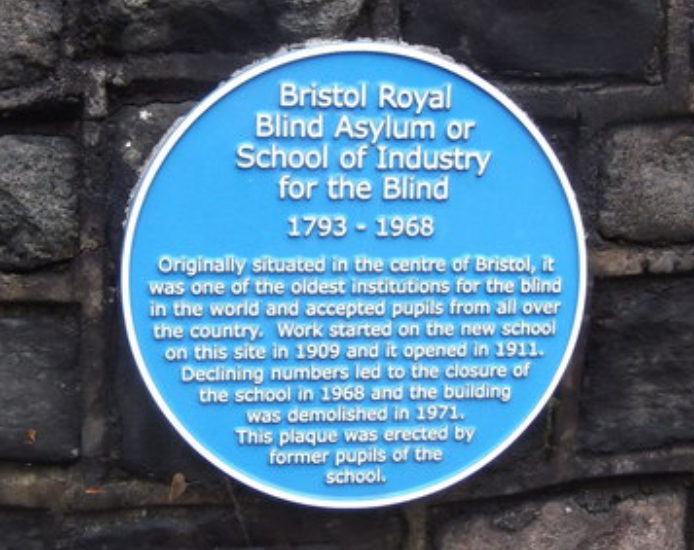
Blue plaque commemorating the Bristol Royal Blind Asylum, Henleaze (openplaques)
This still doesn’t explain why the Asylum’s reports show her from Bath, unless she had originally attended another blind school there. According to The Children’s Homes website, there was an ‘Institution for the Blind, Deaf and Dumb’ in Bath, which from 1863 had permission …
… to operate as a certified school, allowing it to receive children boarded out from workhouses by the poor law authorities. It maintained this status until 1896.
So perhaps she’d spent time at the Bath institution in her younger years, and then moved to Bristol. Unfortunately, I’ve been unable to locate any reports similar to those for the Bristol Blind Asylum, although there may be some records held in UCL’s special collections.
In 1911, ‘Elizabeth Tomalin’ is enumerated at 39 Southwell Street, St Michael’s, Bristol. Aged 39, she is boarding at the house of a Mr Cox and his family, employed as a chair caning and basket worker at the Blind Asylum. Her birthplace is recorded as Luton, and the ‘disability’ column notes that she has been partially blind from the age of two months. With her is London-born Mary Jane Roper, the same age as Elizabeth, but totally blind from birth. Mary Roper also appears in the pupil lists for the Asylum at the same time as Elizabeth.
I could initially find no trace of Elizabeth/Lily in the 1921 census. As she and Mary Roper appeared to be quite close, I tried a search for the latter and found her boarding at 1 Park Lane, Bristol, in the household of a cocoa master for the well-known chocolate firm J Fry & Sons. Her occupation is ‘chair caning’ at the Blind Asylum, and boarding with her is her long-time friend Lily Tomlin [sic]. ‘Lily’ is 50 years and one month old, also working at the Asylum, and originally from Luton. The 1921 census was taken on 19 June that year, indicating a birth date of late April or early May 1871.
The 1934 Report from the Institute shows Elizabeth Tomalin and Mary Roper both listed amongst the women workers at the Asylum; E Tomalin’s date of admission is now shown as 1903 – perhaps the year she came back to the Asylum as a worker (although she was clearly working there in 1901). Her age is now shown as 53 (b. 1871). At the time WWII broke out, Elizabeth Tomalin appears in The 1939 Register at 43 St Michael’s Hill, Bristol, born 3 May 1871, a cane chair seat maker (blind). She is lodging in the household of paint packer Walter Hand and his family, as is Mary Roper.
All the records from the Asylum so far indicate that this Elizabeth Tomalin was associated with the institution for over 40 years, from the age of 16, first as a pupil and then an adult out-worker, that she was born in late April/early May 1871 and came from Luton. To try to confirm whether or not she was Rose’s sister, I ordered a digital copy of Rose’s sister’s birth certificate from the GRO (below):

Birth certificate for Elizabeth Tomlin, 1871 (GRO)
Her date of birth here is recorded as 4 May 1871, whereas The 1939 Register shows it as 3 May and the 1921 census indicates a birth late April/early May. Close but not exact, like the spelling of her surname and intermittent use of the first name Lily. However, I have known many birth dates in the Register to be days or years different to birth certificates, so annoyingly, a day ‘out’ may not disprove the possibility entirely.
The death of Elizabeth Tomalin was registered in Bristol in 1965. She died on 4 June 1965 and was buried at Avonview Cemetery in the St George area of the city. She was 94. I wonder if she and Mary Roper lived out their old age togather? Mary, it seems, died in Bristol in 1958, aged 86. Was this Elizabeth Tomalin really Rose Tomlin’s sister? I think, on balance, she was. Did Rose ever see her sister after she went to Bath/Bristol? Was Arthur even aware of his blind sister-in-law? As usual, there are more questions than answers, and that proved to be the case with Rose’s only surviving brother too.
William Tomlin: Truant, militiaman, railway worker in India … or was he?
A troubled youth
Rose’s only surviving brother was William Tomlin, whose birth was registered in Luton in the last quarter of 1875. A transcript of his baptism record at Ancestry records a date of birth of 21 September, his baptism on 3 November 1875, at Christ Church, Luton. He is at Adelaide Terrace, George Street, Luton, with parents and three of his sisters in 1881. An unnamed brother’s birth was registered – together with his death – in Luton in 1880, and another, Henry, was born and died in 1885, when William was ten. His youngest sister, Lilian, was born in Luton in 1890, when he would have been 14 years old. But it seems that, by then, he had been sent away from home.
I expected to find him with the rest of the family at 3 Windsor Street, Luton, in the 1891 census, but there is no sign of him there, or nearby. Could he have been blind like his sister Elizabeth, and sent away to school? At 16, of course, it’s possible that he had left home to find work, but the only William Tomlin, born around 1875 in Luton that I could find in the 1891 census was a ‘lad in home’ …

Extract from 1891 census (Ancestry): Limehouse district Dr Barnardos Youths Labour House
Class: RG12; Piece: 299; Folio: 58; Page: 4
William Tomlin, aged 16, is at Barnardo’s Youth Labour House at Commercial Road, Stepney, undertaking wood chopping and said to be born at Windsor St., Luton, Beds. The Children’s Homes website states that the Labour House was opened in 1882.
It provided lodgings and work for up to 120 boys aged between 17 or over who were too old for Barnardo’s children’s homes. Activities carried out at the establishment included wood chopping, the manufacture of fire-lighters and the operation of an aerated water factory.
The regime was tough, and the home played an important role in preparing boys for emigration to Canada. William Tomlin was not an orphan, and his father was still living with the rest of his family in Luton. I can see no real reason why he should be there, but the precision of the address in his place of birth gave me pause. Had he run away from home and lied about his family circumstances?
I found a clue in a record for Wm Tomlin in the Luton Chapel Street Boys’ School log for 7-11 June 1886:

Extract from Chapel Street Boys’ School, Luton, log 1886
(FindMyPast, Bedford and Luton Archives ref L/3/2/54-1)
It seems this boy was sent back to the Walthamstow Truant School because of the irregularity of his attendance at Chapel Street Boys’ School. So was Rose’s eleven year old brother really sent to a truant school in London? Was he maybe upset by his brothers’ deaths or his sister’s departure to the Blind Asylum? Or a boy who refused to go to school for some other reason? According to the ever-useful Children’s Home site, the Truant School:
… received boys who, having persistently failed to attend ordinary school, were committed to detention for up to three years or until they reached the age of fourteen … in most cases, after three months at the school, boys were released on license on condition that they attended school regularly. Failure to do so would result in a return to the Truant School, this time for a slightly longer period.
Parents contributed two shillings a week for boys at the school. Is it possible that the local school board caused William to be sent to truant school in London because of his poor school attendance, and sent him back again when his behaviour failed to improve? Unlikely as it seems, another clue from an article in the Luton Times and Advertiser of 15 March 1889 suggests that he was a serial offender.
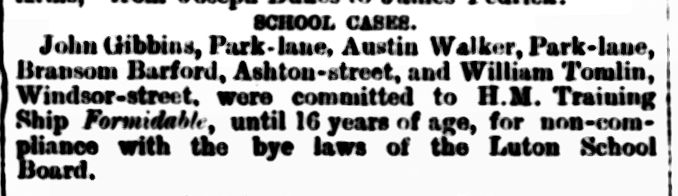
Exract from Luton Times and Advertiser, 15 March 1889 (British Newspaper Archive at FindMyPast)
Three years after his return to Walthamstow Truant School, he appears again in Luton, this time being committed at the Borough Petty Sessions to HM Training Ship Formidable until 16 years of age. In 1889, he was 14, the upper age for the Walthamstow Truant School. The Children’s Home website informs us that the ship was moored off Portishead, near Bristol and had been established in 1869 as an Industrial School Ship, allowing it to take children committed by the courts.
So by the time his sister Rose Tomlin married Arthur Ephgrave at the end of 1892, William had been in trouble for non-attendance at school for at least six years and had spent much of that time in institutions designed to reform his ways.
Let us rewind to 1891, when William appears to have been transferred from the Formidable in Portishead to the Barnardo’s home in London, perhaps in preparation for emigration to Canada. Did he go? Other clues suggest not, and that he found his way back to Luton, where his hot-headedness got him into trouble. On 5 March 1892, the Herts Advertiser reports on a serious stabbing incident in Luton.
William Tomlin of Dumfries Street and another lad were involved in an altercation in which their friend 17 year old Albert Palmer stabbed a man called Hewlett, although the latter’s injuries weren’t life-threatening. The incident, in Waller Street, Luton, was described by various witnesses, with some confusion about who provoked, hit and stabbed whom.
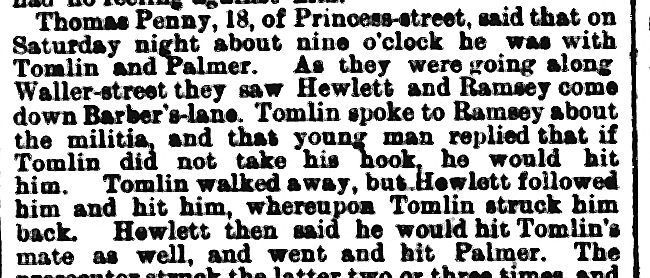
Extract from much longer article, Herts Advertiser, page 8, 5 March 1892 (British Newspaper Archive, FindMyPast)
Tomlin seems to have been involved in some pushing and shoving, having asked Hewlett’s companion about the Militia and been told to ‘take his hook’ which I take to mean ‘go away’. The case was referred to the next Assizes, although I haven’t found a further account.
From Bedfordshire militia to the Indian Railway police, and family life
William Tomlin’s interest in the Militia may, perhaps, be explained by an attestation form found at FindMyPast and signed in Luton by a William Tomlin, dated 27 January 1892. This William states that he is resident at 18 Dumfries Road, Luton, is 16 years and seven months old (ie born August/September 1875) and is a Labourer for a C Cooper. Rose’s brother would have been 16 years and six months old. Dumfries Street is quite literally round the corner from Windsor Street, where his family were enumerated in the 1891 census. His description notes his fresh complexion, grey eyes and brown hair, a scar on his left cheek and his short stature (5′ 2 3/4″):
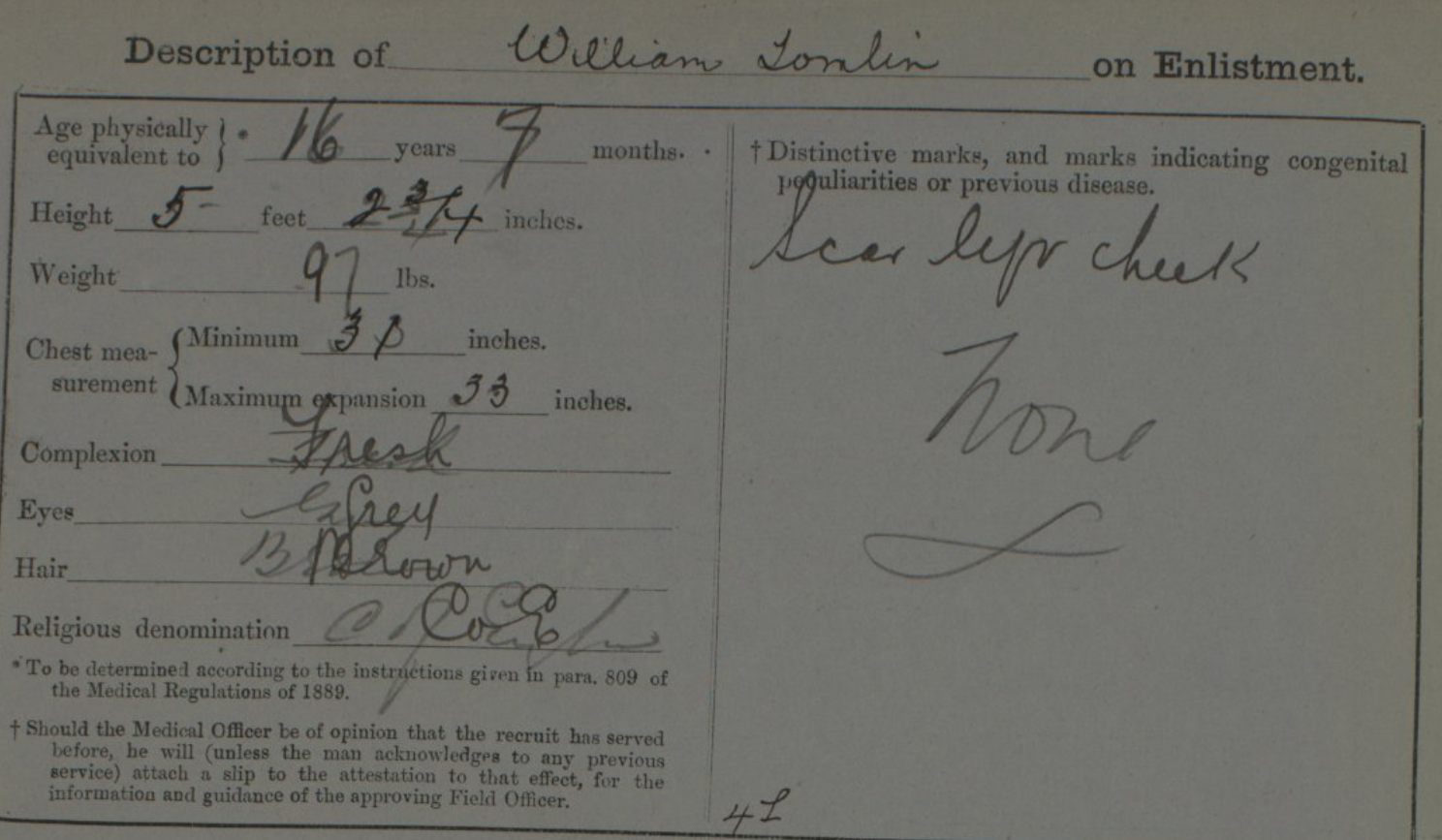
Extract from Militia Attestation for William Tomlin, FindMyPast
He was declared fit to join the militia (Bedfordshire Regiment) for a period of six years on 14 March 1892, just over a week after the stabbing incident was reported in the local newspaper. That this is the same lad involved in that altercation is supported by the same address, Dumfries Street/Road, being quoted in both cases. Whether he is Rose’s brother is still open to question, although his age is almost exactly right. Unfortunately, there is no other detail, such as next of kin, that ties this William into Rose’s family and there is nothing in the militia record to show when and where he served. The service number assigned to him was 2140, written in pencil at the top of the form (E.504).
The 3rd Battalion Bedfordshire Regiment Militia undertook regular training camps. Members may have transferred to the regular army, but I haven’t found any further records to suggest that William Tomlin did so. By 1901, he would have been 26 years old, but I have not been able to locate him in England or Wales in the census of that year.
I next found a possible sighting of him at Luton Union Workhouse. The record (Ancestry) shows that William Tomlin, born in 1874, self-admitted on 29 July 1911, that he lived in Luton and was of the Wesleyan faith. His occupation is shown as ‘railway police (India)’, and he was discharged on 5 September 1911. I have not been able to locate him in Luton in the 1911 census, which was taken on 19 June that year. Is this the same William Tomlin who joined the militia? If so, what was he doing in India, why was he now back in Luton, and what took him into the workhouse? Again, I have no firm answers.
Back in India, in Jubbelpore, Bengal, a William Tomlin signed up to join the British Army on 28 December 1914. His age is 40 years and one month (born October/November 1874), birthplace Luton. He states that he had previously served in the Great Indian Peninsular Railway Volunteers and that he had been discharged on completion of 12 years’ service. According to the Families in British India Society (FIBIS), the Volunteers comprised staff of the GIP Railway. The attestation of 1914 assigns him a service number of 4239, later amended to 19983. No dates relating to his former service are given, but if he was in Luton in 1911, having completed 12 years service by then, he would have joined the volunteers in 1899 or earlier. Which might fit with a militia attestation in 1892 for six years, during which time he transferred to the regular army. IF this is the same man. Well, in addition to the birthplace and roughly consistent birth date, his description also broadly tallies, taking into account that this is now a middle-aged man:
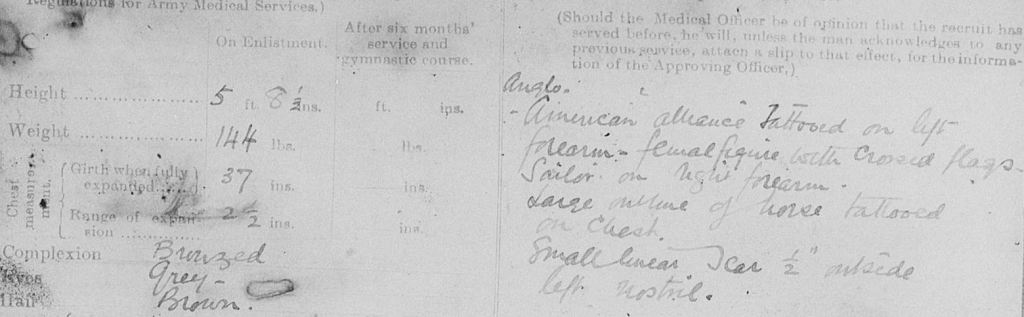
Extract from British Army Service Record (WO 363 – First World War Service Records ‘Burnt Documents’) via FindMyPast
He is 5′ 8 1/2″, his complexion is bronzed, his eyes grey and his hair brown, and he has a small linear scar outside his left nostril and he has acquired an impressive collection of tattoos on his arms and chest. He is 5″ taller than the 16 year old militiaman, but perhaps he put on a spurt of growth! Or am I clutching at straws here? By the way, the index record at FindMyPast somehow transcribes Luton in Bedfordshire as Suton in Norfolk!
Later pages of the service record show that he served in India and ‘home’ (ie UK) between two terms in France (September 1915-June 1916 and October 1916 to February 1919). He was “accidentally injured on 3 March 1917 whilst on duty, suffering from abrasions of both ears, bruised face, fractured lower jaw (left)” and promoted to Corporal on 14 June 1918. He states that he married Edith Jacobs in Jhansi, India on 3 July 1905, and that they had four daughters, one of whom had died (in 1915). They were all born in India, in Cawnpore (Kanpur) or Jhansi, in Northern India, their dates of birth recorded between 1906 and 1914. There are two addresses for his wife in Luton: York Street and Kempston Road. His address in India is E41 Civil Lines, Jhansi. This was – and still is – close to Jhansi Railway Station. The GIP line opened from Kanpur to Jhansi in 1888.
A later document in the service record bundle is a repatriation certificate for Corporal William Tomlin dated 30 September 1919. His occupation is ‘guard’ and address c/o V T G I P Railway Offices, Bombay. His birth year is shown as 1873 this time. If he married after completion of his 12 years’ service in 1905, that would suggest that he joined the volunteers in 1893, which would fit even better with his post-militia service starting in 1892.
There are records at Ancestry for his marriage and the births and deaths of his four daughters, Violet, Lillian, Rose and Hilda. Did he name two of his daughters after his sisters Rose and Lillian? In 1919, FindMyPast has passenger lists showing Gnr William Tomlin, Mrs Tomlin and three ‘Misses’ Tomlin (aged over 12, 11 and 5 – matching his surviving daughters’ ages). Their intended permanent residence is India.
I have not found a death record for William Tomlin, in India or elsewhere. His wife Edith died in India on 2 July 1944, and is shown as ‘widow’, so he had predeceased her. I wonder if, after all, he met up again with sister Rose on his return to Luton before and after WW1?
As a footnote, all three of William’s daughters married in India, where they had spent their whole lives. The eldest, Violet, and youngest, Hilda, all travelled to the UK in 1948 with their husbands and families and settled in Brent, London. The marriage of the middle daughter, Lillian, seems to have been short lived and her husband returned to London; I haven’t found any further trace of her.
Main Sources:
- 1881-1921 censuses (Ancestry, FindMyPast, The Genealogist)
- The 1939 Register (Ancestry, FindMyPast)
- FreeBMD indexes
- Birth certificate (GRO)
- Baptism, marriage, burial records (Ancestry, FindMyPast, FamilySearch)
- Old maps (National Library of Scotland, The Genealogist)
- Lloyd George Domesday Survey (The Genealogist)
- Children’s Homes website
- Families in British India (FIBIS)
- WW1 service records (FindMyPast)
- Indian Army Records (FindMyPast)
- British Newspaper Archive (FindMyPast)
 My Stocking Roots