My great great aunt Alice grew up in Redbourn, Hertfordshire, where her father was a baker. She first worked locally as a silk winder before giving birth to an illegitimate son in her brother’s house in London. After emigrating to Detroit, Michigan, she married and had two further sons, the first later joining them there. She left many descendents in the US, some of whose stories are told here. But first, Alice …
Early life, work and family in England
Alice was born in St Albans in 1882 and makes her first census appearance in 1891 at High Street, Redbourn, aged 9. Her father, my 2xgreat grandfather Jesse Ephgrave, was a baker, while his wife Harriet, nee Scrivener, worked in the straw hat industry. By then, her parents had had ten children, three of whom had died in infancy. They had 13 children in all, with nine – including Alice – surviving.
I haven’t found any further record of her childhood. Her father was fined several times for not sending his children to school, which may explain a lack of school records for her. By 1901 she is the oldest of four children still living at home; many of their neighbours are running their own businesses along Redbourn High Street, including a grocer and shopkeeper and the publican of the Railway Inn. She is employed as a silk winder, probably for the nearby silk mill owned by the Woollam family, which was established in Redbourn around 1857. The Redbourn Village website has photographs and information on the history of the mill and the workers there. The mill was closed in 1906, as the local silk industry fell into decline; there is an interesting history of three generations of the Woollams and their involvement in silk in Hertfordshire and beyond at St Albans History.
At some point between 1901 and 1905, Alice seems to have sought alternative employment as a domestic servant – although whether that was in Redbourn or further afield, I don’t know. However, on 12 November 1905, at 63 Cowper Road, Stoke Newington in London, Alice, who is described as a general servant, gave birth to an illegitimate son, Frederick Charles Ephgrave. The address was home to my great grandfather Frederick Ephgrave, who worked in Hornsey in the dairy industry. My great grandmother Phoebe Caroline registered the birth.
As I have no record of where Alice was in the preceding four years, I don’t know if she’d moved to London to find work, or whether she went to stay with her older brother’s family to give birth away from prying eyes in Redbourn.

Extract from birth certificate of Frederick Charles Ephgrave 1905 (GRO)
Perhaps the boy’s first name reflects Alice’s thanks for her older brother’s support.
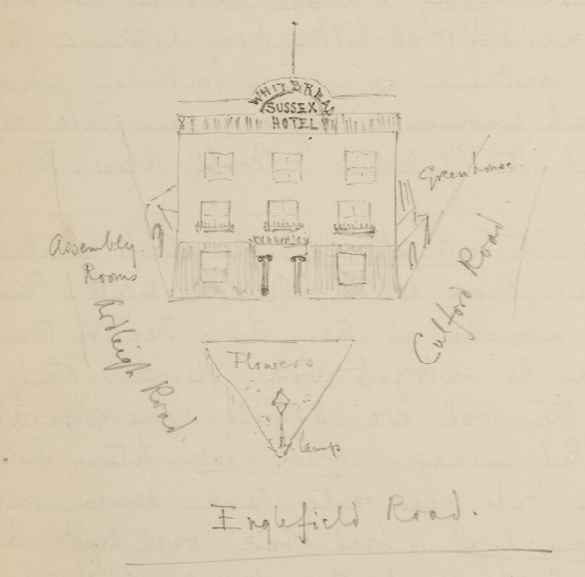
Cowper Road appears on Charles Booth’s poverty map of London as an area of artisans, close to St Mathias Church. In one of the survey’s notebooks from around 1899, it is described:
Culford Road is clean and base with small fronts and large backs, builders’ plates on the doors, only the east side of the road has a pavement, the west is still a gravel footpath.
Extract from Charles Booth BOOTH/B/347 p 109 (LSE)
The notebook (same ref) also features what is referred to as an old-fashioned public house on the corner, run by Whitbread’s, the Sussex Hotel. It is said that it still hosted dances and music for locals’ “wives and daughters”, with lots of flowers to a bed at the front and in window boxes, something to brighten up a built-up area of Victorian terraced houses that 70 years later were to be demolished (Stoke Newington History article on Cowper Road).
Alice seems to have returned to Hertfordshire after her son’s birth, although I don’t know when. By 1911, young Frederick is living, on census night at least, with his grandparents Jesse and Harriet Ephgrave in Redbourn. His mother, Alice, is the only servant in the household of Tristram Risdon at ‘The Thicket’, in nearby Harpenden. Mr Risdon was a confidential advisor in dry goods (whatever that means!); his household comprises his wife and son and daughter, both in their 20s.
Seeking a new life and family in the US
On 21 October 1912, Alice Ephgrave travelled alone by ship from London to the US, via Canada. On the ship’s manifest, she is described as a 30 year old, single, domestic [servant]. Her next-of-kin is named as her father Jesse Ephgrave, High Street, Redbourn, her final destination Detroit, Michigan. She intended to stay with ‘friend Mrs Alexander Copeland’, Hunt Club, Grossepoint, Detroit. Other parts of the record indicate that she was in good general health, could read and write, was 5’2″, paid for the passage herself and had not been to the US before.
The Hunt Club was established at Grossepoint in 1911. This was an affluent district of Detroit in the mid-1900s, with many businessmen and others in society building second homes there. Initially the centre for fox hunts, the club expanded to include polo and other equestrian sports. The History of Grosse Point website mentions it in passing when describing the area’s development. It is now called Grosse Pointe Equestrian. I don’t know who Mrs Alexander Copeland was; there are a few mentions in Detroit newspapers of her giving and attending luncheons; perhaps she was one of the members, or an official of the Club.
What did Alice experience on the voyage? She sailed on the SS Ascania to Canada which, according to Wikipedia, was launched at the Swan Hunter Shipyard in 1911. She departed on her maiden voyage from London to Montreal via Southampton and Quebec in May that year and ran a fortnightly service on that route.
This image of the SS Ascania is said to have been taken in December 1912, just two months after Alice landed in the US.
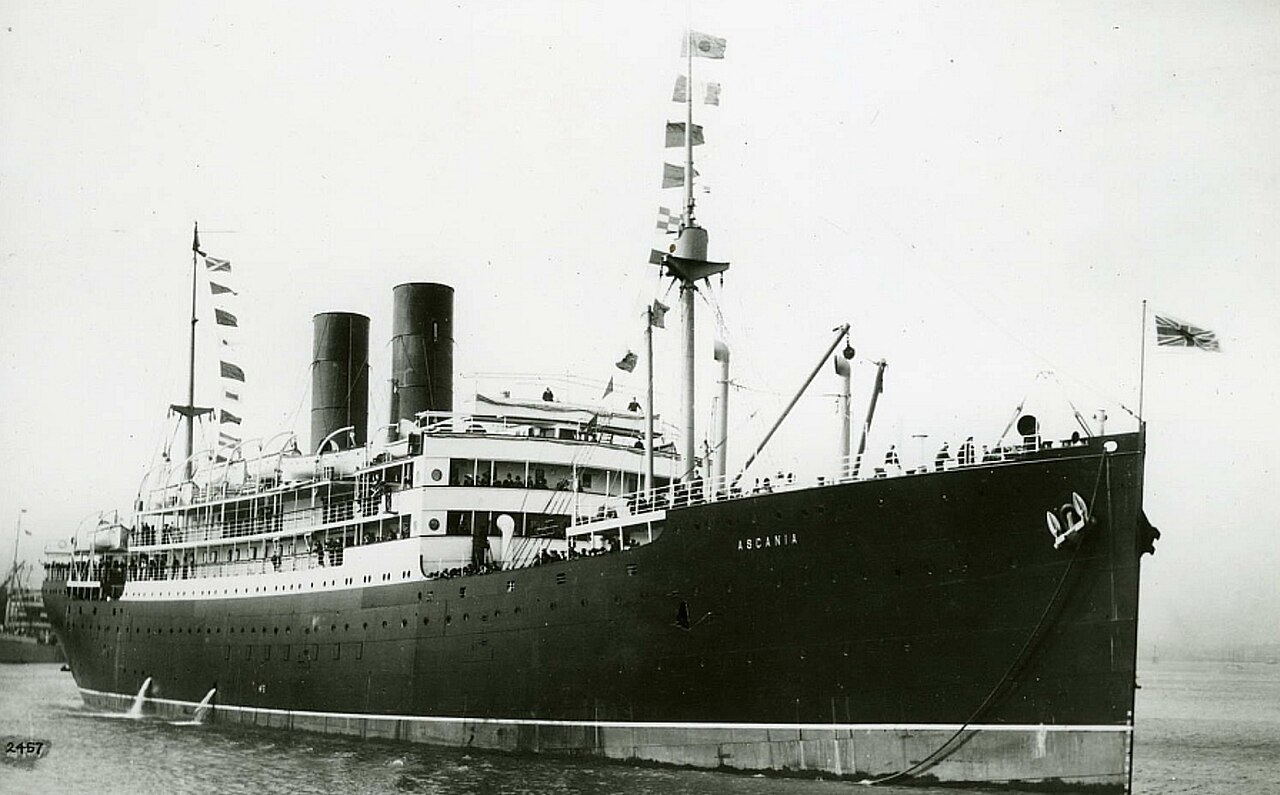
SS Ascania, December 1912, Public domain via Wikimedia Commons
Tyne Built Ships records that she had accommodation for 200 second class and 1500 third class passengers. A month after Alice Ephgrave departed, The Luton Times and Advertiser carried an advert for ‘domestics’ to travel to Australia or Canada by assisted passage at the cost of £3. Special conducted parties were led by Mr P H Collings (whose adverts and reports of successful trips appeared in many other newspapers of the time). Perhaps Alice responded to the ad, or was part of another scheme operated by Mrs Alexander Copeland of The Hunt Club.
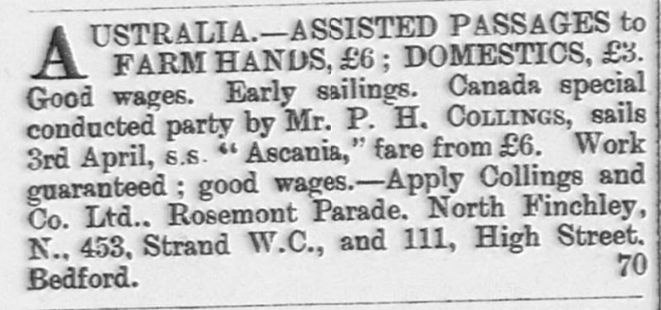
Luton Times and Advertiser, 15 November 1912 (FindMyPast)
From reports of Mr Collings’ trips, it seems that the voyage to Canada took around ten days. Alice then travelled on to Detroit by Ferry.
The following year, she appears in the city’s directory as a maid at 55 Jefferson Avenue, Detroit. Unfortunately, I don’t know how to find out who she was working for, but it seems that she continued working in service until, on 28 March 1914, she married Harry Field. The record for their marriage describes her as a cook, while he was a stableman. Both were single and born in England: he in Redbourn, she in St Albans. Her mother’s maiden name is written Schreibner, rather than Scrivener.
Marriage, war(s) and family
As their marriage record shows, Harry was born in Redbourn, Hertfordshire, where Alice spent her childhood. He was born on 17 March 1885, so was three years younger than his wife. His father, Joseph Field, was a church sexton and gardener, and the family lived at Church End, where Alice’s brother later lived. At the time of the 1901 census, he is still living at home with his family, working as a groom (domestic). He left England on 17 August 1907 on the SS Minneapolis, described as a ‘horseman’, like many others on the ship’s manifest. At that point, his final destination was to be Milwaukee. There is another record of his arrival in 1912, this time described as a groom, final destination Detroit, Michigan. I haven’t found any records of his return to England in between. Did Alice and Harry know each other in Redbourn, and was his earlier trip, in 1907, to test the waters before encouraging Alice to join him? I don’t know.
After their marriage, the couple made their home in Wayne, a western suburb of Detroit, site of several car and aircraft manufacturing companies. In 1918, Harry was drafted into the US Army; by then he was 33 years old and was living with Alice at 452 Ferry Park Avenue, Wayne. Google Street View shows that many of the low-rise buildings lining the street are abandoned, derelict and boarded up. I haven’t found any photos to show what it was like in the 1920s. It is unclear whether he actually saw any service in WW1.
Alice’s son Frederick Charles Ephgrave was eight years old when his mother emigrated in 1912. He may have continued to live with his grandparents in Redbourn until he was old enough to join his mother, but I have no proof of that. In July 1920, when he was 15, he travelled to the US to join her and his stepfather. Alice and Harry Field had two sons together: Harry junior, born in 1922, and Arthur, known as Art, in 1925. A year after his youngest half-brother was born, Fred, as he was known, married Florence Julia Steh on 18 February 1926.
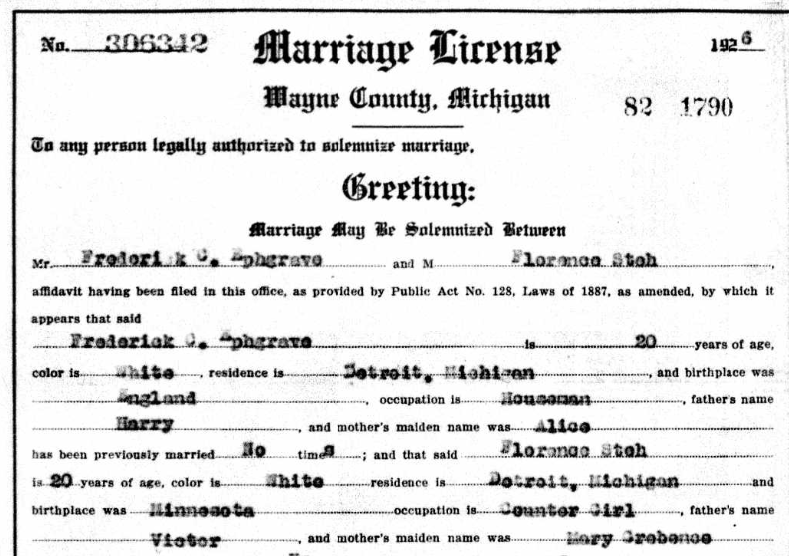
Extract from marriage license, Michigan Department of Community Health (Ancestry)
I’m not sure what Fred’s occupation ‘houseman’ means, but he and his bride were both 20 years old. She was working as a counter girl, presumably in a store, and came originally from Minnesota. He gives his father’s name as Harry (his stepfather). The couple had a daughter, Florence Harriet Ephgrave, on 10 December in the same year. In 1929, Fred was working as a salesman when he and Florence made the journey north to Windsor, Ontario, Canada, seemingly for work. By the time the US Federal census was taken in 1930, they are back home in Wayne, Detroit, at Ellsworth Avenue. Fred is working as an agent selling insurance. His mother, stepfather and half-brothers are also living in Wayne, where Harry Field is a painter and decorator, running his own business. On 12 June 1938, Fred and Florence’s second daughter Penelope Mary Ephgrave was born in Detroit.
The 1940 US Federal census finds Fred, Florence and their two young daughters living at North Cleveland Avenue in Cook, Chicago, Illinois. He is working as a painter (contractor). His mother and stepfather are still in Wayne, at West Ferry Park, where Harry Field is also a painter, for a private club. Neither of their sons, by then in their late teens, are in work. I wonder if the private club was The Hunt Club, the address where Alice’s friend Mrs Alexander Copeland was based in 1912?
The Second World War saw all the men in the family registered with the local draft boards: Fred Ephgrave in Cook, Illinois (with a note that he wears glasses) and Harry Field senior in Wayne, both in 1940, followed by Harry junior in 1942 and Art, in 1943. When Harry junior married beautician Nondis Ray in Ohio in October 1942, he is described as a civil engineer; she was a divorcee and had a young son. Harry junior saw service in WW2 as a navigator of B17 bombers; he and Nondis had two children, Harry Field III and Nondis Elizabeth, born in 1944 and 1947 respectively. After the war, he continued to live in Wayne, working as a draughtsman for an architectural firm.
His younger brother Art also married in Ohio, in 1943, to Zoeann Wright. Their daughters Caren and Charlene were born in 1943 and 1946 respectively, in Detroit, and the family continued to live there; Art also worked as an architectural draughtsman like his brother.
In the 1950 US Federal census, Fred Ephgrave, who became a naturalised US citizen in 1944, is enumerated twice: 1. as head of household with wife Florence and daughter Penelope, aged 44, from England, ‘sells homes and real estate’ for a home sales and electrical appliances company and 2. as a prisoner in jail in Delaware, Indiana, again aged 44, from England, working as a salesman for a building and electrical appliances company.
A newspaper article from Muncie Evening Press of 20 June 1950 reveals his crime: Fred Chas Ephgrave, manager of the Perfect Appliance Company, was accused twice of obtaining money under false pretences by two customers; they had ordered and paid for electrical goods but not received them. His defence was that the goods were not supposed to be delivered until the customers’ new homes had been built. He had been held in the county jail for ten weeks since his arrest in Indianapolis as he was unable to raise the required $10,000 bail. The trial’s outcome was reported on 22 June 1950 by The Star Press:
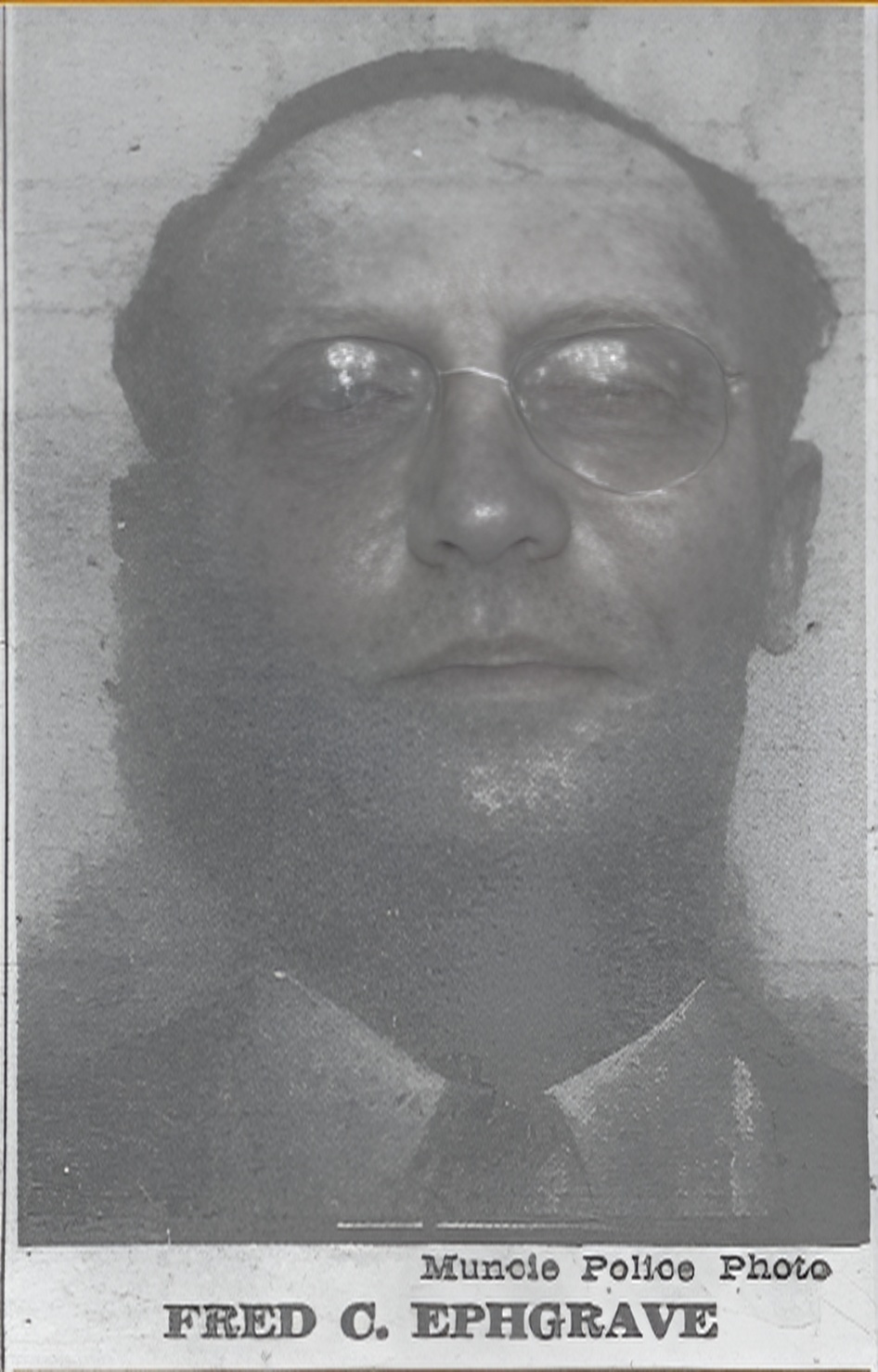
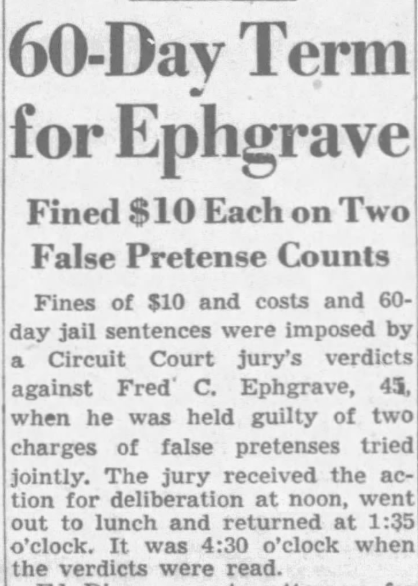
Extracts from The Star Press, 20 April (left) and 22 June 1950 (Newspapers.com)
He was sent to the state penal farm in Putnamville for 60 days, and fined $10 for each charge. Other papers record that he was released on 18 August after serving both sentences concurrently. By the beginning of the following year, he had moved from Muncie to Indianapolis.
Other Ancestry members have shared photos which are said to show Fred, his mother and stepfather, half brothers Harry junior and Art and their families.
Fred’s wife Florence died in 1966 in Minnesota, and he followed in 1971. Daughter Florence Harriet married Russell Orville Griffin in 1946 and had two children; her second husband was Lowell Staley. She died in 2002. Her sister Penny married Donald C Holbrook in 1958 and as far as I know they had one daughter.
Harry Field junior died in 2010, his brother Art in 1974. Their mother Alice Field died in Detroit in 1959. Her husband Harry died at a nursing home there in 1967. Alice’s descendents included three sons, six grandchildren and at least three great grandchildren.
Main sources:
- 1881-1891 censuses (Ancestry, FindMyPast, The Genealogist)
- Passenger lists (Ancestry)
- US Federal censuses 1930-1950
- Newspapers.com (Ancestry)
- US yearbooks (Ancestry)
- US marriage records (Ancestry)
- US social records (Ancestry)
- US city directories (Ancestry)
- Wikipedia
- British Newspaper Archive (FindMyPast)
- Charles Booth’s London notebooks
 My Stocking Roots
.jpg)