The 12th child born to my 2xgreat grandparents, Rose grew up in her father’s home village of Redbourn, where he was a master baker. She worked as a skilled waterproof clothing machinist with her older sister. I made a cardinal error marrying her off to the wrong man, tracing their lives without double checking the facts. This is ACTUALLY her story!
Skilled work in waterproofs
Rose was born at the end of 1891 (on 2 December), not long after her parents and siblings had moved to Redbourn, a village near St Albans in Hertfordshire. This was her father Jesse’s home village, although he and his wife Harriet had not long moved back there after raising their large family in St Albans. They had 13 children altogether: Rose was the 12th. Three of her older siblings had died before she was born. Her baby brother Bertie Ephgrave, the 13th child, died when Rose was just two years old.
Although she came from a large family, by the time she was born, many of her brothers had left home to raise families of their own. At the time of the 1901 census, aged nine, she was the youngest of four still living at home at High Street Redbourn with their baker father: Alice, who was 19; George, 16 and Nellie, closest to her age, 11. Ten years later, she and Nellie, by then in their 20s, are recorded in the 1911 census as ‘Machinist, Waterproof Clothing Factory’.
This was probably the firm of A J Nicholson’s of St Albans. Fleetville Memories (PDF of a slideshow) has photos and background information on the firm and its history, including the St Albans works. Local newspapers carried several adverts in 1917 for women and boys to join the firm in various capacities; it is known that many of the male workforce had been conscripted into the army – despite pleas from the managing directors that Nicholson’s would struggle to complete orders for army greatcoats if its men left. Nell and Rose were already working there before the war, but may have had to increase their workload to cope with the missing men.
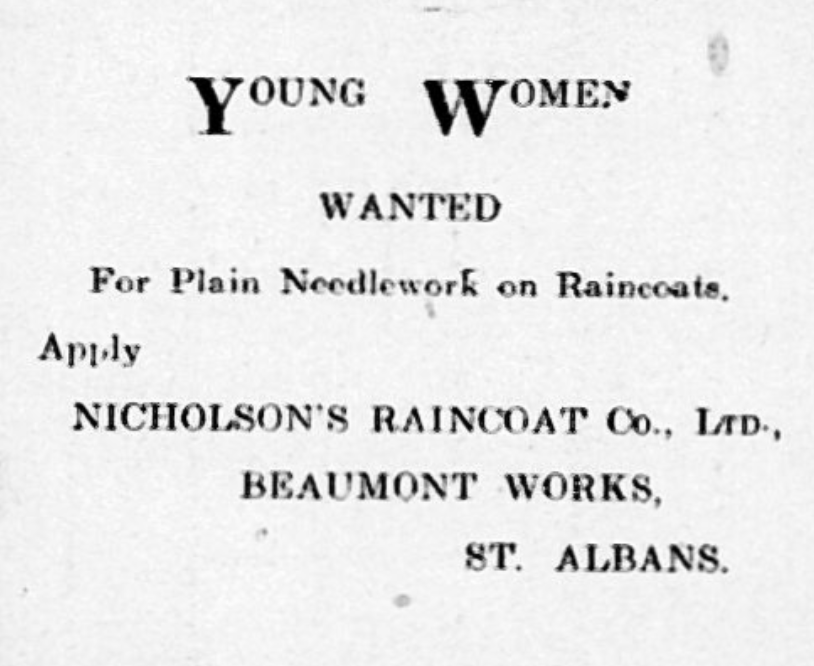
Advert by Nicholson’s Raincoat Co., Ltd (Herts Advertiser, 26 May 1917, FindMyPast)
Mistaken identity
Their older sister Alice emigrated to the US in 1912, leaving her six year old illegitimate son Fred (Frederick Charles Ephgrave) with her parents and sisters until he was old enough to follow suit. Their brother George Ephgrave had already moved to London with his wife, joining their other brothers – including my great grandfather Frederick Ephgrave – working for a milk sterilizing company. Sister Nellie married in the first few months of 1915, while her soldier husband was on leave from the army.
I initially thought that Rose married Thomas Henshaw shortly afterwards. She would have been 23, he was a few months older. He had grown up in St Albans and at the time of the 1911 census was working there as a baker, and living with his parents and siblings in Fishpool Street. I only had access to an index record for their marriage, so was unable to confirm any other details, but it seemed a likely fit. How wrong I was. It wasn’t until I had traced this couple’s lives through a childless marriage, move to London (where Thomas was a Stevedore for the Carron Shipping Company of Wapping), and her early death in 1940 from cancer, that I decided to do a final sweep of records at FindMyPast. And there was a transcription of a marriage that confirmed I had followed the wrong path:
Rose Ephgrave, born 1892 (age 28), daughter of Jesse Ephgrave, married Harry George Hoar, son of Frederick Hoar, on 27 March 1920 at Christ Church, Luton, Bedfordshire. Harry was born in 1893, and both were single.
The index record for the previous marriage only showed the parties’ names, not their fathers’ names, nor their ages. The Rose Ephgrave who married Thomas Henshaw in 1915 was born in 1888 – obvious from the 1921 census, The 1939 Register and her death certificate, but I just didn’t pay attention. So, now onto Rose and Harry Hoar’s lives, back on track.
Married life in Luton and family connections
In the same year that Rose and Harry married, her nephew Fred Ephgrave followed his mother Alice and emigrated to Detroit, Michigan, in the US. He had been living with Rose, her sisters and parents – possibly since birth, so that must have been a wrench for all of them. A year after their marriage, Rose and Harry Hoar are living at 6 Wimbourne Road, Luton. Hang on, that address rings a bell. Rose’s parents had moved to Luton from Redbourn and they are living at the same address; they are sharing the same property, each couple said to be occupying two rooms each. Harry’s occupation is rather cryptically described as ‘Fitter, Greyser’ (could that be greaser? or geyser?). He was working for the Davis Gas Stove Company … another name that rang a bell. Rose’s older sister Clara had also made a late marriage after more than two decades in domestic service. By 1939, her husband Allan Lamb was also working at the Gas Stove company.
Rose’s husband Harry Hoar was actually born on 19 March 1892 in Luton. In 1911, he was working as a general labourer for an India Rubber Company, living at home with his parents and siblings at ‘The Gas Works’, Fish Street, Redbourn. Fish Street joined the High Street, where Rose lived with her family, so their paths must have crossed often. Harry’s father was the Manager of the Gas Works in Fish Street, and they had lived at that address since at least 1901. This affiliation with gas may have led Harry to work for the Davis Stove Company by the 1920s.
I can’t know for sure, but it is possible that i n 1911 Harry worked for ‘The Amalgum’, at Pickford Mill, Lower Luton Road, in nearby Harpenden. Originally a paper mill on the River Lea, but:
In 1911 the mill buildings were acquired by Mr Thomas Warwick and adapted to manufacturing rubber products, notably in later decades for the retreading of tyres, the business being known as the Almagam Mills.
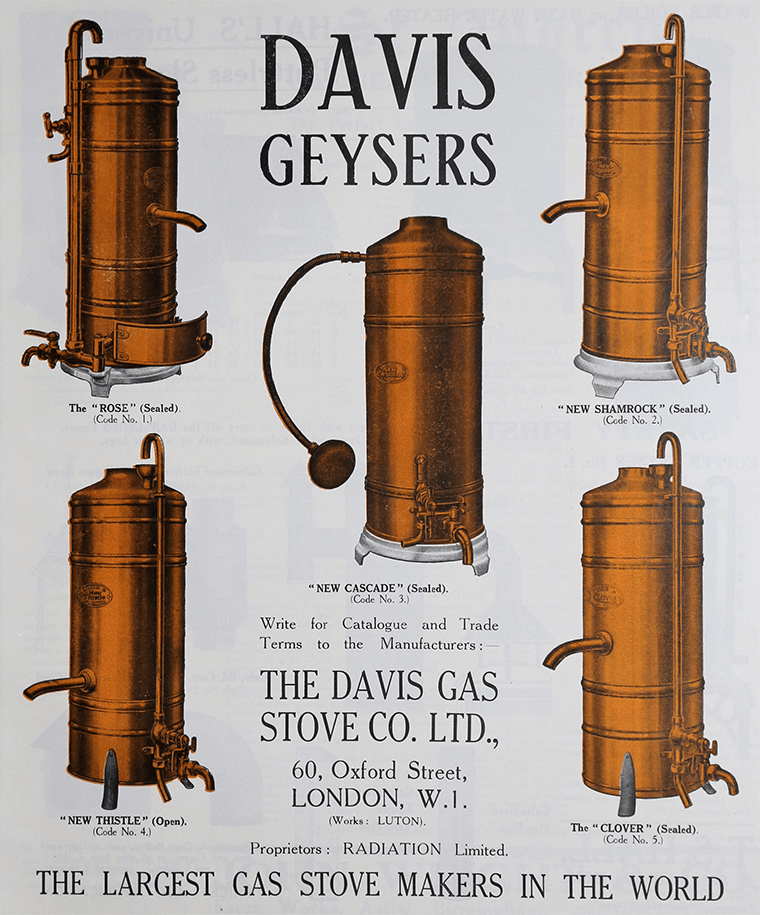
Harpenden History has an article on The Amalgum and links to its earlier role in paper-making. I haven’t found any other obvious rubber factories in the Redbourn/St Albans/Luton areas. However, as the couple married in Luton, it is possible that Harry had found work there – perhaps at the Davis Gas Stove company. According to Grace’s Guide, the company lodged a patent for improvements to ‘water heaters or geysers’ in 1918; perhaps that prompted a recruitment drive and Harry responded? This image below is from Grace’s Guide, an advert from 1927 showing a range of geysers, possibly the type of water heaters Harry fitted:
I haven’t found any verifiable WW1 service or medal records for Harry, although there are a few men of that, or similar names, in the indexes at Ancestry and FindMyPast. Electoral registers from 1918 show him living with his brother Sidney at 44 Maple Road, Luton. And that’s another address that rings a bell. In 1918, Rose’s sister Nellie was living at no. 50 with her husband George Pratt. Did Rose meet Harry when visiting Nellie, or had they known each other in Redbourn since childhood?
Luton in WWII
Electoral registers indicate that Rose and Harry lived at Wimbourne Road until 1922, but by 1924 they are registered to vote at 39 Clifton Road. After a decade, during which Rose lost both parents and three of her brothers, they moved to 33 Granville Road, where they were still living at the time of The 1939 Register. Harry is still working as a geyser fitter. There are two young girls living with them: Annie and Ivy Conley, who were 15 and 12 years old and at school. It is possible that they were evacuees; two girls of those names and rough years of birth were born in Hull, Yorkshire, subject of ‘the Hull Blitz’ the following year, with significant loss of life.
However Luton, with the Vauxhall Motor Works diverted to building tanks and other weaponry from 1940, was hardly a safe haven. On 30 August 1940, as reported by the BBC on the 75th anniversary, German aircraft dropped 51 bombs on the Vauxhall factory in one minute, killing 39 people. Rose’s two brothers-in-law worked there, but I have not found any reports suggesting that they were injured. The BBC report interviewed a man who was a boy in Luton at the time, who described seeing the bombers fly over en route to the factory some three miles away. I wonder if Rose and Harry saw them too? It must have been a terrifying time.
Harry and Rose do not appear to have had children of their own. They continued to live at 33 Granville Road for the rest of their lives, a few streets along from her sister Clara at Ferndale Road. Google Street View shows that no. 33 was, like the rest of the street, a narrow fronted terraced house, brick built, with a small front area and a garden to the rear that backed on to the garden of their previous home at 39 Clifton Road. Both roads run at right angles to Wimbourne Road, so they did not move far with any of their change of addresses.
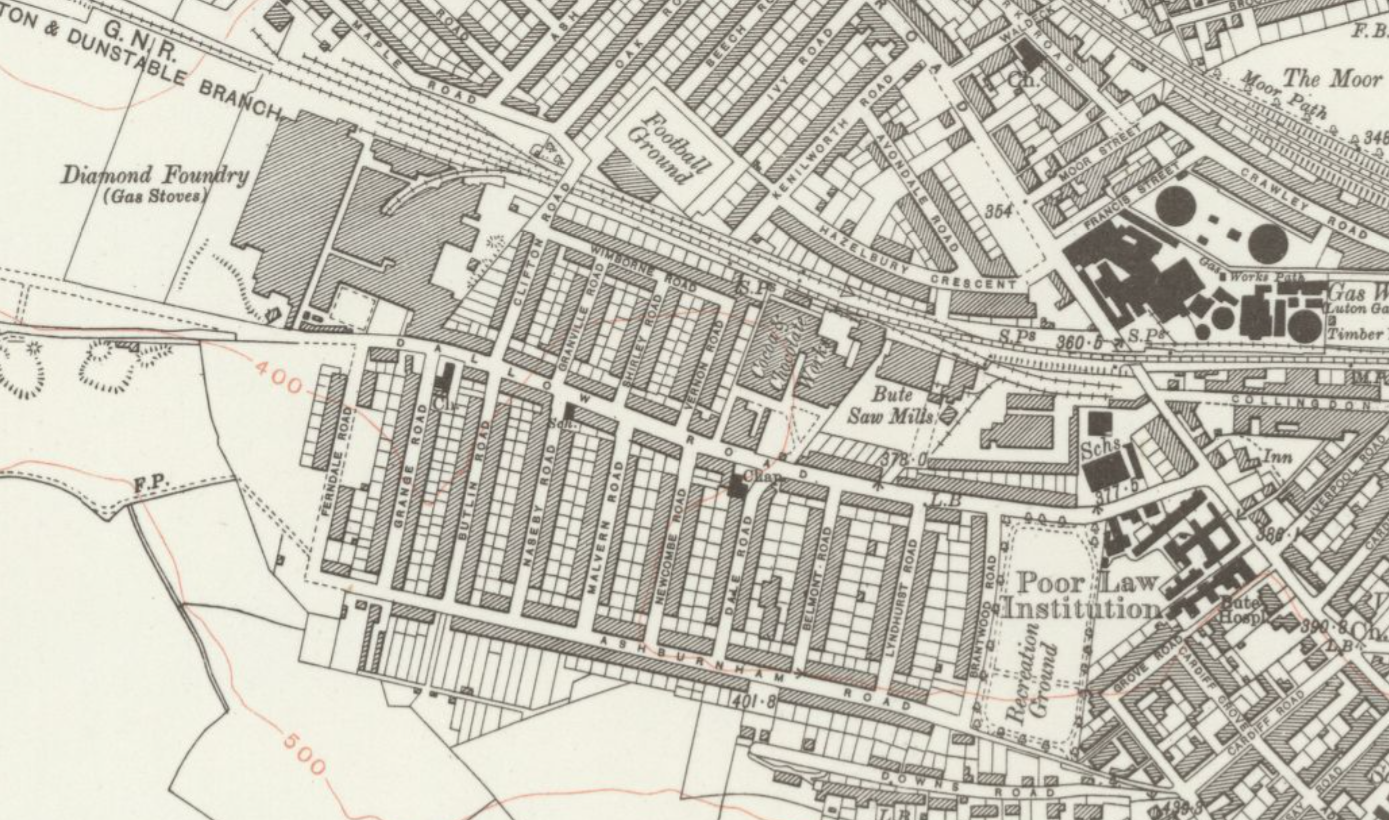
Extract from OS map Bedfordshire Sheet XXXIII.NW Revised: 1922, Published: 1926 (Published with permission from the National Library of Scotland)
The map above shows Wimborne Road centre left, towards the football ground, with Clifton and Granville Roads adjoining it. The Diamond Foundary for gas stoves, on the top left, is the site of the Davis Gas Stove company where Harry Hoar worked.
Rose Hoar died in Luton in the first quarter of 1969; her widower followed her to the grave on 3 April that year, his address shown as 33 Granville Road in his probate record.
I apologise to Rose’s memory for marrying her off to the wrong man initially, and wish there were more I could say about her life beyond the simple records. But I hope I have finally noted the correct ones and given a sense of some of the backdrop to her life.
Main Sources:
- 1901-1921 censuses (Ancestry, FindMyPast, The Genealogist)
- The 1939 Register (Ancestry, FindMyPast)
- Birth, marriage and death records (FreeBMD, Ancestry, GRO)
- Grace’s Guide
 My Stocking Roots
