Records show that my 2xgreat grandfather William Joseph James Gibson was at least the third generation in his family to carve fancy mirror frames for a living. The looking glass frames that he carved were luxury goods, but he and his wife Phoebe, nee Wakefield, raised their family of seven in cramped conditions in Victorian London. I wanted to find out more about his craft and the areas of north London where they made their homes.
A servant and a frame carver: how did they meet?
William Joseph James Gibson married Phoebe Virginia Wakefield on 28 January 1877 at Holy Trinity Church, in the East London parish of Hoxton. He was 21, she was 23 and they both give the same address at the time of the marriage – 120 Shaftesbury Street. Both William and his father (also William) are described as looking glass frame carvers. Phoebe’s father Charles Wakefield has the improbable occupation of hair dresser; he was already dead by the time of the marriage and her still young, widowed mother, married for a second time two months after this wedding. The witnesses, George Rodway and Henry J Thrower, do not appear to be members of the family.
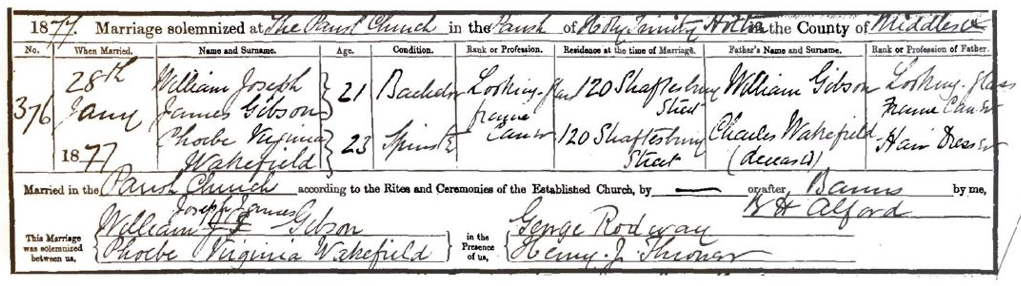
Extract from marriage certificate of William Gibson and Phoebe Wakefield, 1877 (GRO)
The church had been built just over 25 years earlier, designed by the same architect – William Railton – who designed Nelson’s Column in Trafalgar Square, and who died the same year the couple were married. The church’s website places it in the anglo-catholic tradition. Were they ‘high church?’ Was this a reason for their choice of marriage place, or was it just the closest to where they were living? Shaftesbury Street was – and still is – just over a block north from the site of the church, so the latter would seem to be the case. But why were they there? At the time of the 1871 census, William was a 14 year old boy living with his family at King Street, Clerkenwell, about a 20 minute walk away and, by the way, not far from where I used to work. Phoebe, meanwhile, was a 17 year old servant (out of work), living with her widowed mother and two younger brothers at Westmoreland Place, Shoreditch … barely five minutes’ walk from the church.
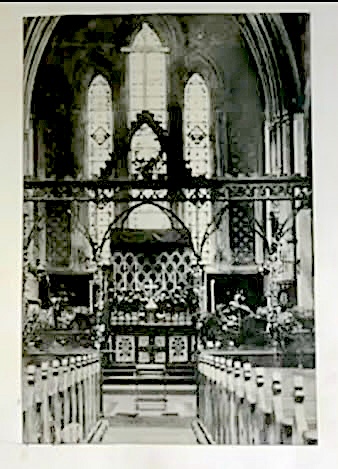
High Altar, Holy Trinity Hoxton c.1906 (Public domain, via Wikimedia Commons)
So, Phoebe’s home was close to the church, but she was living at Shaftesbury Street at the time of her marriage. A look at 120 Shaftesbury Street in the 1881 census at The Genealogist shows that it was home to George Rodway, Leather Gilder, one of the marriage witnesses. Perhaps he worked in the same workshop as William. I haven’t been able to locate the other witness in the censuses. However, a further clue comes with the marriage, on 11 March 1877 at the same church, of Phoebe’s widowed mother Phoebe Wakefield to Henry James Nightingale. They too both give 120 Shaftesbury Street as their address, so perhaps all four were living or lodging there. William J J Gibson and Phoebe V Gibson are both witnesses to the marriage.
It is still not obvious how Phoebe met William; another possible clue, though, is in her mother’s new husband’s occupation. Henry James Nightingale was a pianoforte maker, the son of a cabinet maker, both crafts related to frame carving. Perhaps Phoebe somehow met William through her stepfather-to-be’s work while William was lodging with George Rodway.
Family life and a few white lies
William and Phoebe’s first child, my great grandmother Phoebe Caroline Gibson, was born on 10 December 1877 at 17 Shakespeare Road, South Hornsey (now Stoke Newington), about a 20 minute walk from Holy Trinity Church. This was the home of William’s parents, William and Caroline Gibson, and the couple is still living there with them at the time of the 1881 census. By then, looking glass frame maker ‘William Junior’ and his wife Phoebe have nine month old baby William in addition to three year old daughter Phoebe. The house would have been fairly full, as William senior and his wife Caroline’s six children, aged 1-22, lived there too, the eldest son Henry Gibson also working as an ornamental carver, the youngest aged just one year.
Shakespeare Road has since been renamed Shakespeare Walk, and Google Street View shows that the end of the road where the early numbered buildings would have been is now lined with modern low-rise multi-storey flats. Half way along is The Shakespeare pub, which has been brought back to its Victorian glory, with mosaic floors and etched glass. It is a ‘one star’ pub on CAMRA’s National Inventory of historic interiors.
A miracle birth?
It appeared, from ages given in the 1881 census, that Phoebe’s mother gave birth to her half-sister Louisa Nightingale, in 1877 or 1878, after her second marriage. I failed to find a birth registration for her with the surname Nightingale. However, I did find the birth of Louisa Ellen Wakefield registered in Hackney on 1 January 1877. She was said to be the daughter of Charles Saffary Wakefield, hair dresser, and Phoebe Wakefield, formerly Wade. She was born at 19 De Beauvoir Crescent on 21 November 1876, four months before the long-widowed Phoebe Wakefield married pianoforte maker Henry James Nightingale.

Extract from birth certificate of Louisa Ellen ‘Wakefield’ (GRO)
To say that her late husband, Phoebe’s hair dresser father, Charles Saffary Wakefield, was also Louisa’s father was stretching the truth beyond a miracle, as he had died in 1862, some 14 years earlier! The family later seem to have colluded in the fiction that Louisa was born after Henry Nightingale and Phoebe married, so in the 1881 census her age is recorded as three, when she would have been four and a half, and 13 instead of 14 1/2 in 1891. It seems likely, however, that Henry Nightingale was her father.
A growing family and several house moves
William and Phoebe’s family grew over the next few years. They were still at 17 Shakespeare Road when their second son Charles Gibson died on 2 January 1883 aged six weeks. His death was due to dropsy (fluid build up in the body) and an obstructed hernia. The baby’s mother registered the death, his father William described as a looking glass frame maker on the certificate (below).

Extract from death certificate of Charles Gibson 1883 (GRO)
Two daughters and a son followed. On 6 February 1884, daughter Louise Eugenie Gibson was baptised at St Matthias Church, Stoke Newington. Her father has the abbreviated occupation of frame maker, the family address is recorded as 60 Milton Road, Stoke Newington.
Milton Road (now Milton Grove), in fact, runs parallel to Shakespeare Road, so they had not really moved very far. Perhaps William’s parents’ home had became too crowded as their own, younger children grew up. The 1870s OS map shows long terraces running back to back, separated by gardens. Click to enlarge the map to see the intricate detail of each property recorded.
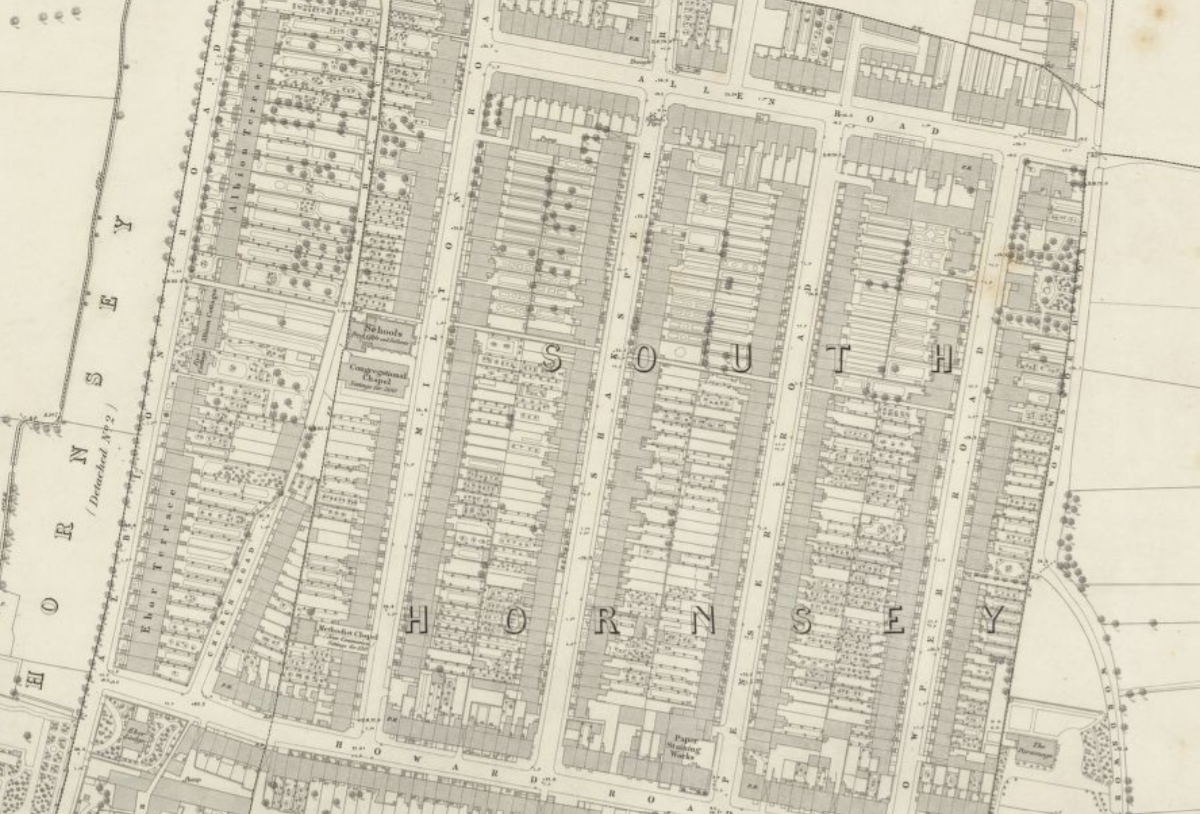
London – Middlesex III.96 Surveyed: 1868, Published: 1872.
Published with permission from The National Library of Scotland
Google Street View shows no.60 Milton Grove as part of a terrace of attractive brick-built 2-3 storey houses with sash windows and a few steps up to the elegant front door. Although many of these properties have been sold as complete houses in recent years, it is likely that, in the 1880s, they were in multiple occupancy, if not divided into distinct flats. As we don’t have a census return of the Gibsons’ time there, we can’t know how many rooms they rented, but I suspect it may have been two or three for their relatively small family at that time.
Their younger children do not seem to have been baptised – at least, I have not found records that they were. At the time of the 1891 census, the family of mother, father and five children are enumerated at 1 Summerhill Terrace, Summerhill Road, in Tottenham, north London. William, by then aged 35, is described as an overmantel maker, as is James Gibson, a 48 year old boarder from North Shields, Northumberland. Given that William’s father was also from North Shields, it seems likely this James was a relative, but I have not yet been able to pin down how.
Their youngest child, a son named George Henry Frederick Gibson, was born on 9 February 1896, completing the family. The baby’s mother registered his birth six weeks later. He was born at 93 Summerhill Road just a few months before his eldest sister, Phoebe Caroline Gibson, married Frederick Ephgrave (who were to become my great grandparents). Her father is described as a cabinet maker on her marriage certificate, although he is an overmantel frame maker on his son George’s birth certificate of a few months earlier.

Extract from birth certificate of George Henry Gibson 1896 (GRO)
It seems, from the Summerhill Road history website, that numbers 53-93 Summerhill Road formed Eliza Terrace and Summerhill Terrace; both terraces have since been demolished, a sheltered housing scheme known as Summerhill Village now standing in their place. 11 Summerhill Road (1 Shakespeare Villas) has been restored in recent years, and its owners have presented some interesting timelines and background information on the road’s general development. Summerhill Road was built in the 1850s, as a ‘sample street’; that is, with a range of different architectural styles.
By the time the 1901 census was taken, William and Phoebe have moved again, this time to 16 Nevill Road, Stoke Newington. It is close to their previous two homes, its lower end just visible in the upper right corner of the map above, although the road hadn’t yet been developed at the time the 1870s map was drawn. William’s occupation is recorded as overmantel maker (cabinet maker). Their four youngest children are still living at home: 19 year old William is working as a railway porter; the other three children, Louisa, 16, Sydney, 11 and George, 5, have no occupation.
Their eldest daughter, Phoebe Ephgrave, had by then moved to Hackney, and already had three children; my grandmother Jessie Ephgrave would be born at the end of 1901. Phoebe’s sister Caroline, then aged 14, was staying with them in Hackney on census night.
Oddly, when his eldest son William Ernest Gibson married Maud Louise Chumley on 30 August 1903, William senior’s name is recorded as William John (not William Joseph James), and his occupation, like that of his railway porter son, is labourer. Neither bride nor groom record their middle names, but do both give an address of Arnold Road, Tottenham. That this is indeed the correct William junior is born out by one of the witnesses being his sister Louise, and records in their later lives matching names, ages and occupations. Was it sloppy recording by the vicar or parish clerk, or were the couple just not that bothered about recording full and correct details?
Cabinet making and frame carving: what kind of work did William do?
William Joseph James Gibson’s occupation stayed constant throughout his married life (apart from son William’s marriage certificate). He carved fancy wood frames for looking glasses (mirrors) and, more specifically, overmantels, later diversifying into cabinet making. Overmantels were designed to sit snugly on a mantelpiece over a fireplace, so would have a flat bottom frame. As Westland London, specialists in antique fireplaces etc., suggest:
“An antique mirror has the ability to transform a room. Whether it’s an antique wall mirror or an antique fireplace overmantel mirror – there’s something alluring about them, with their finely carved frames and beautiful glass. They were symbols of prestige and wealth – only the richest could afford large mirrors before modern times“.
They also state that Victorian overmantels were often very richly carved and sometimes gilded, although William would have focused on carving the elements of the frame. This advert from The Gentlewoman of 5 December 1896 shows the style of decorative overmantels then in vogue. These are large pieces of furniture, some with built-in shelves or brackets to hold china, light fittings or other ornamental features.
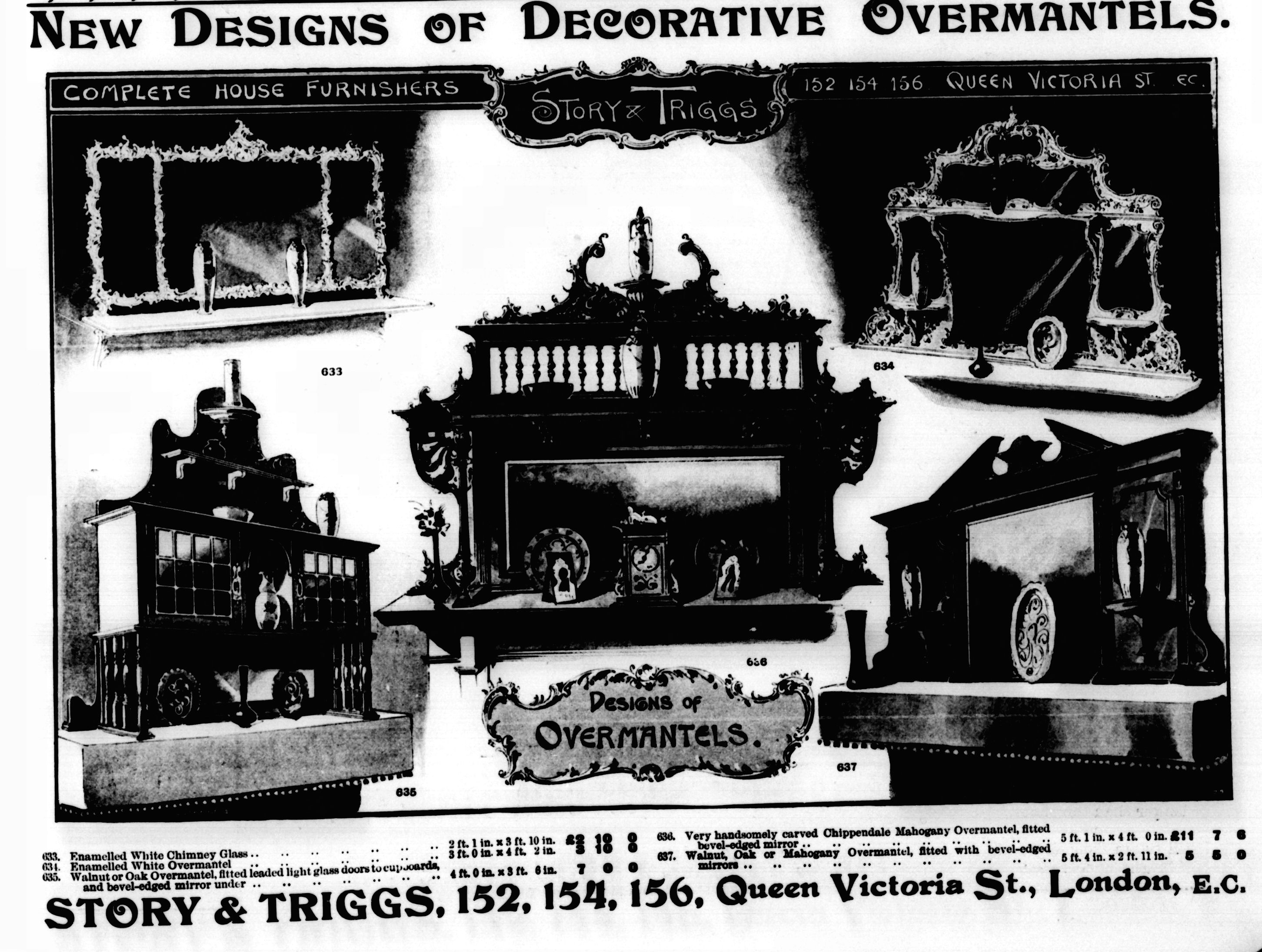
Extract from The Gentlewoman, 5 December 1896 (British Newspaper Archive, FindMyPast)
The 1911 census shows that William was still working as a wood carver/overmantel maker. Intriguingly, it also shows that his workplace was his home, at 16 Nevill Road. I had assumed that William would have carved the wood for the frames in a workshop, particularly as he had also been described as a frame maker … putting the pieces together to complete the frame. How would he have managed to carve such large pieces as those above at home?
The Lloyd George Domesday Survey (The Genealogist), which was contemporary with the 1911 census, records 16 Nevill Road, like its neighbours either side, as a block of flats:
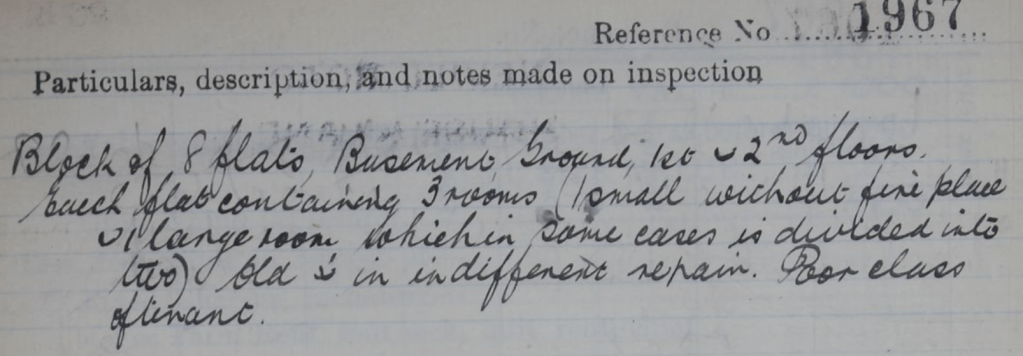
Extract from Lloyd George Domesday Survey (The Genealogist) Ref 1967
There were eight flats, two in the basement and six on the other floors (probably two each to the ground, first and second levels). Each flat contained three rooms: one small with no fireplace, one large room “which in some cases is divided into two”. The property is said to be old and in indifferent repair, with a poor class of tenant. How rude! I have to admit to being rather disappointed and saddened at this description. The family’s previous properties seemed to have been rather grander buildings, although they may only have shared a few rooms in each.
The 1911 cover sheets shows that the Gibson family were living in Block D, 16 Nevill Road, and that they occupied four rooms (so perhaps they had divided the larger room into two as the Lloyd George record suggests). Their neighbours were:
- Block A: Thomas Wood, aged 40, a french polisher, with his wife and six children
- Block B: Albert Charles Huntley, 30, a van driver for the Salvation Army, with his wife and two young children, and two visitors on census night
- Block C: Charles Hardwick, 38, a carpenter, his wife and five children
- Block E: Isaac Cobb, 53, with the unattractive occupation of sewer flusher for London County Council, his wife and his six children, four of whom are adults. They occupy four rooms like the Gibsons.
- Block F: Walter Payne, 49, a house decorator. He occupies just three rooms with his wife and their eight children aged 4-24.
None of these would seem to fit the description ‘poor class of tenant’ as all are in employment and some are artisans. They are, however, living in very cramped conditions. Goodness knows how William managed to carve luxury overmantels at home in such small spaces.
When I first looked for 16 Nevill Road on Google Street View, I initially dismissed the buildings there as modern. After reading the Lloyd George description, I looked again. Although the modern uPVC windows deceived me for a moment, the decorative brickwork along the top of the facade could well be mid-late Victorian. There are, as described, a basement level and three stories at and above ground level. Although the flats don’t appear on the 1870s map, they seem to have been built by the following decade, next to the existing Holy Trinity Chapel which was built in 1865. The latter is now home to the Walford Road Synagogue, consecrated in 1921, standing on the corner of Nevill Road and Walford Road.
The properties are now used by Nacro Housing for released prisoners and others looking to turn their lives around. No. 16 offers 14 beds for a mix of ex-offenders and those referred for education and training – far fewer than when the 6-7 Gibsons and their 37 neighbours lived there.
The 1911 census also confirms that William and Phoebe had been married for 34 years and had had seven children, one of whom – young Charles, as we know – had died. Two of their other six children are still living at home with them in 1911: Sidney, aged 20, is a portmanteau maker, while the youngest, 15 year old George, is a shop boy, probably running errands, stacking shelves or delivering goods to customers in the local area by cart or bicycle.
The war years, later lives and deaths
By the time the first world war broke out, William Joseph James Gibson was 58 years old. By then, daughter Louise Eugenie had married (in 1906, to Frederick Bassett), had a son, been widowed and had married, in 1910, Frederick George Newman. Fred signed up to fight with the Fourth Kent Regiment (The Buffs) on 9 December 1915, three days before their second daughter was born. His service record at Ancestry seems to suggest that he only saw service at home, but his wife appears to have claimed a pension from the 1920s as a dependent. By 1939, he is described as ‘incapacitated’, so perhaps he had been unable to work for some time.
William Joseph James Gibson did not live to see the end of the hostilities. He died on 18 August 1916 at home at 63 Balls Pond Road, Kingsland, Hackney. He was 60 years old and died of heart disease and bronchitis. His eldest daughter Phoebe Caroline Ephgrave registered the death, her usual address given as 32 Court Hill Road, Lewisham. She had, however, been with her father when he died.

Extract from death certificate of William Joseph James Gibson (GRO)
Two months later, William and Phoebe’s youngest son, George Henry Frederick Gibson (b.1896), joined the Royal Navy on 24 October 1916. He was 20 years old and his civilian occupation was manager of a grocery store, a job he continued after demobilisation in 1919. He married Dorothy Elizabeth Dent in Tottenham on Christmas Day that year, and they had four children.
By the time the 1921 census was taken, his widowed mother had moved to 48 Victoria Road, Stoke Newington. She is occupying one room, sharing the building with three other households. Today, Stoke Newington has a street named Victorian Road, close to Nevill Road where the family previously lived, but none of the buildings appear to date to the 1920s. Phoebe continued to be registered to vote at 48 Victoria Road until the end of the 1920s. By the time WWII broke out, she appears in the 1939 Register, aged 86, as a patient in Hackney Hospital, Homerton High Street.
After that, she disappears from records as far as I can tell. Her daughter Caroline Phoebe Gibson married Walter Arthur Lomas in 1907 and they had nine children. She remarried in 1951, aged 65. Two of her daughters emigrated to Australia, and another to Florida in the US. Many years ago, one of her granddaughters, then based in Victoria, South Australia, contacted me with various details of her branch of the family. She added “did you know that your great great grandmother died in Hamilton, Australia, around 1940?”.
I haven’t found any record of her emigration nor death in Australia, and she would have been very elderly for such a journey, given that she was in hospital in 1939. However, the family may have decided it was safer for her to travel than to stay in London during the War. Hopefully, I will find out at some point. I’d be very pleased to know if anyone else in the family has proof!
Main Sources:
- 1881-1921 censuses (Ancestry, FindMyPast)
- The 1939 Register (Ancestry, FindMyPast)
- Google maps
- National Library of Scotland maps
- Birth, marriage and death records (FreeBMD, Ancestry, GRO)
- Baptism records (Ancestry)
- Army and navy records (Ancestry)
- Lloyd George Domesday Survey (The Genealogist)
- British Newspaper Archive (FindMyPast)
 My Stocking Roots
