When I started researching my family history over 40 years ago, I thought my ancestry would be firmly rooted in London. A DNA test with Ancestry confirmed my years of paper-based and online research: London and the East of England were originally the lands of my fathers (and mothers). In the first half of the 19th century, my 3xgreat grandfather left Norfolk for Southwark, in London. But what was his early life like, what could have led him to leave?
Born in the Burnhams
Aaron Wales (1827-1907) was father to my 2xgreat grandmother Alice Mary Wales (1857-1907), who married James Thomas Stocking (1853-1920) in Walworth, London, in 1874.
Alice and her eight siblings were all born in South London, where their father worked as a Saddler and Harness Maker in and around Bermondsey’s Leather Market. Two years after his marriage to Catherine Alice Stoney (also a Londoner) in Waterloo, London, in 1849, Aaron is enumerated in the 1851 census as a 24 year old Saddler, born in Norfolk, Burnham, with his wife and four month old daughter Margaret Wales. The marriage register shows that his father was also Aaron Wales, a Smith.
Later censuses give varying levels of detail about his birthplace, but his occupation (Harness Maker), birth year (1827) and county of birth (Norfolk) are consistent. The 1881-1901 censuses all indicate he was born in ‘Burnham, Norfolk’, but the 1871 census gives the full name of the village: Burnham Market.
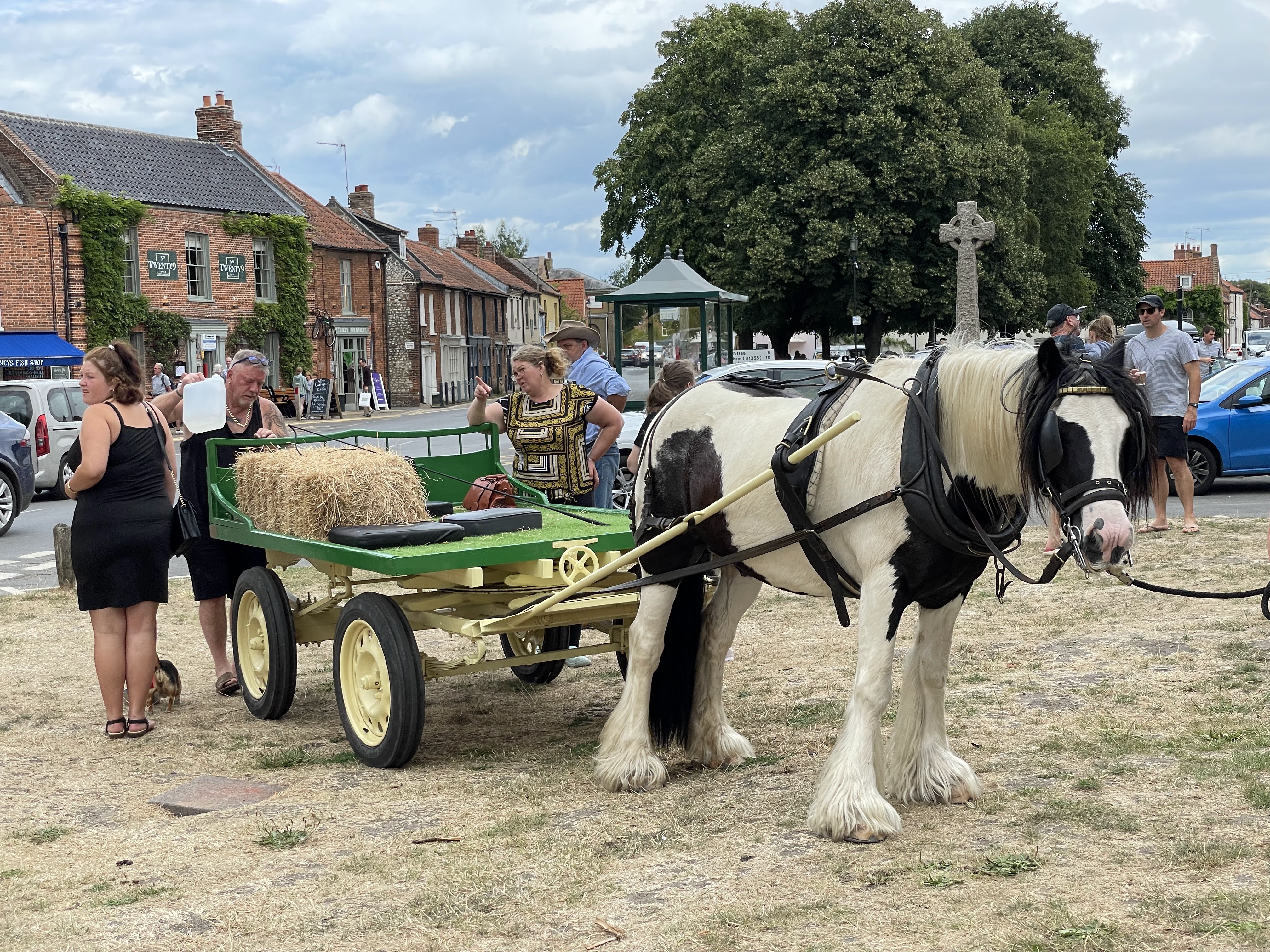
A village map from 2021 shows Burnham Market as a tourist destination with independent shops, pubs, restaurants and attractive buildings, including cottages and churches. We visited in 2022, but parking restrictions meant we couldn’t stay long. The horse and cart (which I photographed that day) didn’t seem to have similar problems:
There are several other ‘Burnhams’ close to the coast of North West Norfolk: Burnham Thorpe (birthplace of Admiral Lord Nelson); Burnham Norton; Burnham Deepdale and Burnham Overy/Overy Staithe are still extant. But three other villages – Burnham Sutton, Burnham Ulph and Burnham Westgate – have merged over the years into adjacent Burnham Market.

Reproduced with the permission of The National Library of Scotland
Aaron was baptised in the parish church of Burnham Sutton and Ulph on the same day as his older sister Susan Wales, on 11 March 1827. Other records suggest that Susan was born in 1826, but unfortunately the vicar didn’t record their individual birth dates in the baptism register.
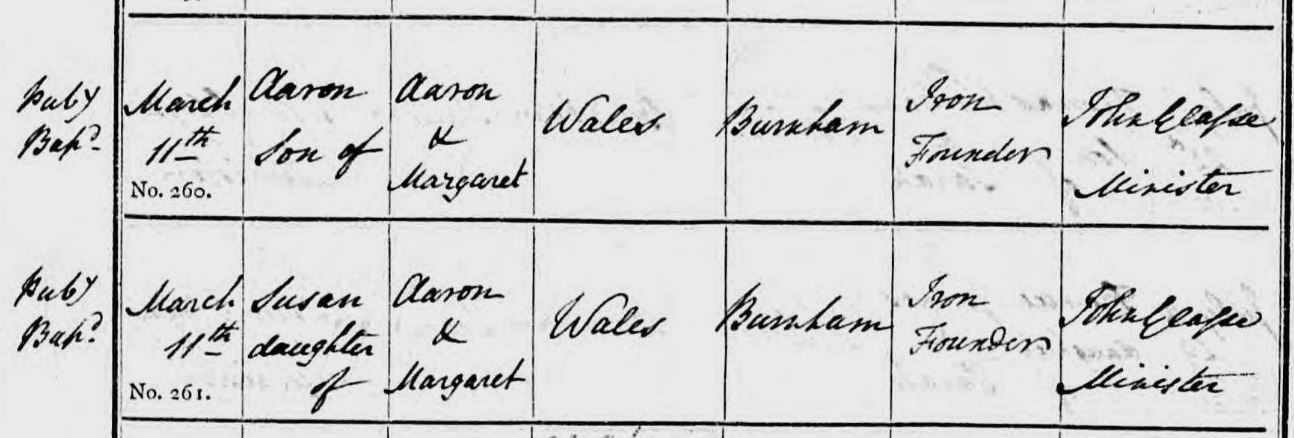
Their father was Aaron Wales, an Iron Founder, their mother was Margaret (after whom Aaron’s first daughter was perhaps named), who was born Margaret Sporne. His parents had married in Burnham Sutton in January 1818, and had two other children: Mary Ann Wales, baptised in the May of the year of their marriage (her father’s occupation ‘Joiner’) and Thomas Wales, baptised in June 1821, when his father was a Blacksmith. Young Thomas died in 1825.
Village life
In the 1841 census, Aaron is aged 14 and living at home with his parents and sister Susan Wales (15) at Back Street, Burnham Westgate. His father is described as a Blacksmith and all family members have a ‘Y’ in the column for ‘Born in County?’. Detail from the above map shows a Foundry on Back Street, which may be where he worked and lived:

Reproduced with the permission of the National Library of Scotland
Their immediate neighbours on Back Street were all also Norfolk-born, and were mainly Field Workers and Agricultural Labourers, a couple of Paupers, a Tailor, a Butcher and a 25 year old Schoolmistress. In addition to a couple of dressmakers, a Butcher and a Carter, were Thomas Forster, a 60 year old Saddler, and Blacksmith William Powell, 50, and an apprentice, 13 year old William Bernard.
Norfolk Heritage Explorer lists a number of important buildings from the 17th, 18th and 19th centuries:
- Satchell’s Foundry House (c.1830, with ‘railings ‘unusual cast iron applied decoration’ made by ‘a foundry in Burnham Market’ on North Street (previously Back Street)
- Forge House (on the Market Place, ‘early 16th century house, timber framed)
- Burnham Westgate Hall (‘a late 18th century country house which may incorporate an older building’)
Pigot´s 1831 Topography and Gazetteer of England (Vol. 1) at Ancestry reports that Burnham Market and its constituent villages had “a tolerable trade in corn, a hemp sheetings and shirtings and an iron foundry”. I can, however, find nothing to suggest any major upheaval in the Burnhams in the 1840s that might have prompted Aaron junior to leave the area. The railways did not reach the village until 1866 (Wikipedia), so he would have had to make the long journey overland by horse and cart, or possibly by sea.
The year before the census, in 1840, Aaron’s older sister Mary Ann Wales (b1818 in Burnham Norton) married William Rust Smith, a Blacksmith, at Burnham Sutton. Her father is named as Aaron Wales, ‘a Grocer’ on their marriage record. In 1847, their other sister, Susan, married Benjamin Henry Habberton. Benjamin is described in the 1851 census as a Saddler, and they are living on the Market Place with his parents (his father both a Saddler and Innkeeper).
At the same time, Mary and ‘Willi’ Smith are living at Foundry Yard with her parents. Both her father and husband are described as ‘Journeyman Blacksmith’. Did Willi join Aaron senior in smithing and iron founding in 1840, leaving Aaron junior to find another trade and take it with him to London? Did he learn his trade from his brother-in-law Benjamin, or was he apprenticed to a Saddler and Harness Maker in the Leather Market, prompting the move? I haven’t found any apprenticeship records for him, so this is pure speculation.
But by November 1849, he was living and working as a Saddler in London, having had time to meet and marry Catherine Alice Stoney, a girl from Newington and thereafter begin the London generations of Waleses.
Main Sources:
- 1841-1901 censuses (Ancestry)
- Norfolk baptisms and marriages (Ancestry)
- Pigot’s 1831 Topography and Gazetteer of England (Ancestry)
- Old Maps at The National Library of Scotland
- Norfolk Heritage Explorer Records
 My Stocking Roots
wow!! 60Frederick Ephgrave: London Dairyman to RAF Engineer
LikeLike