My great great grandfather William Joseph James Gibson followed in his father’s and grandfather’s footsteps carving fancy wooden mirror frames for a living. While previous generations hailed from Northumberland, William junior was born and grew up in east London. He was the eldest of eight children, with 24 years’ difference between him and the youngest born, and had aunts and cousins younger than him. The family moved around a lot. What would this extended and peripatetic family life have been like for him growing up?
Early homes and family
My research into this branch of the family shows that my 2xgreat grandfather William Joseph James Gibson was the latest in several generations of Gibson men, many also called William, who earned a living as cabinet makers, looking glass frame carvers and gilders, and frame manufacturers. He may have been known by a diminutive or nickname to avoid confusion with his father and other Williams in the family, but as I don’t know what that might be, I’ll refer to him here as William junior, and his father as William senior (his grandfather was called Wrightson Gibson, as were several other family members).
As a child, William senior had moved from Northumberland to London with his parents, Wrightson and Margaret Gibson, living in and around Bethnal Green, Hackney and Hoxton. In July 1855, aged around 20, he married Caroline Holland. At the time he was working as a looking glass frame maker and living with his parents at Weymouth Terrace, Shoreditch.
The 1851 census a few years earlier showed his bride-to-be working at 21 Red Lion Street, Clerkenwell, as a servant for Berlin-born Christopher Knuth, pocket book maker. Their marriage certificate shows her address in 1855 as Shepperton Street, Islington, and names her father as Joseph Holland, a watch maker. The latter had died over ten years earlier, and it seems that Caroline had had to move from the family home to find work.
Their first child, William Joseph James Gibson, was born just over a year later on 20 July 1856 at 5 Shepperton Street, as this extract from his birth record shows:

Extract from birth certificate for William Joseph James Gibson (GRO)
I have not found a baptism record for William junior, nor for most of his siblings. When he was born, both his father’s parents were still alive (and still having children of their own), while his mother’s father had died some ten years earlier. Her married sisters Elizabeth Webber and Mary Arnell started their own families a year or so later, providing William junior with seven cousins. Her three brothers, all working in silver, do not appear to have married. In contrast, his father’s two youngest sisters, Sarah Jane and Caroline, were five and two years old respectively when their nephew William junior was born!
By the time he was ten years old, William junior had three more siblings, and his parents went on to have a total of eight children, although the youngest, Joseph Alfred Gibson, was born in 1880, three years after his eldest brother married, and died five years later. I do not know how close the respective families were, but they mostly lived in and around the same areas of east London, and all seemed to move house often.
I was saddened to learn that his adult life with a growing family was fairly tough. The Lloyd George Domesday Survey described his home in a block of flats at 16 Nevill Road, Stoke Newington as housing “a poor class of tenant”. I was also surprised that the 1911 census, taken around the same time, showed that his cramped home was also his place of work. Was the same true for his parents some 50 years earlier? Did they, too, struggle with housing and work while their family grew? What would that have been like for young William?
5 Shepperton Street and 4 Southgate Street (1855-1861)
William junior’s mother gave an address in Shepperton Street when she married, and it seems the newly-weds stayed in the same street, if not the same building, at least until their eldest child was born. The southern end of Shepperton Street (now Shepperton Road) runs close to the Regent’s Canal. Grokipedia (unverified) attributes the majority of housing there to developments dating back to the 1830s and 1840s, with even numbers forming a terrace of “two- and three-storey yellow-brick houses with Regency-style details”, part of which is now grade II listed.
At no.2 Shepperton Street was the Rosemary Branch pub. A history of the pub (which now also houses a theatre) indicates that:
“The inn was very well placed to benefit from the construction of The Regent’s Canal during the early 1820s and for the considerable water traffic it has generated ever since. Up until the mid 20th century the surrounding area was alive with workshops, warehouses and light industry businesses. Barges loaded up with imported timber from Limehouse supplied the dozens of furniture makers lining the canal around Islington and Hackney”.
The Rosemary Branch History (visited 7 March 2026)
Perhaps the concentration of ‘furniture makers’ and proximity to the canal’s timber traffic led William Gibson senior to the area, where he could ply his craft of carving fancy mirror frames. The area was also known for watch and jewellery workers, like Caroline’s father and brothers. The current pub building dates from the 1870s, but by the 1850s, when William junior was born close by, its previous incarnation had a license for musical and other entertainments, including pony racing, tightrope walking and balloon ascents. This would no doubt have been exciting for a young boy growing up nearby.
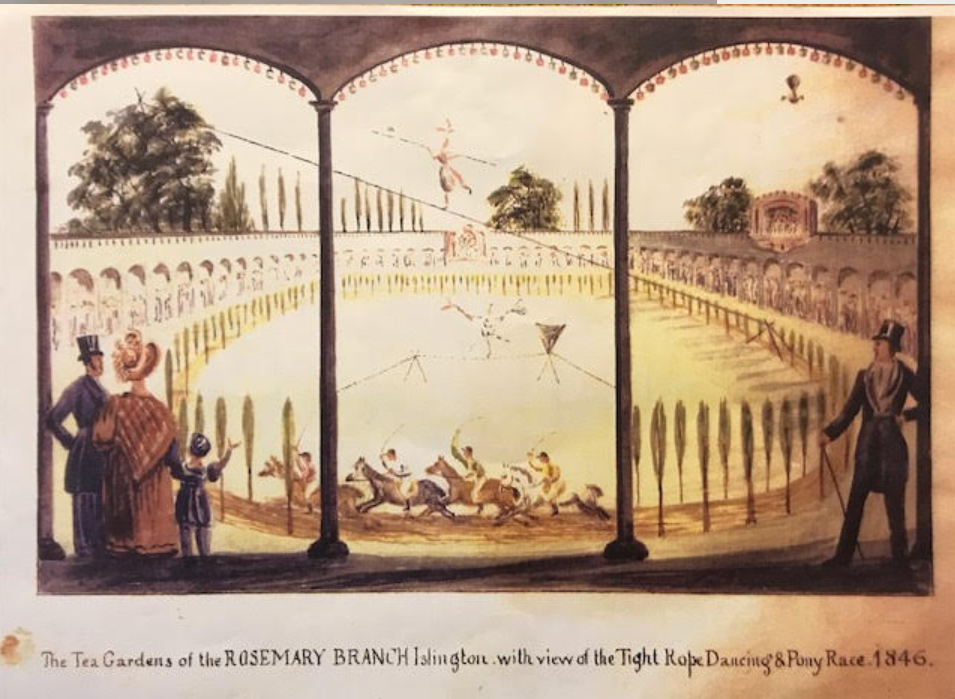
Image from The Rosemary Branch pub/theatre website
Google Street View shows no housing in the space where no. 5 Shepperton Street might have stood, opposite the pub, so it seems William’s childhood home has been demolished, although it was still shown as occupied (by several families) until at least the 1871 census. Directly opposite the Rosemary Branch, on the corner of Southgate Road, stood the Southgate Arms (now converted to a private house). By the time William junior was nearly five years old, he has moved with his parents and younger brother Henry to 4 Southgate Road North, although I am not clear if the pub was in existence then.
The 1861 census shows them lodging there with Charles A Scott, a Clerk from Whitechapel. The border between Hackney and Islington runs down the middle of the street, in an area known as De Beauvoir Town. Initially planned in the 1820s with leafy squares and modest but elegant houses in mind, development in the following two decades saw more humble dwellings built (A walk through the past 2: Eastwards to Southgate Road – Ockendon Road N1). The census doesn’t tell us how many rooms the small family occupied, but it is likely they were crammed into just one or maybe two, sub-let from Mr Scott. William senior may well have carved looking glass frames while William junior and his siblings looked on.
A peripatetic family
The family continued to grow, and continued to move, perhaps in search of work and/or lower rents or better conditions. Although I haven’t ordered copies of all the children’s birth certificates, their birth registrations indicate the districts the family were living in over time. Second son Henry Gibson’s birth was registered in the first quarter of 1859 in Islington. Two years later, the first daughter, Caroline Ada, was born in the Hackney district in Jul-Sep 1861 (possibly at Southgate Street, just across the border). The next three children’s births were each registered in different areas: Margaret Isabella in Apr-Jun 1864 in Islington; Eugenie Elizabeth in Apr-Jun 1867 in St Luke, Middlesex; and Wrightson Charles in the Jul-Sep quarter of 1869 in Holborn.
The first baptisms I have found for William junior’s siblings are those of Eugenie and Wrightson; they were baptised on the same day – 24 October 1869 – at the church of St Barnabas, King Square, Finsbury. From his birth registration, it would seem that this was not long after Wrightson Charles Gibson was born. His sister’s baptism record is annotated to show that she was born two years earlier, on 4 April 1867.
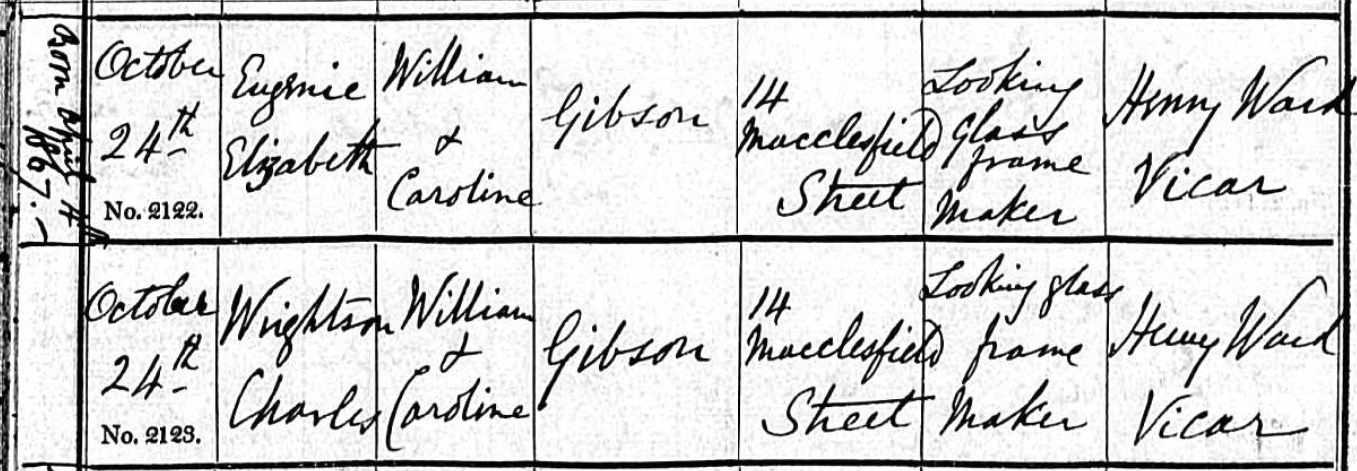
Extract from baptism register of St Barnabas, Finsbury (Ancestry)
The church suffered from bomb damage in WWII and was merged in the 1950s with nearby parishes of St Clement and St Matthew, City Road. From the record, we can see that the family had moved to 14 Macclesfield Street, now Macclesfield Road, which is about four minutes’ walk from the church site. Sadly, as Google Street View shows, the street has no properties dating back to Victorian times … if still extant in the 1940s, I suspect they, too, were bombed and later demolished.
31 King Street, Clerkenwell (1871-187?)
By the time of the 1871 census, William senior, his wife Caroline and their six children are sharing a property at 31 King Street in Clerkenwell with two other families: Abraham Rackham, an upholstery trimmer, his wife and two young children, and tailor William Fleet, his wife and their own six children. While three of the younger Fleet children are described as ‘scholar’, none of the Gibson children is recorded as being in work or school. William junior was around 14 years old by this time, too old for school, but not yet working as a looking glass frame carver. Had he already started an informal apprenticeship with his father or found another elsewhere?
It took me some time to locate King Street on old maps, but I finally found it on this OS map from the National Library of Scotland, published in 1877, the year William junior and Phoebe married:
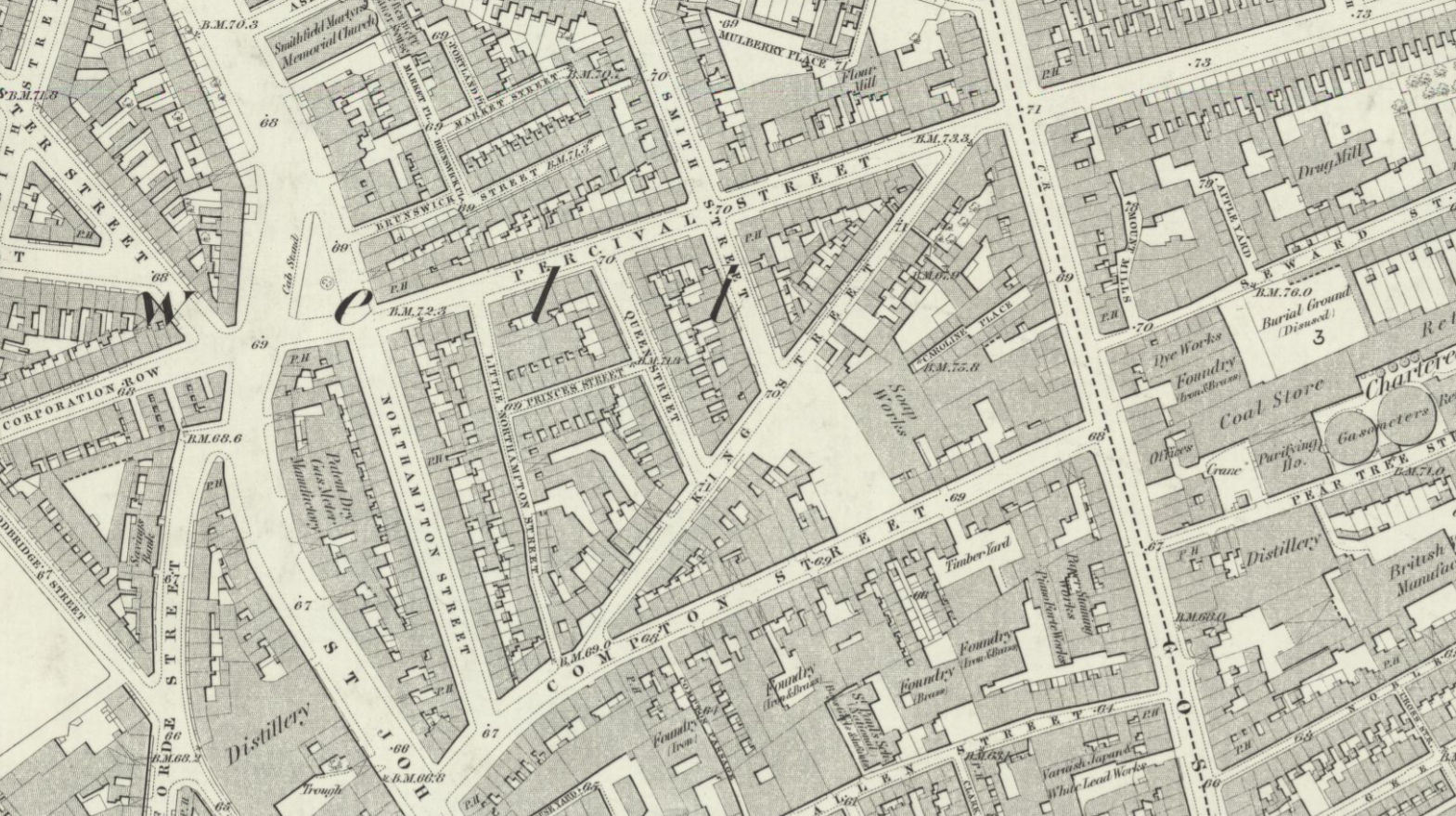
Extract from OS map, London (First Editions c1850s) XXVI Surveyed: 1871, Published: 1877 (Published with permission from the National Library of Scotland)
King Street (now named Cyrus Street) stretches west to east between Compton Street in the south and Percival Street to the north, just south of Northampton Square. Nearby are a soap works, coal store, distillery and gas works. In the 1870s, the Northampton Square neighbourhood, initially occupied by many of Clerkenwell’s watch and jewellery making artisans, had fallen into disrepair, with many ‘mean’ houses crammed into spaces between the original buildings, creating courts and closes with whole families living in single rooms (Northampton Square area: Introduction | British History Online).
William junior’s younger siblings were registered in different districts again: Sarah Minnie in Islington in the Apr-Jun quarter of 1872 and the two youngest children’s births in Edmonton, some seven miles north of Islington (Rosa Phoebe in the last quarter of 1876, and Joseph Alfred in the first quarter of 1880). The latter may not indicate that they had moved that far; from 1878, they were living at 17 Shakespeare Road, Stoke Newington.
The baptisms of Sarah and Rosa took place on the same day – 10 October 1878 – as that of William junior’s first child, my great grandmother Phoebe Caroline Gibson.
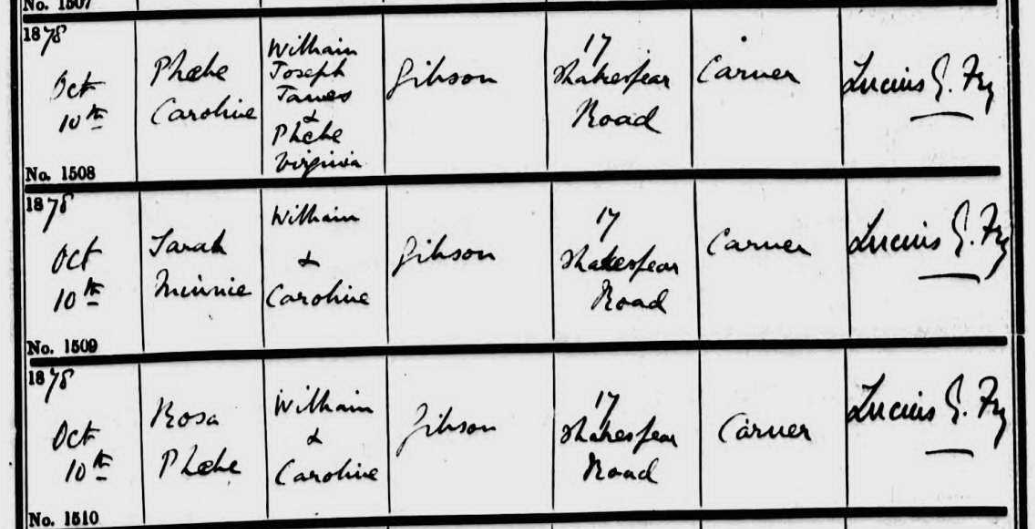
Extract from baptism register of St Matthias Church, Stoke Newington
William senior and William junior and their families were living together at nearby 17 Shakespeare Road, both working as carvers (as was William’s junior’s brother Henry). In 1880, both families each saw the birth of another son: Joseph Alfred Gibson was born in January that year, the youngest of William senior’s children; William Ernest Gibson was born in July, William junior’s second child and eldest son. The house must have been very busy and noisy, with young babies, nursing mothers and working men.
In the two decades between William junior’s birth in 1856 and his marriage in 1877, he and his family appear to have moved many times, albeit within a few miles’ distance. By 1878, they have come together in the same building. It is difficult to know if the constant moving from house to house had any negative impact on young William and his family. They may have had few belongings, although William senior and his two eldest sons were carvers and presumably had at least some of their own tools. They didn’t live in the poorest of London’s slum areas, but conditions were undoubtedly cramped and basic, particularly with William junior and his parents and siblings all living and presumably working in the same place.
William junior raised his own large family in the same area, and although he didn’t move quite as many times as his parents (they stayed at 17 Shakespeare Road for almost a decade), they too lived in cramped and basic conditions. But that’s another story.
Main sources:
- 1861-1881 censuses (Ancestry, FindMyPast, The Genealogist)
- Birth and marriage records (Ancestry, FreeBMD, GRO)
- Maps (National Library of Scotland, The Underground Map, Google Street View)
- British History Online
 My Stocking Roots