My 2xgreat grandmother’s childhood was marked by abject poverty and loss. Her hair dresser father abandoned his family when she was seven, and for a few years afterwards she and her siblings spent time in and out of the workhouse and schools for the disadvantaged. Two of her brothers – and absent father – died young. What brought them to such straits in the first place? And what was life like in and out of the workhouse?
An East End girl
Phoebe was born in the late Spring of 1853; her young parents had married only a few months before, on 21 February 1853, at the church of St Philip, Bethnal Green, in east London.
Extract from birth certificate of Phoebe Virginia Wakefield (GRO)
Her birth certificate (above) shows that she was born on 20 May at 12 John Street, in Mile End Old Town, Stepney, in the heart of London’s east end. Her father was Charles Saffary Wakefield, a hair dresser (barber). Histories of the area, and Phoebe’s mother’s own words, give an insight into the conditions the Wakefields were probably living in at the time of Phoebe’s birth.
Stepney was an ancient area not far north of Limehouse basin and the Thames, and west of the marshlands beyond Bromley-by-Bow. The Ratcliff area of Stepney had, for centuries, seen a constant influx of immigrants from other parts of England and the world beyond, working on the river and in associated marine trades. By the 1840s, also nearby was the railway, carried over arches above the streets, steam and cold-dust descending on the roofs below, breweries and the Ratcliffe Gas Works, which belched out noxious fumes. Wikipedia has more about the evolution of the ancient manor and parishes of Stepney.
French flavours
Phoebe’s mother, formerly Phoebe Wade, registered her daughter’s birth some five weeks after the event. She had spent some of her own childhood in France, while her father Benjamin Parsons Wade worked as a steamship engineer. Phoebe’s middle name may refer to Virginie, her maternal aunt, while that of her younger brother, Charles Theodore Wakefield, born in September 1855, may be a nod to their mother’s brother-in-law, tailor Théodore Guillaume Lingens who married Sarah Wade in Paris in 1851.
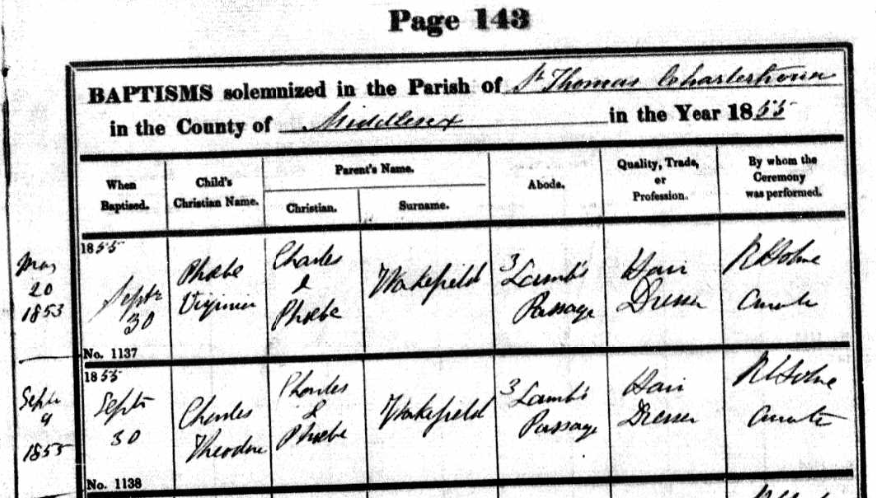
Phoebe Virgina and Charles Theodore Wakefield were baptised on 30 September 1855. By then, the family had moved further west, to Lamb’s Passage, Islington.
Extract from baptism of Phoebe and Charles Wakefield, St Thomas Charterhouse, Islington, 1855 (Ancestry)
The children’s dates of birth are helpfully noted in the margin. St Thomas Charterhouse was designed by the architect of Buckingham Palace in a Gothic Revival style in 1842, so was still a fairly new building by the time the Wakefield children were baptised there. It was closed in 1906. Lamb’s Passage, on the other hand, had first been developed in the late 1770s and was later encroached upon by the Whitbread Brewery’s buildings.
Abandonment, poverty and deaths
Two further brothers were born: Edmund Saffary Wakefield in October 1857, at 1 Halfmoon Street, Bishopsgate, and William James Wakefield on 1 July 1860. The registers of the Central London District Schools at Hanwell (Ancestry) record the admission of Phoebe, Charles and Edmund on 16 August 1860. They were paupers chargeable to the St Ethelburga parish in the City of London Union – their mother is recorded as “in the house”, ie had been admitted to the workhouse. Was she there as a result of William’s birth, causing Phoebe and her other siblings to be sent to a residential school designed for the most destitute poor? And where was their father?
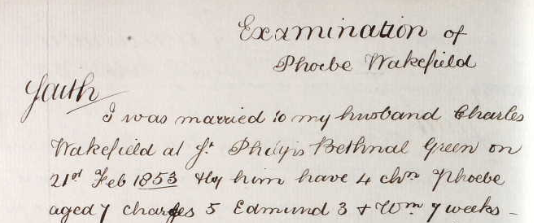
The family’s story to date is told in Phoebe’s mother’s own words or, rather, an official’s paraphrasing of them, in the St Ethelburga’s Parish Examination book. The catalogue record dates the book 1822-1859. Her examination is the last in the book, and undated, but from her statement, it was probably taken in around the third week of August 1860. She ‘saith’ that she:
“by him [her husband] have 4 chn. [children] Phoebe aged 7, Charles 5, Edmund 3 and Wm. aged 7 weeks”
Extract fromLondon, England, Selected Poor Law Removal and Settlement Records, 1698-1922: Examinations of Inhabitants For Relief and Settlement, 1822-1859, St Ethelburga (Ancestry)
She provides details of my 3xgreat grandparents’ life before marriage: they first lived in a furnished room in Chelsea, then travelled around for about 12 months while Charles supported them by betting on horses. They married on 21 February 1853 on return to London, where they lived in one furnished room at John Street, Stepney for about a year. It was during this time their first child, daughter Phoebe Virginia Wakefield was born.
She does not list any further residences, but Phoebe’s brother Edmund was born at 1 Halfmoon Street, Bishopsgate, not far from their grandfather’s home at Pea Hen Court. By 14 May 1860, Charles, it seems, had had enough of family life and had abandoned his wife (six months pregnant) and three children at their home on 40 Plumber [Plummer] Street, City Road.
The reason for the children’s admission to the Central London District School at Hanwell is explained. Their mother “was confined there [Shoreditch workhouse] with my infant” – baby William – and sought relief from there. Having discharged herself, she slept one night “on the stairs” of her father-in-law’s house at Pea Hen Court, Bishopsgate, before appearing before the overseers of the poor of St Ethelburga. Were all the children with her, trying to sleep on the stairs? Her matter-of-fact statement of their hand-to-mouth existence makes chilling reading.
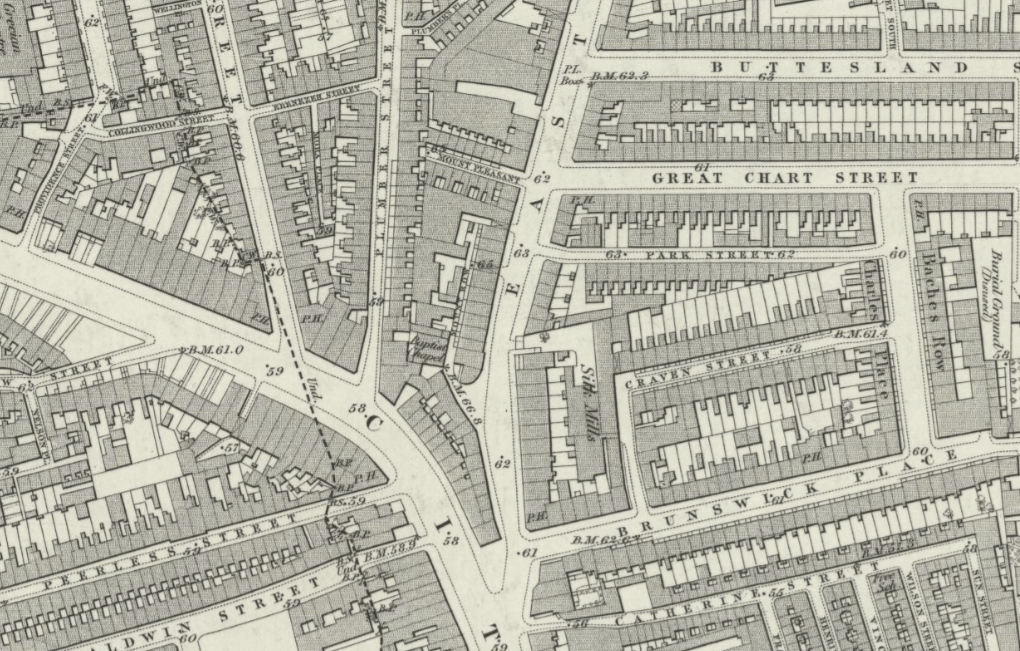
Phoebe’s baby brother stayed with his mother “in the house” after his siblings were sent away. He was baptised in the Chapel of the City of London Union [workhouse] on 16 September 1860, when the family address was given as 40 Plumber Street, City Road. This was Plummer Street, (also called Provost Street) just off the City Road in Shoreditch, seen on the OS map below, an area of dense back-to-back housing surrounded by factories and the wharves of the Regent’s Canal.
Extract from London (First Editions c1850s) XXVII Surveyed: 1872, Published: 1877 (with permission of the National Library of Scotland)
How would young Phoebe Virginia and her siblings have fared away from their mother, destitute though she clearly was?
Central London District School for disadvanted children at Hanwell
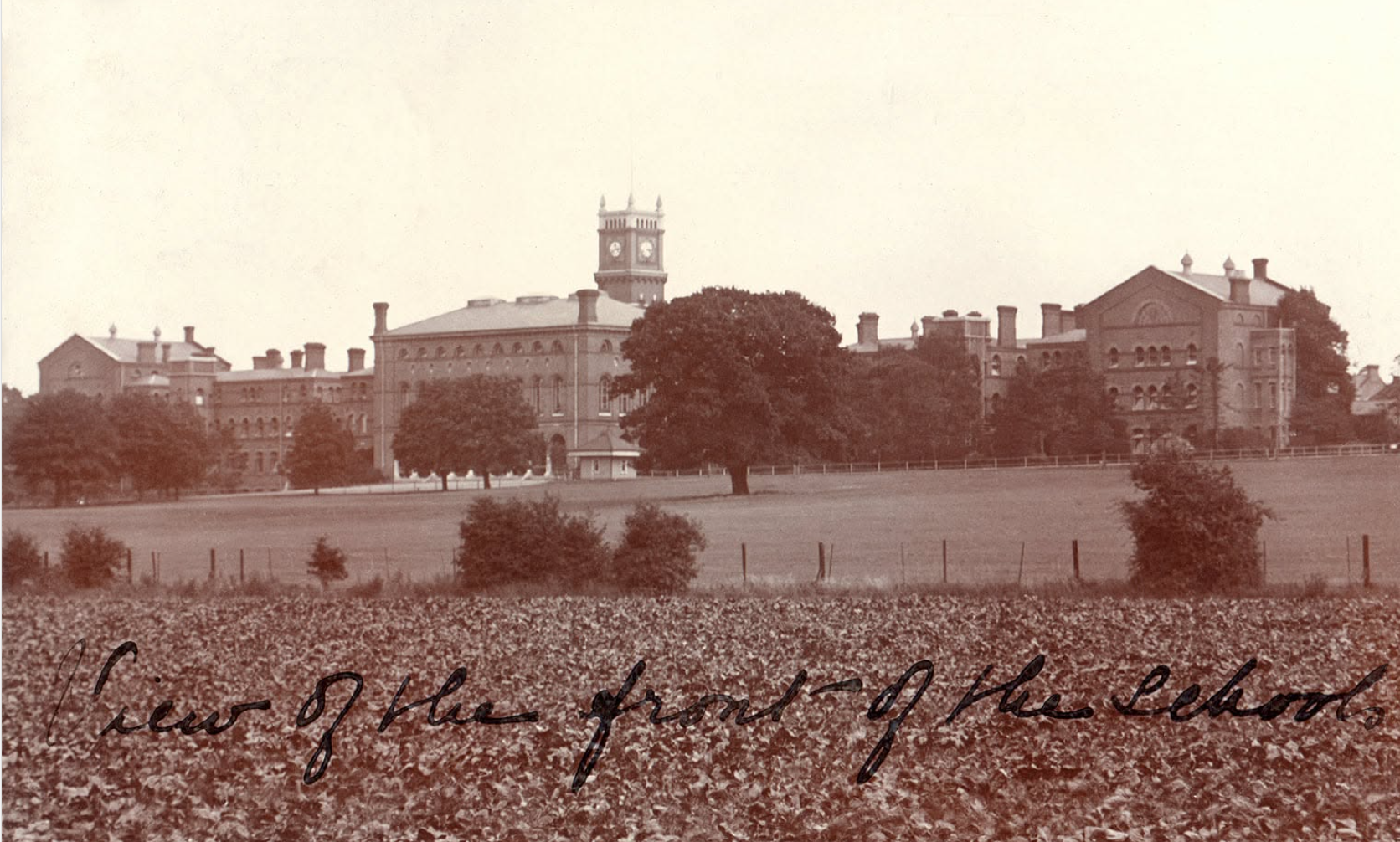
The excellent http://www.workhouses.org.uk website paints a grim picture of the state of health of children admitted to the school, and perhaps a slightly improved one of their potential lot on discharge after education and training (The Central London District School – a residential school for workhouse children). A school for the poor was initially founded at Norwood in 1849, but larger premises were needed. New residential schools were established on farmland at Cuckoo Hill, Hanwell (which gave the schools the nickname, the ‘Cuckoo Schools’). The first children were admitted from 1856, so this would have been where the Wakefield children were sent in 1860. Now the Hanwell Community Centre, the photo below shows the schools in earlier times:
The fact that the premises could accommodate 1200 boys and girls gives an indication of the scale of abject poverty in just this area of London. A description from 1856 notes that girls and infants were housed in one wing, while boys in another, separated by a fireproof corridor – hence ‘schools’, even though they were in the same building. So Phoebe was not only separated from her mother, but would have been separated from her brothers.
Grokipedia provides further detail on the management and operation of the schools:
“Children, typically aged 3 to 14, were admitted directly from parental workhouses upon removal from adult paupers, with intake prioritized based on union needs and medical fitness; for instance, a late 19th-century inspection noted 401 boys present at one assessment, indicative of phased scaling to full capacity. Discharges were regulated to maintain turnover, with children released at age 14 or earlier for apprenticeships, industrial placements, or family reclamation.”
However, the accommodation in the school may have been a great improvement on their previous home life, where they would have been cramped into one or at most two rooms with their parents. The dormitories are said to be heated and to afford fresh air through perforated skirting boards, and a hot water tank served the baths and other offices. The adjacent farm provided more fresh air and opportunities for training in agricultural activities; both girls and boys were taught to read and write and given training to support future employment. Discipline, however, could be harsh and separation from family was probably keenly felt. Hanwell’s most famous resident was a young Charlie Chaplin, who decades later described the place as being ‘sad’.
Continuing poverty and family losses
Phoebe, aged 7, and her brother Edmund, 5, were discharged from the Cuckoo Schools on 14 March 1861, having spent about seven months there. This was just in time for them to appear with their Needlewoman mother and nine-month old brother in the 1861 census, taken on 7 April that year:
Perhaps they had been ‘reclaimed’ by their mother, who had managed to put a roof over their heads by taking in sewing, no longer a charge to the parish. They are living at 4 Holiday Yard, in the parish of St Martin Ludgate. Brother Charles was still at the Cuckoo School, not discharged until 6 June, although I don’t know why he would have been left behind. Perhaps he was ill?
The happy-sounding ‘Holiday Yard’ may not have been much so. The small family shared no. 4 with 12 others grouped in four separate households – perhaps in not more than one or two rooms each. This part of Ludgate, close to St Paul’s Cathedral, was home to ‘stationers’ – bookbinders, booksellers and writers who set up stationery stalls against the cathedral’s walls. Holiday Yard evolved over time as Holiday Court and Ludgate Square which is, in fact, little more than an alleyway (see more, including maps, at: London’s Alleys: Ludgate Square, EC4).
The family’s neighbours weere probably just as poor. They worked as porters, washerwomen, charwomen and labourers, and some worked for bookbinders and bookfolders, who were clearly still populating the area centuries after the foundation of nearby Stationers’ Hall, home to the Worshipful Company of Stationers and Newspaper Makers.
Phoebe’s time with her family did not last long. By 19 September 1861, she is back at the Central London District School at Hanwell with brothers Charles and Edmund (the boys had been readmitted for about a month from early July). Sadly, it seems that their youngest brother, William, who was born in the workhouse, also died there.
Extract from digital death certificate of William Wakefield, 1861 (GRO)
He was 11 months old, dead to ‘infantile fever’ which could include any number of childhood illnesses. That this is indeed Phoebe’s youngest brother is confirmed by his age and his father’s name and occupation.
The school records do not show any discharge dates for Phoebe and Charles after September 1861, but Edmund’s record is annotated with the word ‘dead’ and the date 9 April 1862.
Extract from digital death certificate for Edmund Wakefield, 1862 (GRO)
The certificate shows that he died while at the Cuckoo Schools at Hanwell, aged four years. There is no indication of parentage, his death registered by S Colhown of the School. The cause of death was Tabes Mesonterica, or Tuberculosis, an infectious disease that would no doubt have spread rapidly amongst the hundreds of children accommodated there. Was Phoebe told of her younger brother’s death? She would have been nearly ten years old by then.
More loss was to come. It is difficult to know if the children had seen their father since he had abandoned the family two years earlier. He died six months after his son, on 21 October 1862, at 9 Paul’s Alley, St Giles. He was just 30 years old, and died of Phthisis, another term for Tuberculosis. St Paul’s Alley was in the same area close to St Paul’s Cathedral where his wife and children had lived at the time of the 1861 census. Did they still have any contact? Did he know his sons had died, and that his wife was in the workhouse? And how long would it have taken for the news of his own death to reach them, and what impact would it have had?
I have no answers to any of those questions. How my 3xgreat grandmother coped during this time will never be known to me, unless there are undiscovered letters or other documents to fill in gaps. It all seems indescribably bleak, for her and her surviving children, but probably not an uncommon story.
Between the deaths of her son Edmund and husband Charles, Phoebe’s mother gave birth to another son, Henry Love Wakefield, on 2 July 1862. He was born at 20 Rahere Street, broadly in the same area she had spent most of her adult life. Phoebe’s half-brother has no father named on his birth certificate. Were she and brother Charles still at school in Hanwell then? I have not found any records to indicate where they were between 1862-1866, when they next surface in the poor law records relating to Homerton Workhouse.
Aged 13, Phoebe [Virginia] Wakefield , aged 13, of 22 Grange Street, Hoxton, was admitted to the workhouse on 27 March 1866, with her brother Charles, 10 and half-brother Henry, 3 1/2 (London, England, Workhouse admissions and discharges 1764-1921, Ancestry). Their admission was made on the order of ‘Boards’ (the governors of the poor of the area); the reason: their mother was “in hospital”. A week later, on 5 April 1866, they were once again sent to the Cuckoo Schools at Hanwell. I have to assume, without any further records, that their mother was incapacitated and unable to support her children, but that they had been living with her until then. The children were discharged – presumably back into their mother’s care – a week later on 12 April 1866.
In service and into marriage
Phoebe’s half-brother Henry was baptised at St John the Baptist, Hoxton, aged 5, on 24 February 1867. Their mother stretched the truth somewhat by claiming that the child’s father was Charles Saffary Wakefield, Hairdresser, even though he had died two years before his ‘son’ was born. Were the children all now living with their mother? The family address on the baptism record is 73 Union Street, Hoxton.
We next find her aged 17 in the 1871 census. With her mother, a 37 year old widow and dressmaker, and brothers Charles (15) and Henry (7), she is at 52 Westmoreland Place in Hoxton (a stone’s throw form their former lodgings off City Road), in the wider parish of St Leonard, Shoreditch. This is another house of multiple occupation, as we would call it today.
There are six recorded households in the building, comprising 16 people. Their occupations seem a step up from their neighbours of previous years, including french polishers and mantle makers. Skilled craftspeople like the man that Phoebe Wakefield would marry six years later. For now, she is a servant out of place, but has presumably worked in service at some point since she left Hanwell.
I have not found any records to indicate where my 2xgreat grandmother was living, or what she was doing, between 1871 and 28 January 1877, when she married Looking Glass Frame Maker William Joseph James Gibson at Holy Trinity Church, Hoxton. Was she living with her family, or had she found live-in work as a servant? Both parties give their address at the time of the wedding as 120 Shaftesbury Street, the same address as her mother gave two months later, when she married pianoforte maker Henry Nightingale in the same church. Her newly-married daughter and son-in-law were witnesses to the marriage:
Extract from Holy Trinity, Hoxton, parish marriage record of Henry Nightingale and Phoebe Wakefield, 1877 (London Metropolitan Archives; London, England, UK; London Church of England Parish Registers; Reference Number: P91/TRI/012) – Ancestry
Her brother Charles remained in Hoxton, worked as a cook and fish dealer, married and had ten children, the first born a year before his sister married. Their half-brother Henry pursued a short career in the Royal Navy before settling down with wife and children in Shoreditch. Their mother was widowed for a second time in 1901, and ended her days in a workhouse infirmary. But all of those stories are yet to be told.
Phoebe’s married life was also marked by hardship and poverty, even though her husband seems to have been able to make a living from carving mirror frames. They lived in cramped furnished rooms and rented flats with six surviving children. Read more about their later lives here.
Main Sources:
1861-1871 censuses (Ancestry, FindMyPast, The Genealogist)
London, England poor law records (Ancestry)
London, England school admission and discharge registers (Ancestry)
Maps, National Library of Scotland
Birth and death certificates (GRO)
Parish marriage and baptism records (Ancestry, London Archives)